It's harvest season in the American Midwest. A hailstorm has torn through three thousand acres of mature corn, and a farmer named David needs his crop insurance claim processed fast. He's already called the adjuster, filed the initial report, and submitted soil moisture and yield projection documents from his agronomist. Now he waits. Two weeks in, he's still waiting. The payout he needs to fund replanting is stuck somewhere in a processing queue while his window to get new seed in the ground closes day by day.
This isn't an edge case. It's the everyday reality of agriculture in 2025, where enormous amounts of critical data move on paper, through email attachments, and across disconnected systems that were never designed to talk to each other. The crop doesn't wait, the compliance auditor doesn't wait, and the food retailer demanding traceability documentation certainly doesn't wait. The document processing bottleneck, though, does exactly that.
AgriTech platforms have done a tremendous job digitising farm management, precision agriculture, and supply chain visibility. But the document layer, the actual extraction and routing of structured data from soil test PDFs, insurance claim forms, lab certificates, and compliance filings, has largely been left behind. That gap is where farms and agribusinesses lose time, money, and sometimes entire growing seasons.
Why Agriculture Has a Document Problem Nobody Talks About
Modern agriculture is, surprisingly, one of the most document-intensive industries on earth. A single commercial farm operation generates dozens of document types across a single growing season. Soil test reports come in from accredited labs in varying formats, with different notation systems for nutrient levels, pH values, and micronutrient readings. Crop insurance claims require stacking those soil reports with yield history data, weather records, and adjuster notes. Food traceability compliance demands a continuous chain of custody documentation from field to processor to distributor to shelf.
None of this is a new problem. What's new is the scale. As food supply chains have globalised and traceability regulations have tightened, particularly under frameworks like the EU Farm to Fork strategy and the US Food Safety Modernization Act, the volume of compliance documentation has grown faster than the administrative capacity to handle it.
Most agricultural businesses still manage this through a combination of manual data entry, email chains, and spreadsheets. A lab technician emails a soil report PDF. An office administrator re-enters the key values into a farm management system. An agronomist then pulls that data and reformats it for a recommendation report. Then that recommendation goes into a different system for the farmer's portal. The same underlying data gets touched, re-entered, and reformatted four or five times before it reaches the person making the planting decision. Every touchpoint is a chance for error and a source of delay.
The insurance side is worse. Crop insurance claim processing involves gathering documents from multiple independent sources, each with their own format. Weather station data, satellite imagery metadata, historical yield records, soil analyses, and adjuster field reports all feed into a single claim assessment. Processing these manually, matching fields across documents and validating data against policy terms, can take weeks even when everyone is working as fast as they can.
Food traceability certificates add yet another dimension. A produce company supplying a major UK supermarket chain needs to demonstrate, at any point during an audit, that they can trace any product batch back through every stage of production, including soil health records, pesticide application logs, harvest data, and transport chain documentation. Assembling that chain of custody manually when an auditor calls isn't just inconvenient. In regulated markets, it can mean losing a supply contract.
Traditional document processing approaches rely on optical character recognition combined with template matching. The system learns where data fields appear on a specific form and extracts from those coordinates. This works tolerably well for highly standardised documents. It breaks down almost immediately when document formats vary, which in agriculture they always do. Soil reports from a county extension lab look nothing like reports from a private analytical laboratory. Insurance claim forms differ by provider, region, and policy type. Compliance certificates span dozens of different regulatory formats across international markets.
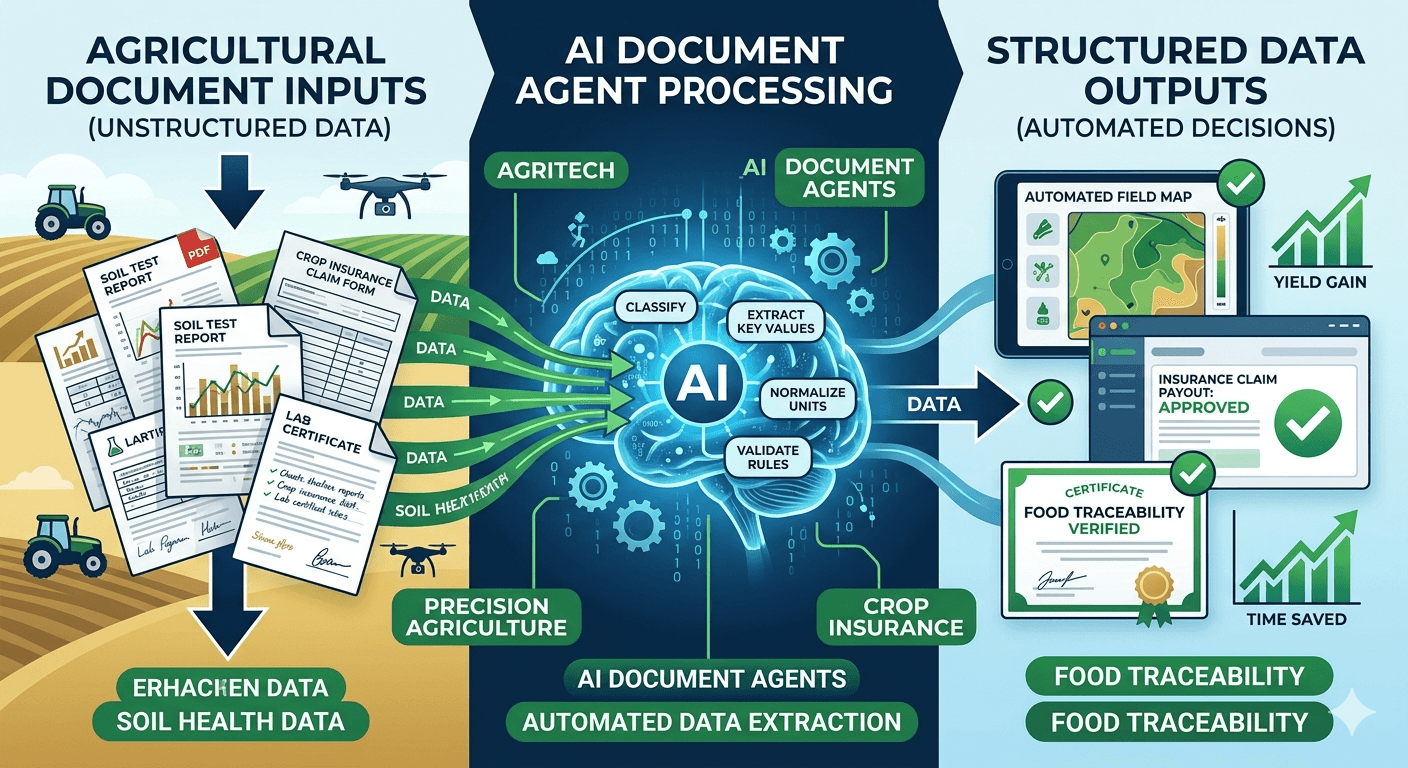
AI-native document processing takes a different approach. Instead of looking for data in predetermined locations, AI agents read and understand document content the way a knowledgeable person would. They identify what a document is, find the relevant data fields regardless of where they appear, validate the extracted values against expected ranges and business rules, and then route the data to wherever it needs to go next.
For an agribusiness operation, that means a soil report arriving as a PDF attachment gets automatically classified, the nutrient and pH values extracted and normalised to standard units, the results compared against field-specific benchmarks from the previous season, and a summary flagged for agronomist review, all without anyone manually touching the document. The same underlying capability, applied to an insurance claim, extracts the loss event details, matches them against the policy terms on file, calculates the eligible claim value, and queues the payment for approval.
Soil Test Reports: From Lab to Agronomic Action in Hours
Soil testing is the foundation of modern precision agriculture. Getting the chemistry right before planting, adjusting nitrogen, phosphorus, potassium, and micronutrient levels based on actual field measurements rather than generic recommendations, has a measurable impact on both yield and input cost. But soil testing only delivers value when the results reach the right people quickly and in a usable format.
The practical reality at most operations is that soil reports arrive from labs as PDFs with varying layouts. Some labs use tabular formats with columns for each nutrient. Others use narrative report styles with values embedded in paragraphs. Some include graphical range indicators. Some use metric units, others imperial. An agronomist consulting across multiple farms and lab relationships might deal with a dozen different report formats in a single week.
AI document agents handle this variation natively. Rather than requiring each lab's format to be templated in advance, the agent reads each report as a document, identifies the analytical results section, extracts the nutrient values regardless of layout, and normalises them to whatever unit standard the farm management platform requires. A calcium reading expressed as meq/100g gets converted automatically to the ppm value that the fertiliser recommendation engine expects.
Beyond the mechanical extraction, the real value comes from what happens next. Once soil data is structured and flowing into the right systems automatically, operations can build workflows that were previously impractical. Fertiliser orders can be triggered automatically when extracted results cross a threshold. Comparison reports between current and historical readings can be generated without manual assembly. The agronomist's time shifts from data entry to interpretation and recommendation.
For agribusiness groups managing soil testing across hundreds of fields and multiple labs, this isn't a marginal improvement. It's the difference between soil data being an occasional manual exercise and a continuous, automated input into precision farming workflows.
Crop Insurance Claims: Speed When It Matters Most
The timing problem with crop insurance is brutal. Loss events, whether flood, drought, hail, or disease pressure, tend to happen fast and at the worst possible moment. A farmer who loses a significant portion of their crop needs access to the payout quickly to make decisions about replanting, cash flow, and next season's planning. Delays of several weeks or months translate directly into compounded losses.
The document challenge on the insurance side cuts both ways. Farmers and farm managers need to assemble and submit a complete claim package quickly, pulling together evidence from multiple sources. Insurers need to process high volumes of claims simultaneously during loss events, which are never evenly distributed across the calendar.
Automating the claim intake side means a claim package submitted as a combination of PDF reports, photos, spreadsheet yield histories, and adjuster notes gets processed through a single pipeline. The AI agent classifies each document, extracts the relevant fields, and assembles a structured claim record that maps directly to the insurer's processing requirements. Missing documents trigger automatic requests rather than a human reviewer noticing the gap three days later.
On the insurer side, straight-through processing for simpler claims, small losses with straightforward documentation where the extracted data validates cleanly against policy terms, can move from intake to payment approval without any manual intervention. Complex claims get enriched data packages that let adjusters focus their time on the actual assessment rather than data collection.
For agricultural lending institutions, the same capability applies to loan document processing. Farm operating loans often require current soil test results, yield history documentation, and insurance coverage verification. Automating the extraction and validation of these documents across a portfolio of farm borrowers is an area where AI document processing delivers immediate throughput gains.
Compliance Certificates and Food Traceability: Closing the Chain
Food traceability is no longer optional in most major markets. EU regulations require that any food business operator be able to trace products one step back and one step forward in the supply chain at any time. US requirements under FSMA push further for certain high-risk produce categories. Retailer standards, particularly among major UK and European supermarkets, often exceed the regulatory floor by a significant margin.
Traceability works only as well as its documentation. A fresh produce operation that can't produce a GlobalG.A.P. certificate, a pesticide application record, or a soil health report during a retailer audit is effectively a failed audit regardless of how well the farm actually operates.
The compliance documentation challenge for food producers spans several document types. Certificates of conformity from accredited inspection bodies need to be received, verified for authenticity and current validity, and filed against the relevant product lots. Pesticide application logs need to be checked against maximum residue limit tables and linked to the product batches they cover. Soil health and water quality reports need to be retained and retrievable against field and season identifiers.
AI document processing agents can manage each stage of this workflow. Certificates arriving from inspection bodies get extracted, the validity period confirmed, and the relevant expiry date flagged before it becomes a compliance problem. Application logs submitted by field staff in varied formats get normalised and cross-referenced against the regulatory MRL tables automatically. When an auditor arrives, the complete chain of custody documentation for any batch can be assembled and exported in minutes rather than assembled manually over several hours.
The broader value of getting this right connects directly to market access. A fresh produce exporter who can demonstrate consistent, automated traceability documentation is a more attractive supplier to demanding retail customers than one who operates on manual systems with periodic gaps. The compliance infrastructure becomes a commercial differentiator.
What Integration Actually Looks Like
Deploying AI document processing in an agricultural context isn't a standalone project. The value comes from connecting extracted document data to the downstream systems that need it: farm management platforms, ERP systems used by agribusinesses, insurance policy administration systems, and regulatory submission portals.
For an integrated agribusiness running SAP or similar ERP infrastructure, soil test data flowing automatically into materials management and procurement modules means fertiliser orders can be pre-validated against current field data rather than last season's spreadsheet. Crop insurance policy documents feeding into the finance system mean coverage gaps are visible before a loss event rather than after.
The integration layer is where a lot of manual workflows currently live. Bridging the gap between incoming documents and operational systems through automated data extraction and routing is what transforms document processing from a back-office cost centre into something that actually accelerates decisions in the field.
The Operating Model That Changes
Perhaps the most significant shift that AI document processing enables for agriculture isn't about any single document type. It's about what the operation looks like when document handling stops consuming professional time.
An agronomist spending four hours a week compiling and re-entering soil test data could instead be spending those hours on interpretation and farm visits. An insurance professional manually assembling claim packages could be doing coverage analysis and risk advisory work. A compliance manager chasing certificates and updating logs could be working proactively on supplier development and audit readiness.
Agriculture is an industry facing genuine talent pressures. Skilled agronomists, crop advisors, and food safety specialists are harder to find and more expensive than they were a decade ago. Using that talent to manually process documents is a real cost, not just an inconvenience.
AI document agents are already handling the mechanical layer, extracting, validating, routing, and flagging. The operations that move first on this are freeing up expert time to focus on what experts are actually for: making better decisions about the land, the crop, and the supply chain.
From soil test to shelf, the documentation chain is long and its weak points are well known. Closing those gaps isn't a technology experiment. It's operational infrastructure that serious agricultural businesses are starting to treat as standard.