Your document extraction system works beautifully. Invoices come in, data comes out, everything flows into your accounting system without a hitch. Then you onboard your first German vendor.
The invoice arrives. The extraction runs. The output is garbage.
The total shows as 47500000 instead of 47,500.00. The date parsed as March 12th when it should be December 3rd. The vendor name came through as a jumbled mess of characters. Your "working beautifully" system just broke on its first international document.
This is the moment most finance teams discover that their extraction tool was trained on English, US-formatted documents and has no idea what to do with the rest of the world. That German invoice with €47.500,00 as the total? The system saw the period and assumed it was a decimal point. It interpreted the comma as a thousands separator. It got the number exactly backwards.
Welcome to global document processing, where everything you thought you knew about data formats turns out to be a local convention that half the world does differently.
The Three Format Nightmares
International documents don't just use different languages. They use different conventions for representing the same information. And these differences create extraction failures that look like bugs but are actually fundamental misunderstandings of how data is formatted.
Number formats are the most common failure point. In the United States, we write forty-seven thousand five hundred as 47,500.00. The comma separates thousands, the period marks the decimal. Simple and obvious, right?
Germany writes the same number as 47.500,00. The period separates thousands, the comma marks the decimal. Completely inverted from US convention. France does the same. So do Spain, Italy, Brazil, and dozens of other countries.
Switzerland might write it as 47'500.00, using an apostrophe for thousands. India might write it as 47,500.00 but group digits differently for larger numbers (1,00,00,000 instead of 10,000,000).
An extraction system that assumes US number formatting will misread every single one of these. A German invoice for €47.500,00 becomes either 47500000 (if the system drops the comma entirely) or 47.5 (if it treats the period as the decimal). Neither is close to correct.
Date formats create a different kind of chaos. When you see 12/03/2024, what date is that? In the United States, it's December 3rd. In most of Europe, it's March 12th. In parts of Asia, it could be interpreted either way depending on context.
This ambiguity causes real problems. Payment terms calculated from the wrong date mean paying too early or too late. Document filing by date puts things in the wrong month. Compliance reporting with incorrect dates creates audit issues.
The tricky part is that dates between 01 and 12 are always ambiguous when written in numeric format. Is 06/07/2024 June 7th or July 6th? Without knowing where the document originated, you genuinely can't tell. And extraction systems that guess wrong create downstream errors that nobody notices until something breaks.
Currency handling adds another layer of complexity. The Euro symbol (€) might appear before the number (€500) or after (500€) depending on the country. Some documents use currency codes (EUR, USD, GBP) instead of symbols. Some use both. Some use neither and expect you to know from context.
Exchange rate timing matters too. An invoice dated three weeks ago in a foreign currency needs to be recorded at the exchange rate from that date, not today's rate. Systems that extract amounts without preserving currency information force manual lookup and calculation for every international transaction. 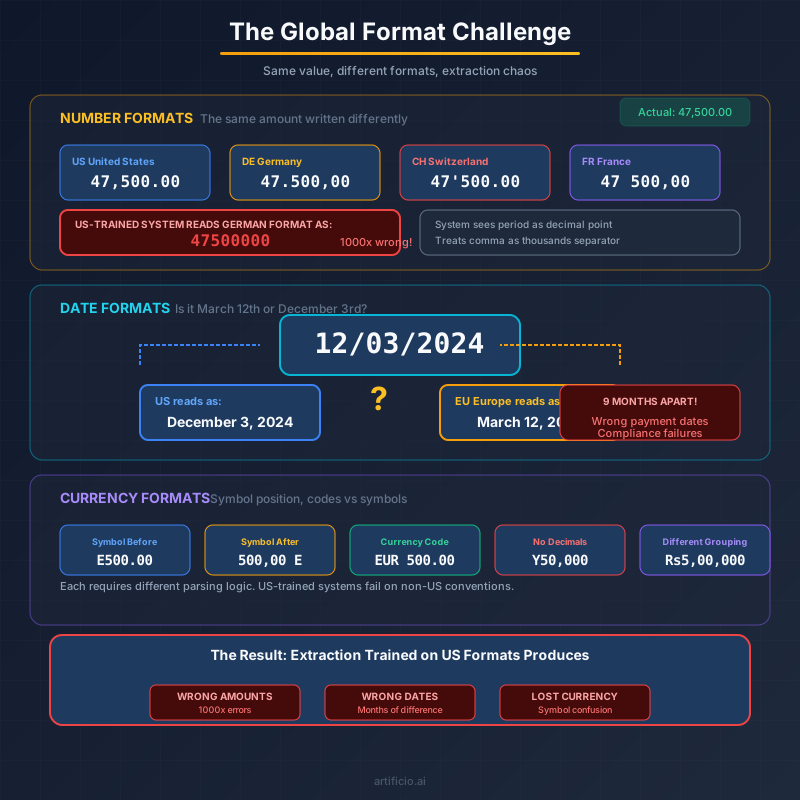
Language Is More Than Translation
Number and date formats are mechanical problems. Language creates a deeper challenge.
Your extraction system knows that "Invoice Number" is the label for a field containing the document identifier. It knows that "Total Amount" indicates where to find the sum. It knows that "Due Date" marks the payment deadline.
But what about "Rechnungsnummer"? That's German for "Invoice Number." Or "Numéro de facture" in French. Or "Número de factura" in Spanish. Or "請求書番号" in Japanese.
A truly global extraction system needs to recognize that all of these labels mean the same thing. Not through manual mapping where someone programs every translation, but through genuine understanding that "Factuurbedrag" on a Dutch invoice is asking for the same data as "Invoice Amount" on an English one.
This gets complicated fast. Languages don't map one-to-one. German compound words like "Mehrwertsteuer" (value-added tax) or "Zahlungsbedingungen" (payment terms) combine concepts that English separates. Japanese uses entirely different character sets and reading directions. Arabic reads right-to-left. Some languages have formal and informal registers that change terminology.
Field labels also vary within the same language. An English invoice might say "Invoice Total," "Total Due," "Amount Payable," "Grand Total," or just "Total." A Spanish invoice has similar variations. The extraction system needs to understand that all of these point to the same concept regardless of exact wording.
Vendor and customer names add another wrinkle. Names in non-Latin scripts need to be captured accurately, not transliterated into nonsense. A Japanese company name in kanji should remain in kanji if that's how your systems identify that vendor. Or it should be converted to the standardized romanization your systems expect. Either way, it needs to be consistent and correct.
The Hidden Step: Normalization
Here's something that doesn't get talked about enough. Extracting data from international documents is only half the problem. The other half is normalizing that data into formats your downstream systems can actually use.
Your ERP doesn't care that the original invoice said €47.500,00. It needs to receive 47500.00 as a numeric value with EUR as the currency code. Your accounting system doesn't care that the French date was written as 15/12/2024. It needs 2024-12-15 in ISO format, or whatever standard format your system expects.
Normalization is the translation layer between "what the document says" and "what your systems need." It converts localized formats into standardized outputs that work regardless of the source document's origin.
Good normalization handles edge cases automatically. That Swiss number with apostrophes? Normalized to standard numeric format. That ambiguous date? Resolved using document origin, language context, and validation against reasonable date ranges. That currency symbol after the number? Converted to a consistent currency code preceding the amount.
Without normalization, extraction just moves the problem. Instead of someone manually reading international invoices, someone manually reformats extracted data. You've automated one step and created work in another.
With normalization, extraction produces clean, consistent, system-ready data regardless of how the source document was formatted. A German invoice, a Japanese invoice, and an American invoice all output the same standardized data structure. Your downstream systems never know the difference.
What This Looks Like in Practice
Consider a mid-sized company with vendors across 12 countries. Before implementing global extraction, their accounts payable process looked like this:
US and UK invoices went through the standard extraction workflow. Everything else got handled manually because the extraction kept failing on non-English documents.
The AP team had specialists assigned by region. One person knew German invoice formats. Another handled French and Spanish. A third managed Asia-Pacific documents. When someone was out sick, their region's invoices piled up.
Currency conversion happened in spreadsheets. Someone would look up historical exchange rates, calculate the converted amounts, and manually enter them into the accounting system. This added 5-10 minutes per international invoice and created regular errors.
Date formats caused constant confusion. The team developed a habit of calling vendors to confirm dates on any invoice where the day and month were both 12 or below. Embarrassing, time-consuming, and still error-prone.
After implementing extraction with proper global support, the process changed completely:
All invoices go through a single workflow regardless of origin country. The system automatically detects the document language and applies appropriate format expectations. German invoices are processed with German number conventions. French invoices use French date formats. Japanese invoices handle Japanese text correctly.
Normalization converts everything to the company's standard format on output. Every invoice produces the same data structure: amounts as decimal numbers with currency codes, dates in ISO format, vendor names in consistent encoding. The accounting system receives identical input regardless of whether the source was from Munich or Miami.
The regional specialists now handle exceptions and complex cases instead of routine data entry. Processing time per invoice dropped from 8-12 minutes to under 30 seconds. Error rates fell from roughly 4% to nearly zero. Month-end close happens two days faster because international invoices don't create bottlenecks. 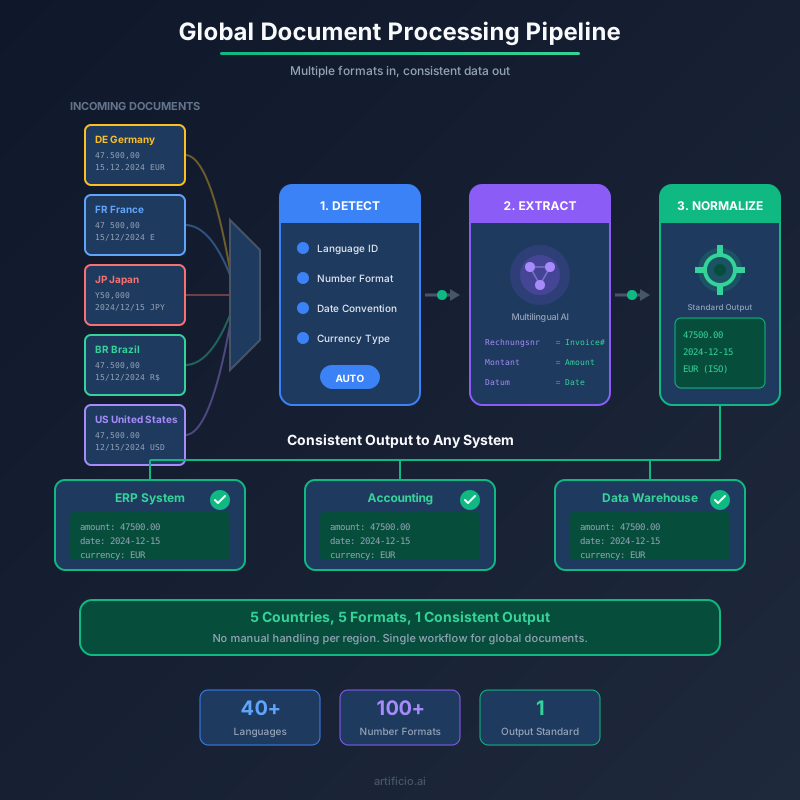
The Vendor Name Problem
One issue deserves special attention because it causes problems that aren't immediately obvious: vendor name matching.
Your accounting system has a vendor named "Müller GmbH" set up in the vendor master. An invoice arrives with "Mueller GmbH" because the sender's system couldn't handle the umlaut. Another invoice shows "MÜLLER GMBH" in all caps. A third shows "Müller GmbH." Are these three different vendors or the same one?
Humans recognize them as the same company instantly. Systems often don't. Without proper handling, you end up with duplicate vendor records, mismatched payments, and reconciliation nightmares.
Good global extraction includes fuzzy matching for vendor names that accounts for character encoding variations, capitalization differences, special character handling, and common abbreviations. "Société Anonyme" and "SA" should match. "株式会社" and "K.K." should match. "GmbH" and "Gesellschaft mit beschränkter Haftung" should match.
This isn't just convenience. It's data integrity. Duplicate vendor records create compliance issues, complicate spend analysis, and make it nearly impossible to get accurate reporting on vendor relationships.
What to Look For in Global Extraction Capability
If you're evaluating document extraction for international documents, here's what actually matters:
Multi-language field recognition means the system understands field labels in multiple languages without manual configuration. It should recognize "Montant Total," "Gesamtbetrag," and "Total Amount" as equivalent without you having to map each one.
Number format auto-detection means the system correctly interprets 47.500,00 as 47500.00 when processing a German document, without being explicitly told the document is German. Context, language cues, and format patterns should drive automatic detection.
Date handling needs to go beyond simple parsing. The system should resolve DD/MM vs MM/DD ambiguity using document context, validate dates against reasonable ranges, and flag genuinely ambiguous cases for review rather than guessing wrong silently.
Currency handling should preserve currency information through the entire extraction and normalization process. Symbol position, code vs symbol usage, and multi-currency documents should all work correctly.
Consistent output formatting means every extracted document produces the same standardized data structure regardless of source format. Your downstream systems should receive identical field formats whether the input was English, German, Japanese, or Arabic.
Character encoding support means names, addresses, and other text fields preserve their original characters correctly. Japanese kanji, German umlauts, French accents, Arabic script, and Cyrillic characters should all come through accurately.
Vendor matching intelligence should handle the variations in how vendor names appear across documents, linking them to consistent vendor records despite formatting differences.
The Competitive Reality
Global business requires global document processing. Companies that can't efficiently handle international invoices, contracts, and financial documents face real competitive disadvantages.
Manual processing of international documents costs more per document, takes longer, and creates more errors. Those costs add up across hundreds or thousands of documents per month. More importantly, they create bottlenecks that slow down vendor payments, delay financial close, and frustrate international partners.
The expectation from international vendors is immediate, accurate processing regardless of their local formats. They don't care that their invoice format differs from your US vendors. They expect the same payment reliability and communication responsiveness.
Organizations that solve global document processing remove a genuine operational constraint. They can add international vendors without adding headcount. They can expand into new markets without worrying about document format compatibility. They can close their books on the same schedule regardless of how many countries their documents come from.
Moving Forward
The challenge of global document extraction isn't going away. International business continues to grow. Remote work has made international vendor relationships more common even for smaller companies. Supply chains span continents. Customer bases cross borders.
Document extraction tools built for English-only, US-format-only processing will increasingly become bottlenecks. They'll require manual workarounds that grow more expensive as international document volume increases.
The solution isn't to avoid international business. It's to implement extraction that handles global documents natively, with automatic format detection, intelligent normalization, and consistent output regardless of document origin.
Your German vendors shouldn't be harder to pay than your American ones. Your French invoices shouldn't require special handling. Your Japanese contracts shouldn't sit in a pile waiting for someone who can read them.
Document extraction should handle the world as it actually is: multilingual, multi-format, and increasingly interconnected. Anything less creates friction that your competitors won't accept.