

Blog
The Art and Science of Data Annotation: A Cornerstone of AI/ML Model Training
Explore how advanced data annotation techniques are revolutionizing AI/ML model training and driving intelligent systems across industries.

Blog
Explore how advanced data annotation techniques are revolutionizing AI/ML model training and driving intelligent systems across industries.
In the rapidly evolving landscape of artificial intelligence and machine learning, one critical component often remains hidden from the spotlight yet serves as the cornerstone of successful AI implementations: data annotation. Behind every sophisticated AI system that can recognize faces in photos, understand spoken commands, detect anomalies in medical scans, or power autonomous vehicles lies an immense foundation of meticulously annotated data. Today, we delve deep into the transformative world of data annotation for AI/ML model training, exploring how advanced annotation approaches are revolutionizing the development of intelligent systems across industries.
The journey toward artificial intelligence that can meaningfully interact with our world begins not with complex algorithms or powerful computing infrastructure, but with something far more fundamental: teaching machines to perceive and understand information the way humans do. This teaching process relies overwhelmingly on supervised learning, a paradigm in which algorithms learn to identify patterns by studying examples that have been pre-labeled by humans. These labels or annotations serve as the essential "ground truth" from which AI systems learn to make accurate determinations about new information they encounter.
The process bears remarkable similarity to human learning in early childhood. Consider how we teach children to recognize animals: we point to various dogs and say "dog," to different birds and say "bird," gradually helping them build mental models that allow them to categorize new animals they've never seen before. Similarly, AI systems require thousands sometimes millions of carefully annotated examples to develop accurate recognition capabilities. An image recognition system learns to identify cats not through explicit programming of "cat-like" features, but by analyzing patterns across thousands of images labeled as containing cats. The quality, accuracy, and comprehensiveness of these annotations directly determine how well the resulting AI will perform in real-world scenarios.
This principle underlies virtually every practical AI application in use today. Facial recognition systems that unlock smartphones, voice assistants that respond to verbal commands, medical imaging tools that detect cancerous cells, content moderation systems that identify inappropriate material, autonomous vehicles that navigate complex environments all depend absolutely on extensive training with properly annotated data. Without this foundation, even the most sophisticated algorithms remain essentially useless, unable to connect their computational capabilities to meaningful understanding of real-world information.
The significance of this annotation process has historically been underappreciated by those outside the AI development community. While public discourse often focuses on algorithmic breakthroughs or hardware advancements, practitioners within the field recognize data annotation as perhaps the most critical determinant of an AI system's ultimate success or failure. The industry wisdom that "garbage in, garbage out" applies with particular force to machine learning an AI can only be as good as the annotated data used to train it.
Yet despite its fundamental importance, data annotation has long represented one of the most significant bottlenecks in the AI development pipeline. Traditional annotation processes typically involve extensive manual labeling by human annotators using rudimentary tools with limited capabilities and inconsistent standards. The results are predictably problematic: slow throughput that extends development cycles by months; prohibitive costs that can consume up to 80% of AI project budgets in data-intensive domains; and quality inconsistencies that directly translate to underperforming AI models.
This bottleneck has real-world consequences across industries. Healthcare organizations struggle to develop diagnostic AIs due to the challenges of annotating complex medical imagery. Autonomous vehicle companies face extended development timelines because of the immense effort required to annotate driving scenario data. E-commerce firms delay deployment of improved product recognition systems while waiting for inventory images to be properly labeled. In nearly every domain where AI promises transformation, the annotation bottleneck has served as a persistent barrier to progress.
Against this backdrop, innovations in the field of data annotation represent not merely incremental improvements to one step in the AI development process, but fundamental accelerators for the entire industry. By addressing this critical bottleneck, modern annotation platforms are enabling faster development cycles, more accurate models, and ultimately more rapid adoption of AI technologies across sectors. The most advanced solutions encompass multiple data types, sophisticated quality control mechanisms, and novel techniques that significantly reduce the time and cost associated with preparing data for AI training.
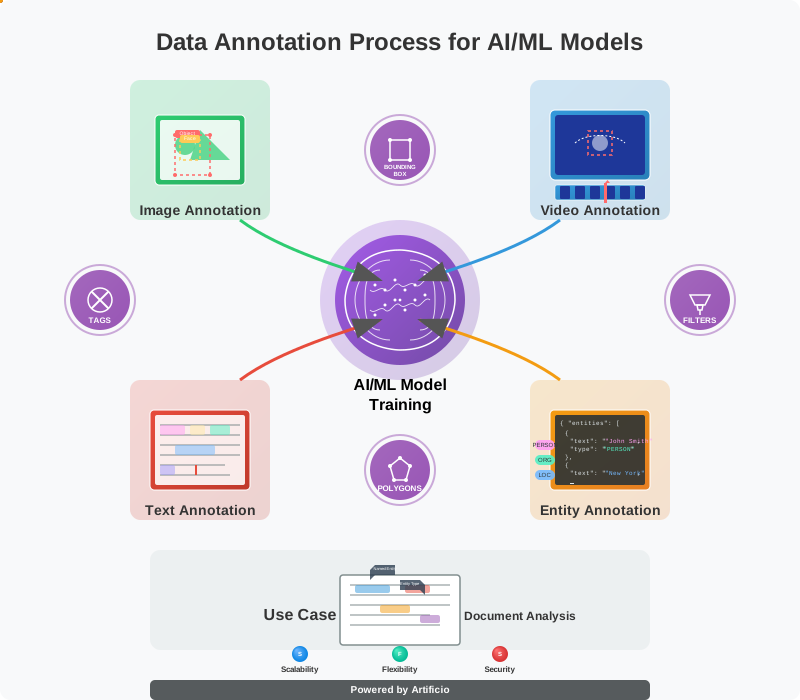
The challenge of data annotation spans multiple modalities, each with its own unique requirements and complexities. Comprehensive annotation solutions must address four fundamental types of annotation, each serving different AI application domains and presenting distinct technical challenges. Understanding these different approaches provides insight into both the complexity of the annotation process and the breadth of capabilities that effective annotation platforms must provide.
At its core, image annotation involves adding metadata to visual content to help AI systems understand and interpret what they "see." This seemingly straightforward task encompasses a remarkable range of techniques and approaches, each suited to particular use cases and objectives within the vast domain of computer vision applications.
The most fundamental approach involves drawing bounding boxes around objects of interest within an image. While conceptually simple, effective bounding box annotation requires sophisticated tools to ensure precision, consistency, and efficiency. Modern annotation platforms offer sub-pixel precision drawing capabilities, intelligent snap-to-edge functionality, and automated assistance that significantly accelerates the bounding box creation process. These capabilities matter tremendously in domains like retail inventory management, where accurate object delineation directly impacts an AI's ability to properly identify and count products on store shelves.
Beyond simple bounding boxes, many advanced computer vision applications require more granular annotation approaches. Semantic segmentation involves precisely outlining the exact boundary of each object, effectively creating a pixel-by-pixel mask that distinguishes the object from its surroundings. This technique proves essential for applications requiring precise object boundaries, such as medical imaging systems that must exactly differentiate between healthy tissue and potential abnormalities, or autonomous vehicles that need to precisely understand where one object ends and another begins. State-of-the-art annotation platforms provide sophisticated polygon and brush tools that enable efficient creation of these detailed segmentation masks, with intelligent edge-detection assistance that dramatically reduces the time required for this typically laborious process.
The field further extends into specialized image annotation techniques such as landmark annotation (identifying specific points on objects, crucial for facial recognition and pose estimation), 3D cuboid annotation (creating three-dimensional bounding boxes, essential for depth-aware applications like robotics and autonomous navigation), and instance segmentation (distinguishing between multiple instances of the same object category, vital for complex scene understanding). Each of these techniques requires specialized tools and approaches, all of which must be seamlessly integrated within a comprehensive annotation environment.
Beyond the technical tools themselves, effective image annotation demands sophisticated workflow management to handle the immense scale required for modern AI training. A typical computer vision dataset might encompass millions of images, each requiring annotation of dozens of objects across multiple categories. Advanced annotation systems address this scale challenge through intelligent work distribution systems, automated quality control checks, and performance analytics that identify bottlenecks or inconsistencies in the annotation process. The most sophisticated platforms also leverage active learning approaches that prioritize the most informative images for annotation, ensuring that human effort focuses on examples that will provide maximum training value for the resulting AI model.
The significance of these advanced image annotation capabilities extends far beyond technical convenience. In practical terms, they translate directly to dramatically faster development cycles for computer vision applications, substantially improved model accuracy, and ultimately more capable AI systems across industries ranging from healthcare and autonomous transportation to retail, agriculture, manufacturing, and security. By transforming the traditionally painstaking process of image annotation into an efficient, scalable workflow, modern annotation platforms enable organizations to overcome one of the most persistent barriers to successful computer vision implementation.
While image annotation addresses the spatial understanding of visual data, video annotation introduces an entirely new dimension: time. Video data captures the dynamic nature of the real world, with objects moving, interacting, changing, and evolving across frames. Annotating this temporal information presents unique challenges that go far beyond simply annotating individual frames as static images.
The most fundamental aspect of video annotation involves object tracking identifying and following specific objects as they move through a scene over time. This process requires maintaining consistent identification of objects despite changes in appearance, position, scale, and even temporary occlusion when one object passes behind another. Traditional approaches to this challenge required painstaking frame-by-frame annotation, an extraordinarily time-consuming process that made annotating even short video clips prohibitively expensive.
Advanced annotation platforms have transformed this process through sophisticated interpolation technologies that dramatically reduce the manual effort required. Rather than annotating every frame, annotators can mark objects at key intervals, and the system intelligently tracks those objects across intermediate frames. The most effective solutions employ sophisticated computer vision algorithms to maintain tracking accuracy even through challenging scenarios like partial occlusions, lighting changes, or rapid movements. When the automated tracking encounters ambiguous situations, it intelligently prompts human reviewers for verification, ensuring accuracy while still minimizing manual intervention.
Beyond simple object tracking, effective video annotation must address additional temporal dimensions such as action recognition, event detection, and scene segmentation. Actions and events unfold over time a person reaching for an object, a vehicle changing lanes, a manufacturing process progressing through stages. Properly annotating these temporal patterns requires specialized tools for marking start and end points, defining action categories, and establishing relationships between different activities within a scene. State-of-the-art platforms provide sophisticated timeline-based annotation interfaces that make these complex temporal annotations intuitive and efficient.
The challenges of video annotation extend further into domains like human pose tracking (following the position and configuration of human bodies across frames), behavior analysis (annotating complex interactions between multiple agents), and anomaly marking (identifying unusual or important events within lengthy video sequences). Each of these specialized annotation types requires dedicated tools and workflows, all seamlessly integrated within a comprehensive video annotation environment.
Scale presents a particularly acute challenge for video annotation. While a typical image dataset might contain millions of distinct images, a video dataset comprises continuous footage that might represent hundreds or thousands of hours of content equivalent to tens of millions of individual frames. Processing this volume of data requires exceptional efficiency and sophisticated prioritization strategies. Advanced annotation systems address this challenge through intelligent sampling techniques that identify the most informationally rich segments for detailed annotation, automated pre-annotation systems that handle routine cases, and distributed workflow management that optimally allocates human attention across the dataset.
The impact of advanced video annotation capabilities resonates across numerous industries and applications. Surveillance systems become capable of detecting specific behaviors of interest rather than simply identifying objects. Manufacturing quality control systems learn to recognize process deviations as they occur rather than just inspecting final products. Autonomous vehicles develop nuanced understanding of traffic patterns and pedestrian behaviors. Sports analytics platforms automatically extract sophisticated performance metrics from game footage. In each case, the ability to efficiently annotate the temporal dimension of visual data unlocks AI capabilities that would be impossible to achieve through static image analysis alone.
Language represents one of humanity's most sophisticated intellectual achievements a symbolic system for encoding abstract concepts, complex relationships, and nuanced sentiments into sequences of words and phrases. Teaching machines to understand this system requires extensive annotation that identifies and labels the structural elements and semantic content of textual data.
The foundation of text annotation begins with entity recognition identifying and categorizing specific elements within text such as people, organizations, locations, dates, and specialized domain entities like medical conditions or legal citations. This seemingly straightforward task quickly reveals its complexity when confronting real-world language with its ambiguities, contextual meanings, and domain-specific terminology. An effective entity annotation system must support precise boundary definition (exactly which words constitute an entity), hierarchical classification (distinguishing between different types and subtypes of entities), and relationship mapping (how different entities relate to one another within the text).
Advanced text annotation platforms provide sophisticated tools for efficient entity marking, with intelligent assistance features that dramatically accelerate the process. The most effective systems employ active learning approaches to identify potential entities based on patterns recognized from previous annotations, offering suggestions that human annotators can quickly confirm or modify. As the annotation process progresses, the system continuously improves its suggestions, creating a virtuous cycle of increasing efficiency without sacrificing human oversight and judgment.
Beyond entity recognition, comprehensive text annotation encompasses syntactic analysis identifying the grammatical structure of sentences including parts of speech, dependency relationships, and constituent phrases. This structural understanding proves essential for applications ranging from machine translation to grammatical error correction. Modern annotation platforms offer intuitive visualization tools for syntactic annotation, representing complex grammatical relationships through clear graphical interfaces that make this traditionally specialized task accessible to a broader range of annotators.
Perhaps the most challenging aspect of text annotation involves capturing semantic dimensions the actual meaning conveyed by the text. This includes sentiment analysis (identifying positive, negative, or neutral attitudes), intent recognition (determining what action or response a text is seeking), coreference resolution (establishing which pronouns refer to which entities), and discourse structure (how different sentences and paragraphs relate to form coherent arguments or narratives). Each of these dimensions requires specialized annotation approaches supported by comprehensive text annotation environments.
The field further extends into domain-specific text annotation capabilities essential for specialized applications. Medical text annotation identifies conditions, treatments, and relationships between them. Legal text annotation marks citations, precedents, and argumentation structures. Financial text annotation identifies entities like companies, products, and market indicators, along with events like acquisitions, earnings reports, or regulatory changes. By providing customizable annotation schemas and domain-specific assistance features, advanced platforms enable efficient annotation across these specialized fields.
As with other data types, scale presents a significant challenge for text annotation. Modern natural language processing models typically train on corpora comprising billions of words, with annotation requirements potentially spanning millions of documents. Sophisticated annotation systems address this challenge through intelligent prioritization algorithms that identify the most informative text examples for annotation, automated pre-annotation of routine cases, and sophisticated quality control mechanisms that ensure consistency across large annotation teams.
The business impact of advanced text annotation capabilities manifests across numerous applications. Customer service chatbots develop more sophisticated understanding of user requests. Content moderation systems more accurately identify problematic material. Search engines deliver more relevant results. Document processing systems extract structured information from unstructured text. Each of these applications depends critically on the quality and comprehensiveness of the annotated text data used for training precisely the challenge that modern annotation platforms address.
While the previous annotation types focus on specific data modalities (images, videos, text), entity annotation addresses a higher-level challenge: identifying, categorizing, and relating distinct pieces of information across datasets. This process forms the foundation for knowledge graphs, recommendation systems, and other applications that require understanding complex relationships between different entities.
The first dimension of entity annotation involves establishing consistent identity—ensuring that references to the same entity are properly connected even when they appear in different forms or contexts. This challenge manifests across data types: the same person might appear in multiple images, be mentioned in various texts, and be referenced in structured database fields. Effective entity annotation systems must provide tools for reconciling these diverse references into a single consistent entity. Advanced platforms enable this reconciliation through sophisticated matching algorithms that suggest potential entity alignments, combined with intuitive interfaces for human reviewers to confirm or adjust these suggestions.
Beyond simple identity, entity annotation must capture attributes that characterize each entity. These attributes might include biographical details for people, organizational structures for companies, geographical features for locations, or domain-specific properties like clinical characteristics for medical conditions. Comprehensive annotation systems support flexible schema definition that enables organizations to specify exactly which attributes should be captured for different entity types, with validation rules that ensure consistency and completeness in the annotation process.
Perhaps the most valuable aspect of entity annotation involves mapping relationships between different entities. These relationships might be hierarchical (a department exists within an organization), associative (a person works for a company), temporal (an event occurs after another event), causal (a condition leads to a symptom), or domain-specific (a medication interacts with another medication). State-of-the-art annotation platforms provide intuitive graph-based visualization tools for defining and annotating these complex relationships, making visible the intricate connections that often remain implicit in raw data.
The challenges of entity annotation extend beyond the conceptual to the practical. Modern knowledge graphs often encompass millions of entities with billions of relationships between them. Managing annotation at this scale requires sophisticated approaches to work distribution, quality control, and conflict resolution. Advanced annotation systems address these challenges through intelligent workflow systems that divide entity annotation tasks into manageable units, consensus mechanisms that resolve disagreements between annotators, and comprehensive audit trails that maintain provenance information for every annotation decision.
The business impact of advanced entity annotation resonates across numerous applications. Recommendation systems develop more nuanced understanding of the relationships between products, users, and contexts. Search engines move beyond keyword matching to deliver results based on semantic relevance. Customer relationship management systems develop comprehensive views of client organizations and interactions. In each case, the quality and comprehensiveness of entity annotation directly determines the sophistication and effectiveness of the resulting application.
Creating a comprehensive data annotation platform capable of addressing the diverse challenges described above requires sophisticated technical infrastructure that spans multiple domains of computer science, user experience design, and systems engineering. The most advanced annotation platforms represent the culmination of years of focused innovation across these domains, resulting in integrated environments that dramatically accelerate the annotation process while maintaining exceptional quality standards.
The foundation of modern annotation systems rests on distributed cloud-native architectures designed for extreme scalability and resilience. These architectures employ containerized microservices, serverless computing resources, and sophisticated orchestration systems to dynamically allocate computational resources based on workload demands. The result is infrastructure capable of handling annotation projects ranging from small experimental datasets to production-scale operations involving billions of data points and hundreds of concurrent annotators.
User experience design plays a critical role in annotation platform effectiveness. Annotation fundamentally involves human judgment, and the interfaces through which humans interact with the data dramatically impact both efficiency and accuracy. The most successful platforms have invested extensively in developing intuitive annotation interfaces optimized for different data types and annotation tasks. These interfaces employ principles from cognitive psychology and human-computer interaction research to minimize cognitive load, reduce error rates, and maximize throughput. Advanced systems further adapt to individual user behavior, learning from each annotator's patterns to provide personalized assistance features that continuously enhance productivity.
Behind these user interfaces lies sophisticated data management infrastructure designed to handle the complex workflows associated with large-scale annotation projects. This infrastructure encompasses content delivery networks that ensure responsive access to high-volume media files, caching systems that minimize redundant processing, and version control mechanisms that maintain complete audit trails of all annotation decisions. Comprehensive platforms further include project management capabilities for defining annotation schemas, establishing quality thresholds, monitoring progress, and analyzing performance metrics across annotation teams.
Quality assurance represents another critical dimension of annotation platform infrastructure. State-of-the-art systems employ multi-layered approaches to quality control, beginning with real-time validation rules that verify annotations against defined schemas and constraints. Beyond these basic checks, advanced platforms implement statistical analysis to identify outlier annotations that deviate from established patterns, consensus mechanisms that compare annotations across multiple reviewers to identify discrepancies, and targeted sampling strategies that prioritize review for potentially problematic cases. These mechanisms collectively ensure that annotation quality remains consistently high even across large distributed teams and complex projects.
Perhaps the most technically sophisticated aspect of modern annotation platforms involves machine learning assistance features. Rather than treating annotation as a purely manual process, advanced systems employ active learning techniques that continuously improve based on existing annotations. As human annotators label initial examples, the system develops preliminary models that generate suggested annotations for subsequent examples. Human reviewers can then focus primarily on reviewing and adjusting these suggestions rather than creating annotations from scratch a workflow that typically increases productivity by 3-5x while maintaining human oversight. As the process continues, the suggestion models continuously improve, creating a virtuous cycle of increasing efficiency.
Leading platforms further employ transfer learning approaches that leverage knowledge across projects and domains. Models trained on one annotation task can provide valuable starting points for related tasks, even when the specific labels or objectives differ. This capability proves particularly valuable for organizations working across multiple AI initiatives, as insights and patterns discovered in one project can accelerate progress in others. The transfer learning capabilities extend to pre-trained foundation models that provide sophisticated understanding of images, language, and other data types even before project-specific annotation begins.
Security and compliance considerations permeate every aspect of advanced annotation platform design. Annotation often involves sensitive data subject to regulatory requirements ranging from HIPAA for healthcare information to GDPR for personal data to industry-specific standards in domains like finance and government. Comprehensive platforms implement robust security controls including end-to-end encryption, fine-grained access management, secure data isolation, and detailed audit logging. These controls ensure that annotation projects comply with relevant regulations while protecting sensitive information throughout the annotation lifecycle.
Altogether, this technical infrastructure represents a quantum leap beyond traditional annotation approaches. While conventional methods might require months of effort from large teams to prepare training data for sophisticated AI models, modern annotation platforms can reduce this timeline to days or weeks while simultaneously improving annotation quality. This acceleration directly translates to faster AI development cycles, reduced project costs, and ultimately more rapid realization of AI's transformative potential across industries.
The theoretical capabilities of advanced annotation platforms manifest in concrete business impact across diverse industries and use cases. In each domain, the ability to efficiently create high-quality annotated data translates directly to faster AI development cycles, more accurate models, and ultimately more valuable AI-driven applications.
In healthcare, the impact begins with medical imaging annotation. Radiological AI systems that detect potential abnormalities in X-rays, CT scans, and MRIs depend entirely on precisely annotated training data that identifies the subtle visual patterns associated with different conditions. Creating these annotations traditionally required scarce expert time from radiologists, creating a severe bottleneck in system development. Modern annotation platforms address this challenge through specialized medical annotation tools combined with workflow systems that optimize the use of expert reviewers. Rather than requiring radiologists to perform all annotation manually, advanced systems enable a tiered approach where trained technicians create initial annotations that medical specialists then review and refine. This workflow typically reduces radiologist time requirements by 70-80% while maintaining annotation quality, dramatically accelerating the development of potentially life-saving diagnostic AI systems.
Beyond imaging, healthcare applications extend to clinical text annotation for extracting structured information from medical records, entity annotation for building comprehensive knowledge graphs of conditions, treatments, and interactions, and multimodal annotation that connects information across imaging, text, and structured data sources. Each of these capabilities contributes to more sophisticated healthcare AI applications ranging from clinical decision support systems to drug discovery platforms to population health management solutions.
In the transportation sector, autonomous vehicle development represents one of the most annotation-intensive AI applications. Teaching vehicles to navigate safely through complex environments requires enormous volumes of annotated data spanning multiple sensors including cameras, lidar, and radar. This annotation must identify and track all relevant objects in the vehicle's environment other vehicles, pedestrians, cyclists, road signs, traffic signals, lane markings, and more across continuous video streams and 3D point clouds. The scale is staggering: a single hour of driving data might generate terabytes of information requiring millions of individual annotations.
Advanced annotation platforms address this challenge through specialized autonomous vehicle annotation tools combined with intelligent assistance features that dramatically reduce manual effort. These systems can automatically track objects across frames once they've been initially identified, suggest annotations based on patterns in previously labeled data, and intelligently prioritize the most informative examples for human review. These capabilities typically reduce annotation time requirements by 60-70% compared to traditional methods, directly accelerating the development timeline for autonomous transportation systems.
Financial services present another domain where advanced annotation capabilities drive significant business value. Risk assessment models that predict default probability based on loan application documents require extensive text annotation to identify and extract relevant information from unstructured content. Fraud detection systems need annotated transaction data that identifies suspicious patterns and relationships between entities. Investment analysis platforms require annotation of financial news and reports to extract market-moving information. In each case, sophisticated annotation platforms provide domain-specific tools and workflows optimized for financial data, enabling more rapid development of AI systems that improve decision-making, reduce risk, and identify new opportunities.
Retail and e-commerce organizations leverage annotation to enhance customer experiences and operational efficiency. Product recognition systems that automatically identify items in images require extensive visual annotation across diverse merchandise categories. Recommendation engines need entity annotation to establish relationships between products, users, and purchase contexts. Customer service automation depends on annotated support conversations that capture intent, sentiment, and resolution paths. Modern annotation platforms address these diverse requirements through comprehensive multi-modal annotation capabilities, enabling retailers to develop more sophisticated AI applications that drive conversion, satisfaction, and loyalty.
Manufacturing operations benefit from annotation capabilities that enable quality control, process optimization, and predictive maintenance. Visual inspection systems require annotated images of products with potential defects clearly marked. Process monitoring applications need annotated video that identifies normal and abnormal operation patterns. Equipment maintenance platforms depend on annotated sensor data that correlates different signal patterns with specific failure modes. By providing specialized tools for these industrial annotation tasks, advanced platforms enable manufacturers to develop AI systems that improve product quality, reduce waste, minimize downtime, and ultimately enhance productivity across the production environment.
Public sector and government organizations increasingly leverage AI for applications ranging from public safety to benefit administration to infrastructure management. These applications require annotation capabilities that address unique government requirements including exceptional accuracy standards, comprehensive audit trails, strict security controls, and often specific regulatory compliance. Sophisticated annotation platforms meet these requirements through enterprise-grade architecture combined with specialized annotation workflows designed for public sector use cases, enabling government organizations to responsibly develop AI applications that improve service delivery and operational efficiency.
Across these diverse domains, a common pattern emerges: the quality, efficiency, and scale of data annotation directly determine how quickly and effectively organizations can develop AI capabilities that drive meaningful business outcomes. By providing comprehensive platforms that transform the annotation process from a bottleneck to an accelerator, modern annotation technologies enable organizations across industries to realize the full potential of artificial intelligence more rapidly and at lower cost than previously possible.
As artificial intelligence continues its remarkable trajectory of capability advancement, the field of data annotation evolves in parallel, with new approaches and technologies continuously emerging to address evolving requirements. Forward-looking research and development efforts are pioneering the next generation of annotation approaches that will further accelerate AI development across domains.
One of the most promising directions involves semi-supervised and self-supervised learning approaches that reduce dependency on fully annotated datasets. These techniques leverage structural patterns within data to learn useful representations before any human annotation, then use limited human input to refine and direct these representations toward specific objectives. Advanced annotation workflows increasingly combine these emerging approaches with traditional supervised learning, optimizing the allocation of human annotation effort to maximize learning outcomes while minimizing required input.
Another transformative development involves synthetic data generation and annotation. Rather than relying exclusively on collecting and annotating real-world data, organizations increasingly complement their datasets with synthetically generated examples that come with perfect annotations by design. Leading annotation platforms are developing sophisticated tools for synthetic data workflows, including annotation transfer systems that map annotations from synthetic to real data, synthetic data validation frameworks that ensure generated examples appropriately represent real-world distributions, and hybrid training approaches that combine synthetic and authentic data to achieve superior model performance.
Multimodal annotation represents another frontier that is actively advancing. As AI systems increasingly integrate information across different data types connecting images with text, audio with video, structured data with unstructured content annotation platforms must evolve to capture the relationships between these different modalities. Researchers are developing novel interfaces and data models for cross modal annotation, enabling the creation of training datasets that capture the rich interconnections between different information sources that characterize real-world understanding.
Edge annotation systems that bring annotation capabilities directly to data sources represent another emerging paradigm. In domains with sensitive data that cannot leave secure environments, annotation traditionally required either deploying annotation teams within those environments or implementing complex data anonymization workflows. Innovative approaches are pioneering deployable annotation infrastructure that brings annotation capabilities to the data rather than vice versa, enabling annotation to occur within healthcare institutions, financial systems, government facilities, and other sensitive environments without compromising security or privacy.
Perhaps most significantly, the field is advancing toward increasingly collaborative human-AI annotation partnerships. Rather than viewing annotation as either a purely human task or something to be fully automated, the next generation of annotation platforms will establish sophisticated collaboration patterns where humans and AI systems each contribute their unique strengths. AI components provide speed, consistency, and the ability to process enormous volumes of data, while human annotators contribute contextual understanding, edge case judgment, and adaptation to novel situations. Together, these hybrid systems achieve outcomes superior to what either humans or automation could accomplish independently.
These innovations collectively point toward a future where data annotation no longer represents a bottleneck in AI development but instead serves as a strategic capability that organizations leverage to create unique competitive advantages. The organizations that most effectively combine human expertise with annotation technology will develop proprietary datasets that enable AI capabilities their competitors cannot match. In this landscape, advanced annotation platforms represent not merely productivity tools but strategic assets that translate directly to market leadership through superior AI performance.
As we've explored throughout this comprehensive examination, data annotation represents far more than a technical prerequisite for AI development it constitutes the essential foundation upon which all sophisticated artificial intelligence capabilities are built. The quality, scale, and efficiency of annotation directly determine how quickly organizations can develop AI applications, how accurately those applications will perform, and ultimately how much business value they will generate.
Modern annotation platforms have transformed this critical function from a bottleneck to an accelerator. By combining intuitive interfaces, intelligent assistance features, sophisticated quality control mechanisms, and enterprise-grade scalability, these platforms enable organizations across industries to dramatically reduce the time and cost associated with preparing training data for AI systems. These capabilities translate directly to compressed development timelines, improved model performance, and ultimately more rapid realization of AI's transformative potential.
The impact extends beyond individual projects to the overall pace of AI innovation. By addressing one of the most persistent barriers to successful AI implementation, advanced annotation technologies are helping to accelerate the broader adoption of artificial intelligence across the economy. Organizations that previously found the annotation requirements prohibitive can now realistically pursue AI initiatives that drive efficiency, improve experiences, enable new capabilities, and create competitive advantages.
In the evolving landscape of artificial intelligence, data will increasingly serve as the primary differentiator between success and failure. Algorithms, computing resources, and development tools are rapidly commoditizing, available to all participants through open-source projects and cloud services. What cannot be easily replicated is proprietary data the unique information assets that enable organizations to train AI systems aligned specifically with their business objectives and operational contexts. By providing the tools to efficiently transform raw information into valuable annotated datasets, modern annotation platforms empower organizations to develop these proprietary data assets and the competitive advantages they enable.
The future of business will increasingly belong to organizations that most effectively leverage artificial intelligence to enhance their capabilities, and the future of artificial intelligence belongs to those who master the art and science of data annotation. Through pioneering platforms and methodologies, the field of data annotation is enabling this future accelerating innovation, expanding possibilities, and ultimately helping to realize the full transformative potential of AI across industries and applications.

Head IT Operations - Co Founder of Artificio
See it in your SAP environment
Bring us a document, a process, or a bottleneck. We'll show how Artificio captures, validates, and posts into SAP — then scale from there.
Security & compliance
ISO 27001:2013 certified, SOC 2 Type 2 compliant, GDPR and HIPAA ready. Every agent action is logged, auditable, and runs in isolated environments.