The Autonomous Enterprise: How AI Agents Are Taking Over the Busywork of SAP
For two decades, "automation" in SAP environments meant faster manual work — better forms, smarter macros, tighter point-to-point integrations. A clerk still opened the invoice. A clerk still decided whether the PO matched. A clerk still typed the posting. Automation just made each of those steps a little quicker.
The Autonomous Enterprise is a different idea entirely. It's not about making manual steps faster — it's about removing them. In an autonomous enterprise, AI agents don't assist a process; they run it, start to finish, with a human stepping in only when a genuine judgment call is required.
This shift sounds incremental when you describe it in a sentence. It isn't. It's the difference between a workforce that processes work and a workforce that supervises work being processed for them. And for organizations running SAP — where the bulk of enterprise document and transaction volume lives — it's arguably the single biggest operating-model change since the move to S/4HANA itself.
This article breaks down what an autonomous enterprise actually is, how AI agents are architected to operate safely inside SAP, what's changed technically to make this possible now rather than five years ago, and what a realistic path toward autonomy looks like for an organization that isn't starting from zero.
A Quick History: Why "Automation" Has Meant Something Different Every Decade
It helps to place agentic AI in context, because "automation" has been re-defined by every wave of enterprise technology, and each wave automated a little more of the judgment, not just the labor.
Wave one: digitization (1990s–2000s). ERP systems like SAP R/3 digitized paper processes. A purchase order became a record instead of a carbon-copy form. This didn't eliminate decisions — it just made them faster to record.
Wave two: rules-based automation (2000s–2010s). Workflow engines and basic rules automated simple, deterministic decisions: if invoice amount matches PO amount exactly, auto-approve. This worked for the easy 20% of cases and pushed everything else into a human queue — which is why most AP departments still drown in exceptions today.
Wave three: RPA (2015–2020). Robotic Process Automation mimicked a human's clicks and keystrokes. It was fast to deploy but brittle — RPA bots can't read a document the way a person can; they follow a fixed script and break the moment a vendor changes their invoice template.
Wave four: agentic AI (2023–present). This is the wave we're in now. Large language models gave software the ability to read unstructured content the way a trained employee does — understanding context, not just matching patterns — and to make a reasoned decision about what to do next, not just execute a pre-written script.
The autonomous enterprise is what happens when wave four is applied not as a point solution, but as the default operating model for a function.
What Makes an Enterprise "Autonomous"
Not every AI deployment qualifies as "autonomous," and the term gets diluted quickly in vendor marketing. There are three traits that separate genuine agentic automation from a more sophisticated version of the same old workflow tooling.
1. Agents Perceive, Not Just Process
A rules engine processes a value: "if field X equals Y, do Z." An agent perceives a document: it reads an invoice, a service confirmation, or a contract the way a trained employee would — pulling line items, vendor identifiers, dates, and context out of a layout it has never seen before, without a pre-built template.
This distinction matters enormously in practice. Template-based OCR tools fail the moment a vendor redesigns their invoice. An AI agent built on a large language model doesn't care about layout; it understands the meaning of the document, which is why it survives format changes that would break a traditional extraction tool.
2. Agents Decide, Not Just Route
A workflow tool routes based on a static rule: "amount over $10,000 goes to manager approval." An agent decides, using a layered classification process that more closely resembles how an experienced AP analyst actually thinks.
Consider what that classification logic typically has to evaluate, in priority order, for a single incoming invoice:
- Is there an exact 3-way match between the invoice, the purchase order, and the goods receipt?
- If there's no PO reference at all, is this a recognized recurring no-PO spend category, like a utility or subscription?
- If a PO number is present but doesn't exist in the system, is this a missing-PO situation that needs discovery rather than rejection?
- Is the vendor a one-time vendor that needs special handling outside the standard master data flow?
- Does this invoice match the fingerprint of one already paid — a potential duplicate?
- For service-based spend, does the invoice need to be matched against a Service Entry Sheet (SES) rather than a goods receipt?
- Does the invoice need to be split across multiple purchase orders because the vendor billed several POs on one document?
A human doing this well has internalized all seven of these checks and runs through them almost unconsciously. An agent has to do the same thing explicitly, in a defined sequence, with each step capable of escalating to a human when the evidence is ambiguous rather than guessing.
3. Agents Act Inside the System of Record
This is the trait that's most often missing from "AI for SAP" tools, and it's the one that matters most to anyone responsible for SAP governance.
Most AI automation products on the market today work next to SAP. They extract data, run it through a model hosted elsewhere, and either generate a file for someone to upload or push a transaction through a side integration layer that lives outside SAP's controlled environment. That pattern creates a second system of record, a second audit trail, and — eventually — a reconciliation headache that someone in finance or IT has to own forever.
A genuinely autonomous enterprise keeps SAP as the single system of record. Agents read and write directly into S/4HANA through governed APIs — primarily OData services — so every action an agent takes is the same kind of transaction a human user would have created, subject to the same authorization objects, the same change documents, and the same audit trail. This is the architecture known as clean core: extending SAP's capability without altering or bypassing its core, so the system stays upgrade-safe and compliant by design rather than by exception.
From Document to Decision: How an Agentic Workflow Actually Runs
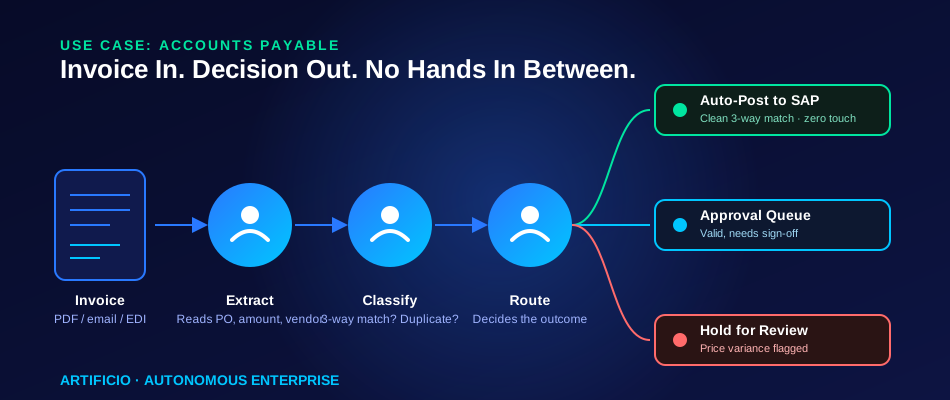
It's easier to understand the autonomous enterprise by walking through a single document's journey rather than describing the concept abstractly. Accounts payable is the clearest example, because invoice processing is the highest-volume, most decision-heavy document workflow in almost every SAP environment.
Step 1: Capture
An invoice arrives — by email, EDI, vendor portal, FTP Folder or scanned mail. In a non-autonomous environment, this is where a person opens it. In an autonomous workflow, an extraction agent picks it up the moment it lands, regardless of format: PDF, scanned image, structured XML, or a forwarded email body.
Step 2: Extract
The extraction agent reads the invoice and pulls out the data that matters: vendor name and ID, invoice number, invoice date, line items, quantities, unit prices, tax, PO references, and payment terms. Critically, a well-built extraction agent is also constrained to not hallucinate values it can't actually find on the document — a non-negotiable requirement when the output feeds directly into a financial posting. Production-grade extraction prompts explicitly instruct the model to return "not found" rather than guess at a missing field, and to flag low-confidence reads for human review instead of silently proceeding.
Step 3: Classify
A second, separate agent takes the extracted data and runs it through the priority-ordered classification logic described above — 3-way match, no-PO recurring spend, missing-PO discovery, one-time vendor, duplicate detection, service PO/SES matching, multi-PO splitting. Separating extraction from classification into two distinct agent calls, rather than asking one model to do both at once, produces meaningfully more reliable results, because each agent has a narrower, better-defined job.
Step 4: Decide and Route
Based on the classification outcome, a routing agent makes one of three calls:
- Auto-post. The match is clean, confidence is high, and the invoice posts directly into SAP with no human touch at all.
- Approval queue. The invoice is valid but needs a human sign-off — for example, it exceeds a threshold or involves a new vendor relationship.
- Hold for review. Something doesn't reconcile — a price variance, a missing goods receipt, a suspected duplicate — and the invoice is routed to a person with the specific reason for the hold already attached, instead of just a generic "exception" flag.
That third outcome is the part most automation projects get wrong. A system that can only say "this didn't work, please investigate" hasn't actually automated the decision — it's just automated the failure to decide. A genuinely autonomous workflow tells the human reviewer why it stopped, which is the difference between a tool that creates a backlog and one that actually reduces one.
Step 5: Post
For the auto-post and approved paths, the transaction writes into SAP through the same OData services a human-entered transaction would use. No file exports, no side database, no separate "automation platform" holding the system of record hostage to a different vendor's roadmap.
Step 6: Learn
Every human correction — a reviewer overriding a classification, adjusting a matched amount, or rejecting an auto-post decision — becomes a signal that should improve the system's confidence calibration over time. This feedback loop is what separates a static rules engine from a genuinely agentic one: the system gets measurably better at knowing what it doesn't know.
Why SAP Is the Natural Home for Agentic AI
It's worth being explicit about why this pattern is emerging in SAP environments specifically, rather than as a generic enterprise AI trend.
The data is already structured around real business processes. SAP's data model — purchase orders, goods receipts, service entry sheets, vendor master records — reflects decades of refined business logic. An AI agent operating against this data isn't inventing a new process; it's executing an existing, well-defined one faster and with fewer hands involved.
OData provides a governed door, not a back door. SAP's OData services expose business objects through standard, authenticated, authorization-checked APIs. This means an AI agent can be given exactly the access a specific role needs — no more, no less — using the same security model that already governs every other integration into the system.
The volume justifies the investment. A mid-size enterprise running SAP processes thousands of invoices, purchase orders, and service confirmations a month. The math on agentic automation only works at volume, and SAP shops, almost by definition, operate at the volume where it works.
Compliance requirements are already in place. Industries running SAP at scale — manufacturing, consumer goods, life sciences, industrial — already operate under audit and compliance regimes like SOX, GDPR, and industry-specific standards. A clean-core, OData-based agentic architecture fits inside those requirements rather than requiring a separate compliance conversation for the AI layer.
Clean Core: The Architectural Decision That Determines Everything Else
It's worth dwelling on clean core specifically, because it's the single architectural choice that determines whether an autonomous enterprise initiative is sustainable or becomes a liability three years from now.
"Clean core" means SAP's standard code and data model remain untouched. Custom logic — including AI agent logic — lives in extensions that sit alongside the core, communicating through released, stable APIs rather than custom code injected directly into SAP's source.
The alternative — bolting custom logic directly onto the core, or routing transactions through a third-party platform that holds its own copy of the data — creates technical debt that compounds with every SAP upgrade. Each release risks breaking the customization. Each new integration adds another system that needs to be reconciled, secured, and eventually migrated.
An autonomous enterprise built on clean-core principles avoids this trap because the AI agents are, architecturally, just another category of authorized user. They read what a human with the same role could read. They write what a human with the same role could write. They show up in the same change documents and audit logs a human transaction would generate. When SAP releases a new version, the agents keep working, because nothing about how they connect to the system has changed.
This is also, frankly, the difference between an AI vendor that understands enterprise SAP environments and one that's repackaging generic document AI with an SAP logo on the slide deck. The architecture is the tell.
The Human Role in an Autonomous Enterprise
A common misconception is that "autonomous" means "unsupervised." It doesn't, and the organizations that get the most value out of agentic automation are the ones that design the human role deliberately rather than treating it as a leftover.
In a mature autonomous workflow, humans occupy three distinct roles:
Exception handlers. When an agent routes something to "hold for review," a human resolves it — ideally with the agent's reasoning already attached, so the review is a five-minute judgment call rather than a from-scratch investigation.
Threshold setters. Humans decide what confidence level is high enough for auto-posting, what dollar thresholds trigger mandatory approval, and how aggressive duplicate detection should be. These are business decisions, not technical ones, and they should be revisited periodically as the system's track record builds trust.
Auditors. Someone needs to periodically sample auto-posted transactions to confirm the agent's decisions were correct, not just confident. This is the equivalent of a quality control function, and it's what allows the auto-post threshold to expand safely over time as evidence accumulates.
The net effect, done well, isn't fewer people thinking about AP — it's the same people spending their time on the 10–15% of invoices that actually require judgment, instead of being evenly spread across all of them regardless of whether judgment is needed.
Common Pitfalls in Autonomous Enterprise Initiatives
Having looked at what works, it's worth being equally direct about how these initiatives go wrong, because the failure modes are consistent across organizations.
Treating extraction accuracy as the whole problem. Many AI document projects optimize obsessively for "can it read the invoice correctly" and treat the routing/decision logic as an afterthought. In practice, classification logic — knowing what kind of exception you're looking at — is where most of the operational value lives, because that's what determines whether a human ever has to get involved at all.
Allowing hallucination risk into financial postings. Any extraction agent that's allowed to guess at a missing value rather than flag it is a liability the moment it touches a posting. Hallucination-prevention constraints aren't an optional nicety in this context; they're the difference between an automation tool and an audit finding.
Building outside the system of record. As covered above, this is the architectural mistake that looks fine in a demo and becomes expensive in year two, when the side system needs its own maintenance, security review, and eventual replacement.
Skipping the threshold-setting conversation. Organizations sometimes deploy agentic automation and either set auto-post thresholds so conservatively that almost nothing gets automated, or so aggressively that errors slip through and erode trust in the system before it's had a chance to prove itself. Getting this calibration right takes a deliberate rollout, not a flip of a switch.
Underestimating the change management. AP analysts whose job has been "process every invoice" now have a job that's "investigate the invoices the system flagged." That's a meaningfully different role, and organizations that don't actively manage that transition see resistance that has nothing to do with the technology and everything to do with how the change was communicated.
A Realistic Path to Autonomy: You Don't Start With a Big-Bang Rollout
Few organizations move from fully manual AP to a fully autonomous workflow in one step, and trying to do so is usually a mistake. The realistic path looks more like a sequence of trust-building phases.
Phase one: shadow mode. Agents process every document and generate a recommendation, but a human makes every actual decision. This phase exists purely to measure accuracy without any operational risk, and it typically reveals exactly where the classification logic needs tuning before anything goes live.
Phase two: auto-post for the highest-confidence category only. Usually this is the clean 3-way match — the simplest, most deterministic case, and the one where errors are easiest to catch in spot audits. Everything else still routes to a human.
Phase three: expand category by category. As confidence and audit history build for one category, the next-most-complex category — no-PO recurring spend, then duplicate detection, then service PO/SES matching — gets added to the auto-post path, always with a defined rollback if accuracy drops.
Phase four: steady-state autonomy with continuous audit. The majority of volume flows through without human touch, with ongoing sampling-based audits and periodic threshold reviews rather than a "set it and forget it" assumption.
This phased approach is also, not coincidentally, how trust gets built between an organization and any vendor implementing this kind of system. It's much easier to extend access and scope to a partner who has already demonstrated accuracy on the easy 40% of volume than to hand over the entire AP function on day one.
Beyond Invoices: Where Else the Autonomous Enterprise Pattern Applies
Accounts payable is the clearest illustration because of its volume and well-defined decision logic, but the same architecture — extraction agent, classification agent, routing agent, clean-core write-back — applies wherever SAP processes high-volume, document-heavy decisions:
Plant Maintenance (PM). Work order requests, equipment failure reports, and maintenance logs arrive in unstructured form from technicians and need to be captured, classified by urgency and equipment type, and routed into the right maintenance plan — a four-pillar pattern of Capture, Extract, Verify, and Integrate that mirrors the AP workflow's structure.
Production Planning (PP). Production confirmations, quality deviation reports, and shift handover notes follow a similar capture-and-classify pattern before integrating back into planning and scheduling data.
Sales Order Processing. Customer purchase orders arriving by email or EDI in non-standard formats need extraction and validation before they become a clean sales order in SAP — a workflow with its own version of the duplicate-detection and missing-reference challenges seen in AP.
Quality Management (QM). Inspection results and non-conformance reports often arrive as scanned forms or free-text notes that need structured extraction before they can drive a quality decision in the system.
The common thread across all of these is the same: wherever a human is currently reading something and then making a structured decision inside SAP, that's a candidate for agentic automation. The pattern is portable; only the classification logic changes.
Proof It Works: What a Real Deployment Looks Like
Frameworks are only convincing up to a point — the real test is whether this pattern survives contact with a live, high-volume enterprise environment. In deployments where this architecture has been implemented for SAP-based sales order and invoice automation, the documented impact has come from exactly the mechanism described above: removing manual touches from the high-confidence majority of transactions while keeping a clean audit trail and a clear human escalation path for the rest. Organizations evaluating this kind of initiative should expect to measure success the same way — not "did we buy an AI tool," but "what percentage of volume now requires zero human touch, and how has our error rate on auto-posted transactions changed."
Why Now: The Technical Shift That Made This Possible
It's reasonable to ask why this is happening now rather than five years ago, since none of the underlying business problems are new. Three things changed roughly simultaneously.
Language models crossed a reliability threshold for unstructured reading. Earlier-generation OCR and document AI tools required templates and broke on format variation. Large language models read documents more the way a person does — by understanding context and meaning rather than matching a fixed layout — which is what makes them durable against the constant small variations real-world documents contain.
SAP's API surface matured. OData services, RAP (the ABAP RESTful Application Programming Model), and the broader push toward clean-core extensibility gave external systems a governed, stable way to read and write SAP data without custom ABAP development inside the core — a prerequisite for agents to act safely inside the system of record.
The cost of running these models dropped enough to justify document-level automation. Processing every invoice through a large language model would have been economically absurd a few years ago. It's now routine, which is what makes whole-function automation viable rather than automation limited to a handful of high-value documents.
Put together, these three shifts are what separate the current wave of agentic automation from the AI-for-SAP pitches that circulated in prior years and quietly underdelivered. The technology underneath has genuinely changed, not just the marketing language describing it.
What to Look for When Evaluating an Autonomous Enterprise Partner
For organizations starting to evaluate vendors or partners in this space, a few questions cut through the marketing quickly:
- Does the agent write directly into SAP through governed APIs, or does it export to a separate platform? This single question separates clean-core architecture from a side-system risk.
- What happens when the agent isn't confident? A vendor that can't clearly describe the hold-for-review path hasn't actually solved the hard part of the problem.
- Can you see the agent's reasoning, not just its output? Auditability requires more than a final answer — it requires a visible chain of why that answer was reached.
- Has this been proven at volume in an SAP environment, not just in a generic document AI demo? SAP's data model and governance requirements are specific enough that general-purpose document AI experience doesn't automatically transfer.
- What's the rollback path if accuracy on a category drops? A mature implementation has an answer to this before go-live, not after an incident.
The Real Constraint Isn't the Technology
Most of the individual pieces — large language models, OData, agentic orchestration — have existed in usable form for a couple of years now. What's actually been the bottleneck isn't model capability; it's the integration discipline required to combine these pieces without breaking SAP governance, and the organizational discipline required to build trust in a system gradually rather than all at once.
The enterprises moving fastest toward genuine autonomy aren't the ones chasing the newest model release. They're the ones with the clearest internal answer to two questions: when should an agent be allowed to act alone, and when should it ask first. Everything else — the extraction accuracy, the classification logic, the API architecture — exists to serve that one distinction.
That's the real story of the autonomous enterprise. It's not a single product or a single model. It's an operating philosophy about where judgment lives in a business process, applied consistently across every workflow where a document currently turns into a decision. SAP, by virtue of running the operational core of the world's largest enterprises, is simply where that philosophy is going to be tested first and at the highest stakes.
Conclusion: The Next Decade of Enterprise Software
The shift from "automation" to "autonomy" is easy to understate because the visible changes are gradual — a queue gets shorter, a posting happens faster, a reviewer sees fewer routine items. But the underlying change in operating model is significant: work that used to require a person's attention by default now requires it only by exception.
For organizations running SAP, this isn't a future-tense conversation. The technical pieces — language models capable of reliable document understanding, governed APIs for safe read/write access, and proven classification logic for the highest-volume document workflows — are available today. The remaining question for most enterprises isn't whether to move toward an autonomous operating model, but how to sequence the move safely, starting with the highest-confidence, lowest-risk category of work and expanding scope as the evidence justifies it.
That's the real story of the next decade of enterprise software: not a single breakthrough, but a steady, auditable expansion of how much of the enterprise can run itself.
Frequently Asked Questions
What is an Autonomous Enterprise? An Autonomous Enterprise is a business where AI agents independently perceive, decide, and act on operational workflows — such as document processing in SAP — with humans involved only for genuine exceptions, not routine execution.
How is an autonomous enterprise different from traditional automation or RPA? Traditional automation and RPA follow fixed rules or scripted clicks and break when a process varies even slightly. Agentic AI reads and understands unstructured content the way a person would, then makes a reasoned decision about what to do next, which makes it resilient to the natural variation found in real-world documents.
How do AI agents integrate with SAP without breaking clean core? AI agents connect to SAP S/4HANA through governed APIs like OData, writing directly into the system of record instead of exporting data to a separate automation layer. This preserves SAP's standard core, keeps every agent action inside the existing audit trail, and avoids the technical debt of side systems that need separate maintenance.
What's the difference between automation and an autonomous enterprise? Automation typically speeds up a single, well-defined task. An autonomous enterprise goes further: agents classify, decide, and route work themselves end-to-end, escalating to a human only when a genuine judgment call is required.
Is agentic AI safe to use for financial postings like accounts payable? It can be, provided the extraction agent is explicitly constrained against hallucinating missing values, the classification logic clearly separates high-confidence cases from ambiguous ones, and a defined hold-for-review path captures anything uncertain before it reaches a posting.
Where should an organization start with autonomous enterprise initiatives? Most organizations start with the highest-volume, most decision-heavy document workflow they have — often accounts payable invoice processing — and begin with a shadow-mode phase where agents recommend actions without executing them, before gradually expanding auto-posting to higher-confidence categories.
Does adopting agentic AI in SAP reduce headcount in finance or operations teams? The more common outcome is a shift in role rather than a reduction in headcount: staff who previously processed every document instead focus their time on the smaller share of cases that genuinely require judgment, while routine volume moves through without manual touch.
What industries benefit most from autonomous enterprise automation in SAP? Industries running SAP at high transaction volume and under significant compliance requirements — manufacturing, consumer goods, life sciences, and industrial sectors — see the clearest returns, since both the volume and the governance requirements favor a clean-core, auditable agentic architecture.