

Blog
Data Collection and Management with AI-Powered Forms in Artificio
Discover how AI-powered forms on the Artificio platform are transforming data collection, management, and integration for greater efficiency and insights.

Blog
Discover how AI-powered forms on the Artificio platform are transforming data collection, management, and integration for greater efficiency and insights.
In the rapidly evolving digital landscape, the efficiency of data collection and management stands as a cornerstone of organizational success. Traditional approaches to form creation and data handling have long been plagued by inefficiencies, technical barriers, and integration challenges that impede the seamless flow of information across systems. The advent of artificial intelligence presents a transformative opportunity to reimagine these processes, offering unprecedented levels of automation, intelligence, and interconnectivity. This article explores the revolutionary capabilities of AI-powered forms within the Artificio platform, examining how this technology is reshaping the paradigm of data collection and management across industries.
Artificio's implementation of AI-powered form generation represents a sophisticated fusion of natural language processing, context-aware design principles, and domain-specific knowledge. At its core, this system operates on a fundamentally different paradigm than traditional form builders by translating user intentions expressed in natural language into fully-realized form structures complete with appropriate fields, validations, and styling.
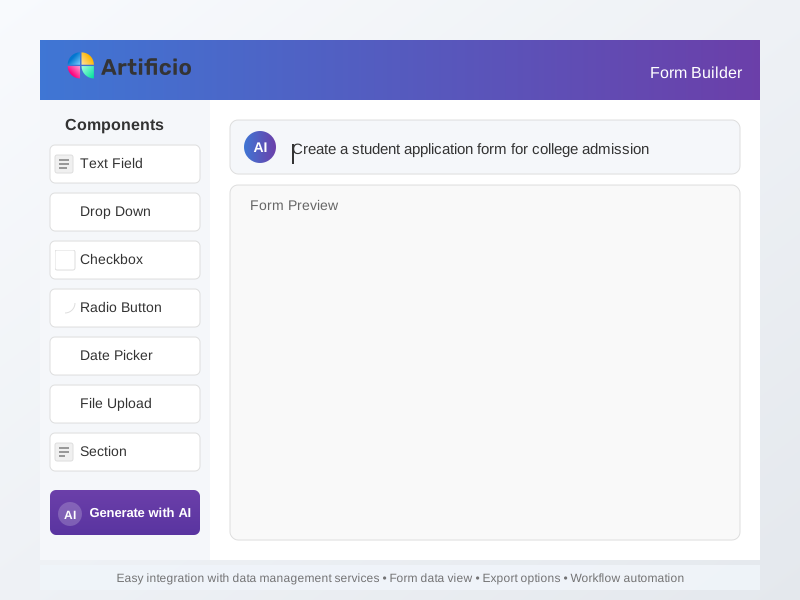
The process begins with the user providing a simple prompt that describes the form's purpose and required information fields. For instance, a user might input: "Create a student application form for college admission." This seemingly straightforward request initiates a complex chain of AI-driven processes. The system first analyzes the semantic content of the prompt, identifying key entities (such as "student," "application," "college admission") and their relationships to determine the form's context and purpose.
Once the system comprehends the form's intended function, it draws upon its knowledge of domain-specific requirements to determine the appropriate fields. In the case of a college application form, the AI understands that standard information categories would include personal details (name, contact information, date of birth), academic background (previous educational institutions, GPA, standardized test scores), program preferences, and potentially supplementary information such as extracurricular activities or personal statements. This domain awareness ensures that the generated form is not merely structurally sound but contextually appropriate for its intended purpose.
The sophistication of Artificio's AI becomes particularly evident in how it handles the structural organization of form elements. Rather than producing a simple list of fields, the system intelligently groups related information into logical sections, creates appropriate hierarchical relationships, and implements conditional logic where necessary. For example, it might organize the college application form into distinct sections for personal information, academic history, and program selection, with each section containing relevant fields arranged in a logical sequence that guides the applicant through a coherent information-gathering journey.
Moreover, the system applies appropriate validation rules based on the nature of each field, ensuring data integrity without requiring the user to manually configure these safeguards. Email fields are automatically validated against standard email formats, required fields are marked accordingly, and numerical fields may be constrained to appropriate ranges. This attention to validation details significantly enhances the quality of data collected through the form while eliminating the technical complexity typically associated with implementing such validations.
The visual design aspects of the form are likewise handled with sophisticated intelligence. Artificio applies responsive design principles to ensure that forms function effectively across device types, implements accessible design patterns that comply with WCAG standards, and maintains visual consistency throughout the form. This is accomplished through a combination of design knowledge embedded within the AI and an understanding of contemporary best practices in user interface design.
Perhaps most remarkably, this entire process occurs in mere seconds, transforming what would traditionally be a labor-intensive task requiring technical expertise into an efficient, accessible process. The underlying technological architecture that enables this capability represents a convergence of advances in machine learning, natural language understanding, and domain-specific knowledge representation, all orchestrated to provide an intuitive, powerful form generation experience.
The marriage of artificial intelligence and user experience design principles within Artificio's form generation system represents a paradigm shift in how we conceptualize the creation of digital interfaces. Traditional approaches to form design have relied heavily on the expertise and intuition of human designers, who must balance numerous considerations including information architecture, visual hierarchy, cognitive load, and accessibility. This process has historically been both labor-intensive and skill-dependent, creating a significant barrier to the creation of truly user-centered forms.
Artificio's AI-driven approach fundamentally transforms this dynamic by embedding sophisticated UX principles directly into the generative algorithms that power the form creation process. The system encapsulates decades of research and best practices in human-computer interaction, applying these principles automatically during the generation process. This embedded intelligence ensures that forms created through natural language prompts adhere to established design standards without requiring the user to possess specialized knowledge of these principles.
Consider the cognitive aspects of form completion from the end-user's perspective. Well-designed forms guide users through a logical progression of information disclosure, grouping related concepts, minimizing unnecessary cognitive burden, and providing clear signposting throughout the journey. Artificio's AI achieves this by analyzing the semantic relationships between different information categories and organizing them into coherent groupings. For instance, when generating a college application form, the system inherently understands that personal identification information constitutes a logical grouping distinct from academic history or program preferences, and structures the form accordingly.
The system's approach to form labeling similarly demonstrates its embedded UX intelligence. Labels are generated with precise, unambiguous language that clearly communicates what information is being requested without introducing confusion or ambiguity. Field descriptions and help text are provided where additional clarification might benefit the user, particularly for complex fields or those requiring specific formatting. This attention to linguistic precision ensures that the end-users completing the form understand exactly what information is being requested and why.
Visual hierarchy, another critical element of effective form design, is automatically implemented through consistent spacing, typography, and color usage that directs the user's attention appropriately through the information gathering sequence. The system applies subtle visual cues to distinguish between required and optional fields, establishes clear relationships between labels and their corresponding input elements, and uses whitespace strategically to create a sense of visual breathing room that reduces the perceived complexity of the form.
Error prevention and handling often overlooked aspects of form design are integrated into the generated forms with sophistication. The AI implements appropriate client-side validations that catch potential errors before submission, provides clear, contextual error messages that explain the nature of any problems, and intelligently places these messages in proximity to the problematic fields. This approach to error handling significantly reduces user frustration and abandonment rates while improving the quality of submitted data.
Accessibility considerations are deeply embedded within the generation process as well. The AI automatically implements ARIA attributes to support screen reader compatibility, ensures sufficient color contrast for visibility, maintains keyboard navigability, and provides alternative text for non-text elements. This systematic approach to accessibility ensures that forms created through Artificio are usable by individuals with diverse abilities and needs, without requiring the form creator to possess specialized knowledge of accessibility guidelines.
Perhaps most remarkably, the system achieves all of this through a deceptively simple interface that masks the tremendous complexity operating beneath the surface. Users need not consciously consider these myriad UX factors, as the AI handles these considerations automatically. This democratization of good design represents one of the most profound implications of AI in interface creation the ability to produce sophisticated, user-centered designs without requiring extensive training or expertise from the creator.
The collection of form submissions represents only the initial phase in the data management lifecycle. The true value of collected information emerges through its organization, accessibility, and actionability. Artificio's Form Data View establishes a centralized repository that transforms raw form submissions into structured, queryable data assets that drive organizational decision-making and operational processes.
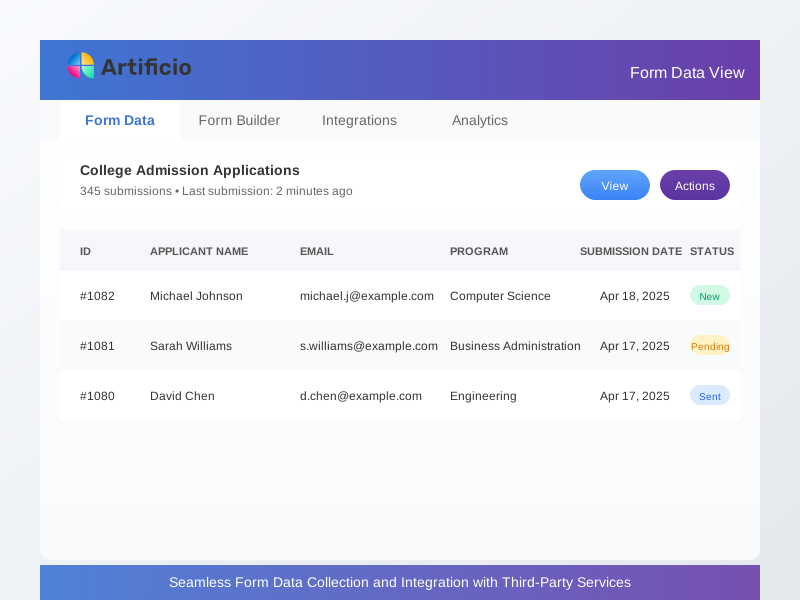
The Form Data View functions as a sophisticated database interface specifically optimized for form-generated data. Upon receiving submissions, the system automatically organizes incoming information according to the form's structure, maintaining relational integrity between different data points and ensuring consistency across submissions. This structured approach allows organizations to maintain clean, organized datasets without requiring manual data manipulation or normalization.
The architectural design of the Form Data View reflects contemporary best practices in data management, implementing a layered approach that separates storage, processing, and presentation concerns. At the storage layer, the system employs robust database technologies that ensure data durability, consistency, and security. Sophisticated indexing strategies optimize query performance, allowing for rapid retrieval even as datasets grow to significant scale. Atomicity guarantees protect against data corruption during simultaneous operations, ensuring that concurrent submissions are processed correctly without data loss or inconsistency.
The processing layer applies intelligent transformations to incoming data, standardizing formats where appropriate, validating submissions against defined rules, and flagging potential anomalies for review. This automated data cleansing significantly reduces the manual overhead traditionally associated with maintaining data quality in large-scale collection systems. For instance, address information might be standardized according to postal conventions, phone numbers formatted consistently regardless of how they were entered, and duplicate submissions identified through sophisticated matching algorithms.
At the presentation layer, the Form Data View offers an intuitive interface that balances comprehensive functionality with usability. Administrators can quickly navigate through submissions, apply filtering criteria across multiple dimensions, sort results according to various attributes, and export selections for external use. The interface employs responsive design principles, ensuring that data remains accessible and manageable across device types from desktop workstations to mobile devices.
Advanced search capabilities further enhance the utility of the Form Data View, allowing users to locate specific submissions through natural language queries or structured parameter combinations. Full-text search across all form fields enables users to quickly locate submissions containing particular keywords, while field-specific filters allow for precise targeting of submissions meeting specific criteria. This search flexibility proves particularly valuable as datasets grow, enabling users to quickly locate relevant information without navigating through extensive datasets manually.
Data visualization components integrated within the Form Data View transform raw submissions into actionable insights through intuitive graphical representations. Trend analyses reveal patterns in submission timing, geographic distributions highlight regional variations in response, and comparative visualizations expose relationships between different form fields. These visualizations enable administrators to quickly identify patterns and anomalies that might remain obscured in tabular representations, facilitating data-driven decision-making without requiring specialized analytical expertise.
Version tracking and audit logging maintain comprehensive records of all interactions with submitted data, creating an immutable history of modifications, exports, and access events. This rigorous approach to change management ensures accountability, supports compliance requirements, and provides a reliable foundation for data governance initiatives. Administrators can review complete histories of each submission, including any modifications made after initial submission, establishing a clear chain of custody for all information within the system.
Security controls are implemented throughout the Form Data View, with role-based access restrictions, field-level permissions, and customizable visibility rules ensuring that sensitive information remains protected. Encryption at rest and in transit safeguards data against unauthorized access, while comprehensive audit mechanisms detect and alert on suspicious access patterns. These security measures are designed to support compliance with various regulatory frameworks including GDPR, HIPAA, and CCPA, depending on the nature of the collected information.
The Form Data View represents a crucial bridge between raw data collection and meaningful organizational action, transforming form submissions from isolated information points into a cohesive, actionable data resource. This centralized approach to data management eliminates the silos commonly associated with form-based collection systems, creating a unified data foundation that supports cross-functional visibility and collaboration.
The true power of digital forms extends far beyond their capacity to collect information; it lies in their ability to initiate automated workflows and distribute data to the systems where it can drive organizational action. Artificio's approach to integration represents a fundamental advancement over traditional form systems, establishing frictionless pathways between collected information and the diverse ecosystem of business applications that depend on this data.
At the architectural level, Artificio implements a sophisticated integration framework built on modern API technologies that facilitate secure, reliable data exchange with external systems. This framework employs a multi-layered architecture that abstracts the complexities of different integration patterns, providing a unified interface through which form data can be channeled to various destinations with minimal configuration overhead. The system supports synchronous and asynchronous communication patterns, accommodating the diverse timing requirements of different integration scenarios from real-time notifications to scheduled batch processing.
The platform's communication capabilities extend across multiple channels, enabling organizations to engage with form submitters through their preferred communication mediums. Email integration allows for the automatic generation and dispatch of personalized messages triggered by form submissions or status changes. These communications can incorporate dynamic content drawn directly from submission data, creating contextually relevant messages that acknowledge receipt, request additional information, or provide updates on processing status. Templates ensure messaging consistency while personalization tokens maintain the human connection essential for effective communication.
SMS integration extends this communication capability to mobile devices, enabling time-sensitive notifications that reach recipients regardless of their email habits. The platform implements optimized message formatting that accommodates the character limitations of SMS while preserving clarity and professionalism. Scheduling capabilities allow organizations to respect recipient time preferences, while delivery confirmation ensures accountability in mission-critical communications.
WhatsApp integration acknowledges the growing importance of messaging platforms in professional communication, particularly in regions where WhatsApp serves as a primary business communication channel. Rich message formatting capabilities, multimedia support, and interactive elements create engaging communication experiences that transcend the limitations of traditional notification systems. This integration is implemented with careful attention to WhatsApp's commercial guidelines, ensuring sustainable, compliant usage of the platform for business communications.
Beyond direct communications, Artificio's integration capabilities extend to core business systems that drive organizational operations. CRM integration enables the automatic creation or enrichment of customer records based on form submissions, eliminating the manual data entry traditionally required to maintain accurate customer information. Sophisticated matching algorithms identify existing records that may correspond to the submission, preventing duplication and maintaining data integrity within the CRM. Bidirectional synchronization ensures that subsequent updates in either system propagate appropriately, maintaining consistency across platforms.
ERP integration enables form data to flow directly into enterprise resource planning systems, triggering inventory adjustments, financial transactions, or resource allocations based on form submissions. This connectivity transforms forms from simple data collection tools into active participants in operational workflows, capable of initiating complex business processes without manual intervention. The integration layer handles the complex data mappings required to translate between form structures and ERP schemas, ensuring that information is correctly positioned within the appropriate ERP modules.
Marketing automation system integration allows form submissions to trigger segmented campaigns, lead nurturing sequences, or personalized marketing journeys. Sophisticated audience mapping ensures that form submitters are added to appropriate marketing segments based on their provided information and behaviors, enabling targeted follow-up without requiring manual audience management. Attribution tracking preserves the connection between marketing initiatives and resulting form submissions, providing clear visibility into campaign effectiveness and return on investment.
Database export capabilities provide flexible pathways for integrating form data with specialized analytical systems or legacy applications that may lack modern API interfaces. Configurable export formats accommodate diverse system requirements, from structured CSV formats to specialized XML schemas or JSON structures. Scheduling options allow organizations to establish regular synchronization patterns that align with analytical processing windows or system availability constraints.
Webhook support extends the platform's integration capabilities to any system capable of receiving HTTP notifications, providing a universal integration mechanism that requires minimal configuration. Organizations can register external endpoints to receive real-time notifications of form submissions or status changes, creating event-driven architectures that respond immediately to new information. This webhook mechanism serves as a powerful extension point, enabling integration with specialized or proprietary systems that may not be directly supported through dedicated connectors.
Perhaps most significantly, all of these integration capabilities are configured through intuitive interfaces that abstract the underlying technical complexity. Administrators can establish sophisticated data flows without writing code or understanding the intricacies of API protocols. Visual workflow builders allow for the definition of conditional logic that determines how and when data should flow to external systems, creating intelligent integration patterns that adapt to the specific characteristics of each submission.
This comprehensive approach to integration transforms forms from isolated data collection points into critical components of the organizational data ecosystem. By eliminating manual data transfer processes and establishing automated pathways between collection and action, Artificio significantly accelerates the speed at which organizations can respond to new information while simultaneously improving data accuracy and consistency across systems.
The versatility of Artificio's AI-powered form system manifests across diverse industry contexts, each with unique data collection requirements, regulatory considerations, and integration needs. Examining specific implementations reveals how the platform adapts to these varied demands while delivering consistent improvements in efficiency, data quality, and user experience.
Academic institutions face particular challenges in managing the complex, document-intensive processes associated with student admissions. Traditional approaches often involve disjointed systems for application collection, document management, interview scheduling, and enrollment processing, creating friction points that impact both administrative efficiency and applicant experience.
A leading private university implemented Artificio's form system to reimagine their graduate program application process, beginning with AI-generated application forms tailored to different academic departments. Rather than maintaining separate form structures manually, department administrators simply described their information requirements conversationally, and the AI generated appropriate application structures complete with program-specific questions, document upload fields, and reference request mechanisms.
The centralized data management capabilities transformed how the admissions committee evaluated candidates. Rather than manually compiling application materials, committee members accessed a unified view that presented all applicant information coherently, including submitted documents, reference letters, and interview notes. Advanced filtering and sorting capabilities enabled them to efficiently compare candidates across multiple dimensions, significantly reducing the administrative overhead associated with application review.
Integration with the university's communication systems automated the applicant journey, sending personalized updates via email as applications progressed through various stages. WhatsApp integration provided immediate notifications for time-sensitive communications such as interview scheduling, while SMS alerts reminded applicants of approaching deadlines for supplementary documentation.
The implementation yielded measurable improvements across key metrics: application completion rates increased by 28% as applicants benefited from a more intuitive submission process; administrative processing time decreased by 63% through automated data handling; and applicant satisfaction scores rose significantly according to post-application surveys. Perhaps most significantly, the admissions staff reported being able to focus more time on meaningful candidate evaluation rather than administrative management of application materials.
Healthcare organizations operate under stringent regulatory requirements regarding data collection, privacy, and security, while simultaneously needing efficient mechanisms to gather critical patient information. These competing demands create particular challenges for digital form implementations in clinical settings.
A multi-facility healthcare network deployed Artificio's system to modernize their patient intake process across both primary care and specialty departments. Using AI generation, they created a modular intake system where common demographic and insurance information formed a consistent core, while specialty-specific clinical questionnaires were dynamically appended based on the appointment type. This modular approach ensured that patients provided all necessary information without answering irrelevant questions, improving both completion rates and data quality.
The Form Data View provided clinical staff with immediate access to completed intake information, eliminating the delays traditionally associated with paper form processing. Integration with the organization's Electronic Health Record (EHR) system ensured that information flowed automatically into patient records, maintaining a single source of truth while eliminating redundant data entry. This integration was implemented with careful attention to HIPAA compliance requirements, maintaining end-to-end encryption and comprehensive audit logging of all data transfers.
In a parallel implementation, the organization's clinical research department utilized the platform for study participant recruitment and data collection. AI-generated screening questionnaires identified eligible participants based on inclusion and exclusion criteria, while electronic consent forms with detailed version tracking ensured proper documentation of informed consent. Integration with the research department's specialized databases automated the creation of participant records, streamlining the administrative aspects of study management.
The impact on operational efficiency was substantial: patient check-in times decreased by an average of 12 minutes per patient, representing significant time savings across thousands of daily encounters. Data accuracy improved markedly, with a 67% reduction in insurance information errors that had previously led to billing complications. Clinical staff reported higher satisfaction with pre-visit information availability, enabling more effective preparation for patient encounters.
Financial institutions face a delicate balance between regulatory compliance, risk management, and customer experience in their data collection processes. Extensive documentation requirements can create significant friction in customer acquisition workflows, while data accuracy is essential for proper risk assessment and regulatory reporting.
A regional banking network implemented Artificio's system to transform their small business loan application process. The AI-generated application form intelligently adapted to different business structures, presenting relevant fields based on whether the applicant operated as a sole proprietorship, partnership, or corporation. This contextual awareness ensured that applicants provided all information relevant to their specific situation without navigating irrelevant sections, significantly improving the application experience.
The Form Data View equipped loan officers with comprehensive visibility into application information, implementing role-based permissions that restricted access to sensitive financial details based on job function. Integration with the bank's credit scoring system automated preliminary eligibility assessments, providing immediate feedback to both applicants and loan officers about potential approval paths. Automated document verification processes checked the consistency of provided information against uploaded financial statements, flagging discrepancies for further review.
Communication automation managed applicant expectations throughout the approval process, providing status updates via their preferred channels and requesting additional documentation when necessary. These automated communications significantly reduced inbound status inquiry calls, freeing customer service resources for more complex support scenarios.
The implementation demonstrated substantial business impact: the application completion rate increased by 34%, representing significant potential revenue that had previously been lost to abandonment; processing time for completed applications decreased by 47%, allowing faster response to customers while maintaining thorough evaluation; and the percentage of applications with missing or inconsistent information decreased by 72%, improving the efficiency of the underwriting process.
Manufacturing organizations operating in global supply chains face complex challenges in vendor onboarding, qualification, and ongoing compliance monitoring. These processes typically involve extensive documentation, multiple stakeholders, and rigorous verification workflows that can create significant administrative overhead.
A global manufacturing firm implemented Artificio's system to standardize their supplier qualification process across international operations. The AI-generated supplier onboarding form incorporated region-specific compliance requirements, automatically presenting appropriate certification and documentation fields based on the supplier's location and the categories of goods or services they provided. This intelligent adaptation ensured complete information collection without overwhelming suppliers with irrelevant requirements.
The Form Data View provided procurement teams with a unified supplier information repository, implementing sophisticated permission structures that allowed different functional groups to access relevant sections of supplier profiles. Automated risk scoring analyzed submitted information to highlight potential compliance concerns, creating an efficient prioritization mechanism for further verification activities. Integration with third-party verification services automated the validation of certifications and credentials, reducing manual verification workload while improving accuracy.
Communication automation managed the multi-stage qualification process, automatically requesting additional documentation or clarification when necessary and providing suppliers with visibility into their approval status. Integration with the organization's ERP system ensured that approved suppliers were automatically added to the procurement system with appropriate categorization and payment terms, eliminating manual data transfer between systems.
The implementation delivered significant operational improvements: the average supplier onboarding time decreased from 47 days to 18 days, accelerating the organization's ability to engage new partners; procurement staff reported spending 64% less time on administrative aspects of supplier management, allowing greater focus on strategic sourcing activities; and supplier compliance documentation completeness improved to 96%, significantly reducing potential regulatory exposure.
Non-profit organizations face particular challenges in collecting information from diverse stakeholders while operating under resource constraints that limit their capacity for administrative overhead. Efficient data collection and management processes are essential for maximizing the resources available for mission-focused activities.
A foundation supporting educational initiatives implemented Artificio's system to transform their grant application and reporting processes. The AI-generated grant application intelligently adapted to different project types and funding tiers, ensuring that applicants provided appropriate detail based on the scale and complexity of their funding requests. This contextual intelligence streamlined the process for smaller grant seekers while collecting comprehensive information for larger funding requests.
The Form Data View provided the grant committee with structured access to application information, implementing comparative views that facilitated evaluation across consistent criteria. Automated preliminary scoring highlighted applications that strongly aligned with the foundation's funding priorities, creating an efficient prioritization mechanism for review. Integration with the foundation's financial systems automated the creation of grant disbursement records, ensuring accurate tracking of allocated funds without manual data entry.
For approved grants, the system generated customized reporting forms that reflected the specific metrics and outcomes established for each project. These reporting forms pre-populated with previous submission data where appropriate, reducing the reporting burden on grantees while ensuring consistent tracking of progress against established goals. Integration with the foundation's impact measurement system aggregated data across multiple grantees, automatically generating portfolio-level insights without manual data compilation.
The implementation yielded measurable improvements in the foundation's operations: the grant processing capacity increased by 41% without additional administrative staffing; evaluation consistency improved significantly as committee members accessed standardized comparison views; and reporting compliance among grantees increased to 94% as the streamlined reporting process reduced barriers to timely submission.
These diverse implementations demonstrate the adaptability of Artificio's form system across different industry contexts, each with unique requirements and constraints. The consistent themes across these varied scenarios improved efficiency, enhanced data quality, and better user experiences illustrate the fundamental value proposition of AI-powered form systems across organizational types.
As artificial intelligence continues its rapid evolution, the landscape of form-based data collection stands on the cusp of transformative advancements that will further revolutionize how organizations gather, process, and leverage information. Emerging capabilities point toward a future where forms transcend their traditional role as passive collection instruments to become intelligent, adaptive interfaces that actively participate in the information exchange process.
Predictive form generation represents a significant frontier in this evolution, where AI systems will move beyond responding to explicit prompts toward anticipating organizational needs based on contextual signals. Future systems will proactively suggest appropriate form structures by analyzing organizational activities, upcoming events, or regulatory changes. For instance, a system might recognize an impending product launch from calendar and project management data, automatically generating appropriate customer feedback forms timed to coincide with the release. This predictive approach will shift form creation from a reactive to a proactive process, ensuring that necessary data collection mechanisms are in place before the explicit need arises.
Conversational form experiences will fundamentally reimagine the interaction model for data collection, replacing traditional field-based layouts with dynamic, dialogue-driven interfaces. These systems will engage submitters in natural conversations, adaptively formulating questions based on previous responses and contextual understanding. Rather than presenting fixed sequences of fields, these interfaces will follow conversational patterns that feel natural to the user while still collecting structured data for organizational use. This approach promises to significantly reduce the perceived friction of form completion, particularly for complex information gathering scenarios that currently require extensive form fields.
Multimodal input capabilities will expand the definition of "form data" beyond text-based entries to encompass rich media, vocal responses, and gestural inputs. Future forms will seamlessly integrate capabilities for collecting images, voice recordings, video submissions, or drawing inputs, analyzing these varied inputs with sophisticated AI to extract structured information. For instance, insurance claim forms might allow policyholders to submit photos of damage that are automatically analyzed to extract relevant details, while healthcare intake might include vocal descriptions of symptoms that are transcribed and coded to appropriate medical terminology. This multimodal approach will create more natural submission experiences while potentially capturing richer, more nuanced information than text fields alone.
Automated verification systems will advance beyond basic validation rules to implement sophisticated truth assessment capabilities that verify submitted information against external sources. These systems will automatically cross-reference submissions with public records, organizational databases, or authorized third-party information sources to confirm accuracy without manual intervention. While implementing appropriate privacy safeguards, these verification mechanisms will dramatically improve data quality by identifying potential inaccuracies or inconsistencies at the point of submission rather than during subsequent processing.
Intelligent form adaptation will create experiences that evolve based on individual user behavior, organizational patterns, and aggregate submission analytics. Forms will learn from interaction patterns to optimize their structure, terminology, and help content for specific user segments or use cases. Fields that consistently cause confusion or abandonment will be automatically reformulated or supplemented with additional guidance, while common submission patterns will inform structural refinements that streamline the process for future submitters. This continuous evolution will ensure that forms become progressively more effective collection instruments without requiring explicit redesign.
Embedded decision intelligence will transform forms from pure collection mechanisms into decision support tools that provide immediate value to both submitters and organizations. Forms will incorporate analytical capabilities that process submitted information in real-time to offer relevant insights, recommendations, or preliminary decisions. For instance, a loan application might instantly calculate preliminary approval odds and potential terms based on submitted financial information, while a medical intake might suggest potential treatment approaches based on reported symptoms and medical history. This immediate feedback transforms the submission experience from a one-way information transfer into a value exchange that benefits all participants.
Cross-submission intelligence will enable forms to recognize relationships between different submissions, identifying patterns or connections that inform organizational understanding. Forms will automatically identify related submissions from the same individual across different organizational touchpoints, recognizing returning customers or clients without requiring explicit authentication. Similarly, the system will identify statistical patterns across submission cohorts, automatically highlighting trends or anomalies that might warrant organizational attention. This relational understanding transforms isolated submissions into a connected knowledge graph that provides richer organizational intelligence.
Ethical AI governance will become increasingly sophisticated as these advanced capabilities evolve, with systems implementing robust frameworks to ensure fairness, transparency, and privacy in data collection processes. Future systems will automatically identify and mitigate potential bias in form structures or processing algorithms, ensure that data collection adheres to evolving privacy regulations across jurisdictions, and provide clear explanations of how submitted information will be used and protected. This governance layer will be essential for maintaining trust as forms become more intelligent and capable of increasingly sophisticated data processing.
The convergence of these emerging capabilities points toward a future where "forms" as we currently understand them may become unrecognizable replaced by intelligent, adaptive interfaces that engage users in natural information exchanges while seamlessly integrating with organizational systems. This evolution will fundamentally transform the relationship between individuals and the organizations they interact with, creating more natural, valuable exchanges that transcend the transactional nature of traditional form submissions.
The evolution of forms from static documents to AI-powered, intelligent interfaces represents far more than a technological advancement; it constitutes a fundamental reimagining of how information flows between individuals and organizations. As we have explored throughout this article, the implications of this transformation extend across all aspects of the data lifecycle from collection and processing to analysis and action.
The democratization of form creation through natural language interfaces eliminates traditional technical barriers, allowing domain experts to directly translate their information needs into functional collection instruments without specialized technical knowledge. This democratization accelerates organizational responsiveness to changing information requirements while ensuring that forms accurately reflect the specific context and purpose for which they are intended. The expertise previously locked within technical specialists now becomes embedded within the AI system itself, available to all organizational stakeholders regardless of their technical background.
The enhanced user experience facilitated by AI-generated forms addresses one of the most persistent challenges in digital interactions: the friction associated with information submission. By implementing sophisticated design principles automatically, these systems create submission experiences that respect user time and attention while still capturing the comprehensive information organizations require. This reduction in friction directly translates to higher completion rates, better data quality, and improved satisfaction among those interacting with the organization.
The centralized data management capabilities transform how organizations leverage collected information, creating unified repositories that eliminate silos while maintaining appropriate access controls. This centralization enables cross-functional visibility that supports collaborative decision-making, comprehensive analysis, and consistent customer experiences across touchpoints. The Form Data View serves as a single source of truth that maintains the integrity and accessibility of valuable information assets.
The seamless integration capabilities fundamentally alter the velocity of organizational processes, eliminating manual data transfers while ensuring that information flows automatically to the systems where it creates value. This connectivity transforms forms from isolated collection points into active participants in organizational workflows, capable of triggering actions, updates, and communications across the technology ecosystem. The elimination of manual handoffs between systems not only improves efficiency but significantly reduces the data errors commonly introduced during transfer processes.
Perhaps most significantly, the intelligence embedded throughout the form lifecycle transforms the nature of the information exchange itself. Forms evolve from passive collection instruments to intelligent interfaces that adapt to context, provide immediate value, and actively participate in the information dialogue. This intelligence manifests in every aspect of the process from creation and submission to processing and integration creating experiences that transcend the traditional concept of "filling out a form."
As we look toward the future of AI-powered forms, we see not merely incremental improvements to existing processes, but a fundamental reconceptualization of how individuals and organizations exchange information. The traditional boundaries between forms, applications, and conversations will continue to blur, creating more natural, intuitive interactions that nevertheless maintain the structure and consistency organizations require. This evolution promises to resolve the longstanding tension between organizational data needs and individual experience, creating value for all participants in the information exchange.
Organizations that embrace this transformative approach to data collection and management position themselves advantageously in an increasingly digital landscape. By implementing systems like Artificio that harness the power of artificial intelligence throughout the form lifecycle, they establish more efficient operations, more responsive customer experiences, and more agile adaptation to changing information requirements. In doing so, they transform what has traditionally been viewed as an administrative necessity the humble form into a strategic asset that creates meaningful value for the organization and those who interact with it.
About Artificio
Artificio is a leading provider of AI-powered business solutions, specializing in intelligent automation for data collection, management, and workflow integration. Our platform combines cutting-edge artificial intelligence with intuitive user interfaces to transform how organizations gather and leverage information. With a focus on creating seamless, efficient experiences for both administrators and end-users, Artificio empowers organizations across industries to reimagine their approach to data collection and management.
For more information about Artificio's AI-powered form solutions and to request a demonstration, visit www.artificio.ai

Head IT Operations - Co Founder of Artificio
See it in your SAP environment
Bring us a document, a process, or a bottleneck. We'll show how Artificio captures, validates, and posts into SAP — then scale from there.
Security & compliance
ISO 27001:2013 certified, SOC 2 Type 2 compliant, GDPR and HIPAA ready. Every agent action is logged, auditable, and runs in isolated environments.