

Blog
AI-Driven Forms: Transforming the Way You Build Forms
Explore how AI is transforming form creation, boosting efficiency, accuracy, and user experience. Learn about AI-powered form generation.

Blog
Explore how AI is transforming form creation, boosting efficiency, accuracy, and user experience. Learn about AI-powered form generation.
In the digital age, forms serve as the primary interface between organizations and their stakeholders, whether they're customers, employees, or partners. Despite their ubiquity and importance, the process of creating forms has remained largely unchanged for decades a tedious exercise in manual configuration, field selection, and layout design. This traditional approach not only consumes valuable time but also introduces inconsistencies and errors that compromise data quality. However, a paradigm shift is underway, one that promises to revolutionize how we conceptualize, design, and implement forms across industries.
Artificial intelligence, once confined to specialized applications in research laboratories, has now permeated everyday business operations, transforming mundane tasks into streamlined, intelligent processes. Form creation, an essential yet often overlooked aspect of business operations, stands at the precipice of an AI-driven revolution. The integration of machine learning algorithms, natural language processing, and predictive analytics into form building platforms marks the beginning of a new era one where forms are not just digital replicas of their paper predecessors but intelligent interfaces that understand context, anticipate needs, and adapt to users.
This article explores the transformative impact of AI on form creation, examining how emerging technologies are redefining efficiency, accuracy, and user experience in data collection. From the mechanics of AI-powered form generation to real-world applications across various industries, we delve into the multifaceted benefits and potential challenges of this technological evolution. As businesses and organizations navigate the increasingly complex digital landscape, understanding the capabilities and implications of AI-driven forms becomes not just advantageous but essential for maintaining competitive edge and operational excellence.
The journey of forms from paper to digital and now to AI-driven interfaces reflects broader technological advancements throughout history. Traditional paper forms, once the backbone of administrative processes, required meticulous design, printing, and distribution. The advent of digital forms in the late 20th century marked a significant improvement, eliminating physical constraints and enabling more efficient data collection. Yet, the core process of creating these digital forms remained largely manual designers and developers painstakingly building field by field, form by form.
The first generation of digital form builders, which emerged in the early 2000s, introduced drag-and-drop interfaces that democratized form creation, allowing non-technical users to design forms without programming knowledge. These platforms, while revolutionary for their time, still required users to manually configure each element, from field types to validation rules, resulting in a time-intensive process fraught with potential for human error.
As cloud computing gained prominence in the 2010s, form building platforms evolved to offer more collaborative features, mobile responsiveness, and integration capabilities. Yet, the fundamental approach to form creation remained unchanged users needed to conceptualize, design, and implement forms through manual configuration. This persistent reliance on manual processes has created bottlenecks in organizational workflows, particularly as data collection needs grow more complex and specialized.
The integration of artificial intelligence into form building platforms represents a quantum leap in this evolutionary timeline. Rather than merely digitizing or streamlining existing processes, AI reimagines the very nature of form creation. The traditional paradigm where users manually select and configure each form element gives way to a conversational, intent-driven approach where AI interprets natural language descriptions to automatically generate complete, functional forms.
This shift fundamentally alters the relationship between users and form building tools. Instead of users adapting to the tool's interface and capabilities, AI-powered platforms adapt to users' intentions and requirements. This human-centered design philosophy makes form creation accessible to a broader audience, transcending technical barriers that have historically limited who could effectively create digital forms.
Moreover, AI-driven form builders learn from each interaction, continuously improving their understanding of form design patterns, field relationships, and user preferences. This evolutionary capability ensures that the platform grows more intuitive and effective with use, creating a virtuous cycle of improved efficiency and user satisfaction.
The transition from manual to AI-driven form creation represents more than just a technological upgrade it embodies a fundamental reimagining of how organizations collect, process, and leverage data. By removing technical barriers and drastically reducing the time and effort required to create forms, AI democratizes data collection and empowers organizations to respond more agilely to changing business needs.
At the heart of AI-driven form creation lies a sophisticated interplay of several artificial intelligence technologies. Natural Language Processing (NLP) forms the foundation, enabling the system to interpret and understand human language inputs the descriptions, requirements, and specifications provided by users. These NLP models analyze text for intent, context, and nuance, extracting the essential information needed to generate appropriate form structures.
Machine learning algorithms complement NLP capabilities by recognizing patterns in form design and user behavior. These algorithms analyze thousands of existing forms and their usage data to identify best practices, common field groupings, and effective layout strategies. By learning from this vast repository of design patterns, the AI can make informed decisions about field types, validation rules, and logical groupings that best serve the described purpose.
Computer vision technologies may also play a role, particularly in platforms that allow users to upload existing form templates or sketches as starting points. These systems can analyze visual inputs to identify form elements, understand their relationships, and translate visual designs into digital form structures.
The technical architecture supporting these AI capabilities typically includes:
This architecture enables a remarkably fluid interaction between users and the form building platform, as illustrated in Figure 1 below.
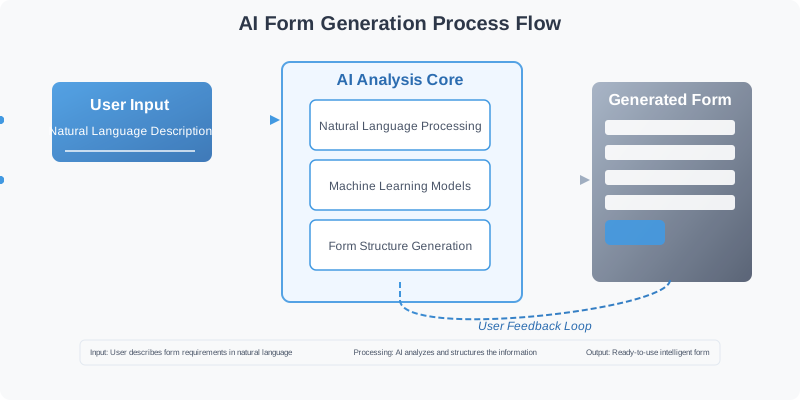
The transformative power of AI in form creation manifests in a streamlined three-step process that replaces dozens of manual configuration actions:
The process begins with users articulating their form requirements in natural language. Unlike traditional form builders that force users to translate their needs into technical specifications, AI-powered platforms accept descriptions in everyday language. Users can specify the purpose of the form, the types of information they need to collect, any conditional logic requirements, and even audience characteristics that might influence design choices.
For example, a user might input: "I need a registration form for a professional conference that collects contact information, dietary preferences, session selections, and payment details. Attendees should see different session options based on their professional role."
This natural language input serves as the seed from which the entire form grows, with the AI interpreting the various components and requirements embedded in the description.
Upon receiving the user's description, the AI system processes the input through its analysis pipeline, making a series of intelligent decisions:
Within seconds, the AI transforms the textual description into a complete, functional form structure. This represents a dramatic compression of what traditionally might take hours of manual configuration into mere moments.
The generated form serves as an intelligent starting point rather than an immutable end product. Users maintain full control to review the AI's work, make adjustments to better align with specific requirements, and apply organizational branding or styling preferences.
This step acknowledges the importance of human oversight while leveraging AI to eliminate the bulk of repetitive, technical work. Once satisfied with the form's structure and appearance, users can immediately deploy it through various channels embedding it on websites, sharing via email, or integrating it with other business systems.
The efficiency of this three-step process becomes particularly evident when visualized alongside the traditional form creation workflow, as shown in Figure 2.
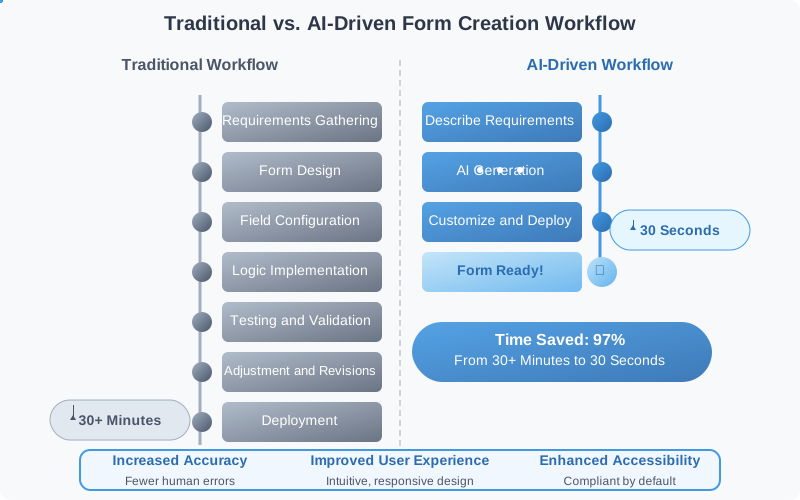
This streamlined process dramatically alters the economics of form creation, transforming a task that once required specialized knowledge and significant time investment into an accessible activity that any business professional can complete in minutes rather than hours.
While the speed of AI-driven form creation reducing 30-minute processes to 30 seconds represents an obvious efficiency gain, the implications extend far beyond simple time savings. This compression of the form creation process fundamentally alters organizational agility and resource allocation.
In traditional environments, form creation often becomes a bottleneck in broader business processes. Marketing campaigns await lead capture forms; HR initiatives stall until appropriate applications are built; research projects delay until survey instruments are finalized. By removing this bottleneck, AI-powered form creation enables organizations to respond more rapidly to emerging opportunities and challenges.
The resource implications are equally significant. In many organizations, form creation requires involvement from multiple stakeholders business experts to define requirements, designers to create layouts, developers to implement logic, and quality assurance personnel to verify functionality. AI-driven approaches consolidate these responsibilities, allowing organizations to deploy specialized talent toward higher-value activities rather than routine form configuration.
This optimization creates cascading efficiency gains throughout the organization. When forms can be created in minutes rather than days, processes that depend on these forms accelerate correspondingly. Project timelines compress, initiatives launch sooner, and organizations capture value more rapidly.
Beyond speed, AI-driven form creation addresses a fundamental challenge in data collection: ensuring consistency and quality in the collected information. Traditional manual form building introduces numerous opportunities for error forgotten validation rules, inconsistent field types, logical contradictions in form flow, and accessibility oversights among them.
AI-powered platforms significantly mitigate these risks through several mechanisms:
These error-reduction capabilities translate directly into higher-quality data, which in turn supports more reliable analysis, decision-making, and automation. The improvement in data quality represents a significant but often overlooked benefit of AI-driven form creation one that compounds over time as organizations build their data assets.
Perhaps the most transformative aspect of AI-driven form builders is their democratization of form creation capabilities. Traditional form development required technical knowledge understanding of HTML, CSS, JavaScript, validation patterns, and accessibility guidelines. This technical barrier limited who could create forms, often concentrating this capability within IT departments or specialized roles.
AI-powered platforms fundamentally alter this dynamic by translating natural language descriptions into technical implementations. This translation layer makes form creation accessible to virtually anyone who can articulate their requirements, regardless of technical background. The marketing manager, HR specialist, field researcher, or small business owner can now independently create sophisticated forms without developer assistance.
This democratization has profound implications for organizational dynamics and innovation:
This democratization effect transcends simple efficiency gains, fundamentally altering who participates in digital transformation initiatives and how quickly organizations can adapt to changing requirements.
AI-driven form builders don't just improve the experience for form creators they enhance the experience for form respondents as well. By applying learned patterns from successful forms and incorporating best practices in UX design, AI-generated forms typically offer superior usability compared to hastily assembled manual creations.
Key user experience enhancements include:
Particularly noteworthy is how AI-driven platforms address accessibility a critical consideration often overlooked in manual form creation. These systems automatically implement accessibility best practices, including:
By building these considerations directly into the generation process, AI-powered form builders ensure that organizations create inclusive experiences by default rather than as an afterthought, helping them meet both ethical obligations and legal requirements around digital accessibility.
For small businesses operating with limited resources, AI-driven form creation offers particularly transformative potential. Consider the scenario of a boutique retailer planning a flash sale. In a traditional environment, creating an order form that captures product selections, customer information, and delivery preferences might require hiring a developer or struggling with limited template options.
With AI-powered form creation, the business owner can simply describe the sale requirements in plain language and receive a fully functional order form within seconds. This form can be customized with the business's branding, embedded on their website, and pushed to customers via email or social media all within minutes rather than days.
This capability proves especially valuable during unexpected events or opportunities. When a local festival announces a last-minute vendor opportunity, a craft business can quickly create application forms. When supply chain disruptions require customer preference surveys, a restaurant can deploy them immediately. This operational agility allows small businesses to compete more effectively against larger organizations with dedicated technical teams.
Real-world implementations demonstrate this impact. A regional bakery used AI-generated forms to quickly pivot during pandemic restrictions, creating custom order forms that integrated with their delivery scheduling system. What would have been a weeks-long development project using traditional methods was accomplished in an afternoon, allowing the business to maintain revenue streams despite disrupted operations.
While small businesses benefit from the agility AI-driven forms provide, enterprises gain equally significant advantages through standardization and workflow integration. Large organizations typically manage hundreds or thousands of forms across departments, creating substantial challenges in maintaining consistency, compliance, and data interoperability.
AI-powered form platforms address these challenges by enforcing consistent design patterns and data structures across the organization. When the marketing department, HR team, and customer service group all use the same AI-driven platform, the resulting forms share common structures and data formats despite serving different purposes. This consistency simplifies data integration, reporting, and analysis across organizational boundaries.
Moreover, enterprise workflows often involve complex approval processes and integration requirements. AI-driven platforms excel at generating forms that connect seamlessly with these workflows, automatically implementing the necessary hooks and data mappings to enterprise systems. Form data flows directly into CRM systems, ERP platforms, or custom databases without manual intervention.
A multinational manufacturing company exemplifies this benefit in their equipment inspection process. Previously, different facilities used inconsistent inspection forms created by local teams, making company-wide analysis nearly impossible. After implementing an AI-driven form solution, they established a standardized approach where site managers could create customized inspection forms that nevertheless maintained consistent data structures. The result was a 64% reduction in form creation time and a 42% improvement in data quality, enabling previously impossible cross-facility analysis of equipment performance.
The healthcare sector presents unique challenges for form creation, requiring careful balance between personalized patient experiences and strict regulatory compliance. Medical intake forms, consent documents, and treatment plans must simultaneously gather comprehensive information, maintain patient engagement, and adhere to HIPAA and other regulatory requirements.
AI-driven form creation offers a powerful solution to this complex challenge. Healthcare providers can describe their information needs in plain language, and the AI system trained on healthcare-specific patterns and compliance requirements can generate forms that meet both clinical and regulatory needs.
These systems excel at creating dynamic healthcare forms that adapt to patient circumstances. Initial screening questions can trigger appropriate follow-up fields, ensuring that patients provide comprehensive information without wading through irrelevant questions. This adaptive approach improves both completion rates and information quality while reducing patient frustration.
A regional healthcare network implemented AI-driven forms for their pre-surgical screening process, replacing 17 different paper and basic electronic forms with a unified, intelligent digital system. The AI-generated forms automatically implemented required disclaimers, accessibility features, and conditional logic based on procedure types. Beyond the immediate efficiency gains for staff, the system improved patient preparation by providing procedure-specific instructions based on form responses, reducing day-of-surgery cancellations by 23%.
Educational institutions face increasing pressure to personalize learning experiences while maintaining assessment rigor. AI-driven form creation supports this balance by enabling educators to rapidly develop customized assessments, feedback forms, and learning evaluations.
Rather than relying on generic template assessments, teachers can describe specific learning objectives, student characteristics, and assessment criteria to generate tailored evaluation instruments. These forms can incorporate various question types—from multiple choice and short answer to file uploads and multimedia responses—to assess different aspects of student understanding.
The dynamic capabilities of AI-generated forms prove particularly valuable in educational contexts, allowing for adaptive assessments that adjust difficulty based on student responses or present different question paths based on demonstrated knowledge areas. This adaptivity supports differentiated instruction within a single assessment tool.
A university psychology department implemented AI-driven forms for research studies and course evaluations, reducing form development time by 76% while increasing response completeness in student surveys by 31%. The department particularly valued the ability to rapidly iterate on assessment design based on preliminary results, creating a more responsive and evidence-based approach to educational measurement.
While AI excels at rapidly generating standardized forms based on requirements, organizations still need to maintain their unique identity and address specific use cases. The most effective AI-driven form platforms recognize this need by striking a thoughtful balance between automation and customization.
Rather than presenting AI-generated forms as finished products, these platforms position them as intelligent starting points—foundations that users can refine, enhance, and personalize. This approach preserves the efficiency benefits of AI while acknowledging the importance of human judgment and organizational context.
Customization capabilities typically include:
This customization layer ensures that AI serves as an accelerator rather than a constraint, amplifying human creativity rather than replacing it. Organizations maintain full control over their forms' appearance and behavior while eliminating the tedious technical implementation work.
Beyond basic customization, sophisticated form applications often require complex logic, multi-step workflows, and intricate data processing. AI-driven platforms increasingly support these advanced requirements through both automated inference and specialized instruction.
When a user describes form requirements that imply complex relationships such as multi-stage approval processes, calculation-driven fields, or branching logic paths advanced AI systems can automatically implement appropriate structures and relationships. For example, describing a "capital expenditure request form with departmental and financial approval workflows based on request amount" might trigger the AI to generate a multi-step form with conditional approval routing.
For highly specialized requirements, these platforms typically provide methods to augment the natural language description with more technical instructions. Users can specify calculation formulas, complex validation rules, or integration parameters that the AI might not infer from general descriptions.
This two-tiered approach automatic inference for common patterns and explicit instruction for specialized requirements allows AI-driven platforms to accommodate increasingly complex form scenarios while maintaining their accessibility to non-technical users.
Organizations operating in regulated industries face additional considerations around form creation, including legal disclaimers, data handling requirements, accessibility standards, and audit capabilities. AI-driven form platforms address these governance requirements through both preventive and detective controls.
Preventive governance features include:
Detective governance capabilities provide oversight after forms are created:
These governance capabilities ensure that the democratization of form creation doesn't compromise organizational control or compliance posture. By embedding governance into the creation process itself, organizations can simultaneously accelerate form development and strengthen their risk management capabilities.
The current generation of AI-driven form builders primarily focuses on initial form creation translating requirements into functional forms quickly and accurately. However, the next evolution in this technology will likely shift toward continuous optimization throughout the form lifecycle.
Emerging systems analyze form performance in real-time, identifying abandonment points, confusion patterns, and completion challenges. Based on this analysis, the AI can suggest or automatically implement improvements to address identified issues. For example, if users consistently hesitate on a particular question or frequently abandon the form at a specific step, the system might recommend rewording, reordering, or restructuring to improve completion rates.
This continuous optimization approach transforms forms from static documents into evolving systems that improve through usage. Rather than creating and forgetting forms, organizations can maintain forms that automatically adapt to user behavior and performance data, creating increasingly effective data collection instruments over time.
Some platforms already implement early versions of this capability, automatically A/B testing different form variations and applying successful patterns to future generations. As these systems mature, the distinction between form creation and form optimization will blur, resulting in continuously evolving data collection tools.
While current AI-driven form builders primarily work from textual descriptions, future platforms will likely incorporate multimodal inputs allowing users to create forms through various communication channels and methods. Voice instructions, hand-drawn sketches, existing document examples, and even video demonstrations might serve as starting points for form generation.
This expansion of input modalities will further democratize form creation, accommodating different thinking and communication styles. A visual thinker might sketch a form layout that the AI interprets and implements, while a verbal processor might dictate form requirements that transform into functional structures.
Simultaneously, the forms themselves are evolving beyond traditional field-and-button interfaces toward more conversational experiences. AI-generated conversational forms present questions in natural language, adapt based on previous responses, and create more engaging user experiences. These chat-like interfaces can significantly improve completion rates for complex data collection scenarios, particularly on mobile devices where traditional form interactions can be cumbersome.
The convergence of multimodal inputs and conversational outputs creates a more natural interaction model for both form creators and respondents, further reducing friction in the data collection process.
Perhaps the most transformative development on the horizon is the integration of form creation systems with broader AI capabilities and data ecosystems. Rather than existing as isolated tools, AI-driven form builders will increasingly connect with other intelligent systems throughout the organization.
Potential integrations include:
These integrations position forms not as standalone data collection tools but as integral components of intelligent information systems sensing mechanisms that gather precisely the data needed for organizational decision-making and automation.
As illustrated in Figure 3, this evolution creates a virtuous cycle where forms become both consumers and producers of organizational intelligence.
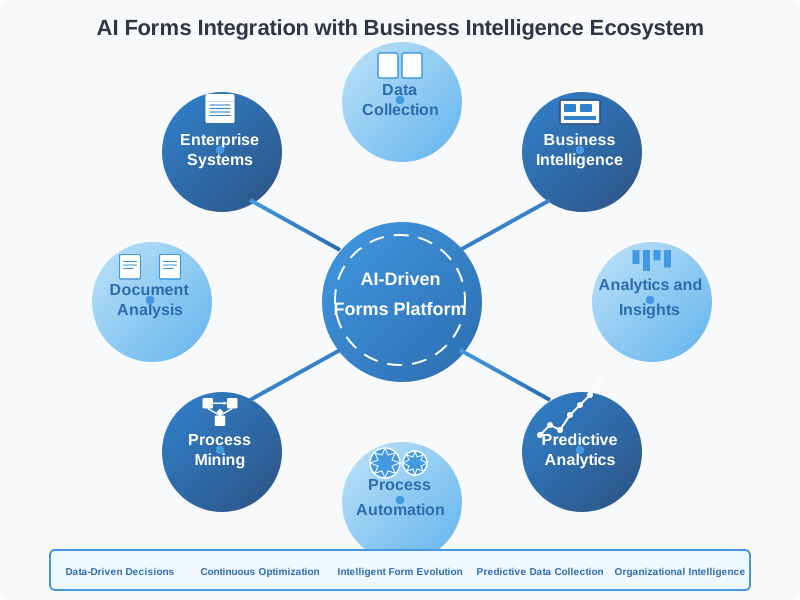
This integrated approach transforms forms from passive data collection instruments into active participants in organizational intelligence tools that not only capture information but help determine what information should be captured and how it should be used.
As organizations consider adopting AI-driven form creation tools, several evaluation criteria emerge as particularly important for assessing platform capabilities:
Organizations should conduct structured evaluations that include both technical assessments and user testing, involving stakeholders from various departments to ensure the platform meets diverse needs.
While AI-driven form builders significantly reduce technical barriers, successful implementation still requires thoughtful change management to overcome organizational inertia and establish new workflows. Effective adoption strategies typically include:
Organizations that approach AI-driven form adoption as a sociotechnical change rather than merely a software implementation achieve significantly higher adoption rates and realized benefits.
As with any technology that democratizes capabilities, AI-driven form creation brings potential security and compliance considerations. The ability for anyone to create forms potentially increases the surface area for data collection errors, privacy violations, or security vulnerabilities.
Organizations can mitigate these risks through several approaches:
These governance mechanisms allow organizations to balance the innovation benefits of democratized form creation with appropriate risk management, ensuring that increased agility doesn't compromise security posture.
As we have explored throughout this article, AI-driven form creation represents far more than an incremental improvement in administrative efficiency. It embodies a fundamental transformation in how organizations conceptualize, implement, and optimize their data collection strategies. By dramatically reducing the technical and temporal barriers to form creation, these systems enable a more responsive, adaptive approach to organizational information gathering.
The implications extend beyond operational improvements, touching on strategic organizational capabilities:
As AI continues to evolve and integrate with broader business intelligence ecosystems, forms will increasingly transform from passive data collection instruments into active participants in organizational knowledge systems tools that not only gather information but help determine what information to gather and how to use it effectively.
Organizations that recognize and embrace this paradigm shift will find themselves with a significant advantage in the increasingly data-driven business landscape. Those that continue to view forms as mere administrative tools rather than strategic assets risk falling behind more agile competitors who have harnessed the transformative power of AI-driven form creation.
The future of forms is not just digital but intelligent responsive to both creator and respondent needs, constantly evolving based on performance data, and seamlessly integrated with broader organizational systems. This future is arriving rapidly, and forward-thinking organizations are already positioning themselves to capitalize on its potential.
About Artificio
Artificio leverages AI and machine learning to transform document processing across industries. Our platform offers both pre-trained and custom-trained models for extracting data from invoices, contracts, medical records, and more. With intuitive annotation tools, automated extraction capabilities, and comprehensive analytics, Artificio helps businesses streamline data management, improve accuracy, and make better-informed decisions. Built with security, scalability, and compliance at its core, Artificio is the trusted partner for organizations seeking to unlock the full potential of their document data.

Head IT Operations - Co Founder of Artificio
See it in your SAP environment
Bring us a document, a process, or a bottleneck. We'll show how Artificio captures, validates, and posts into SAP — then scale from there.
Security & compliance
ISO 27001:2013 certified, SOC 2 Type 2 compliant, GDPR and HIPAA ready. Every agent action is logged, auditable, and runs in isolated environments.