Your OpenText VIM renewal invoice just landed. You scan the number, wince, and then open a ticket because the invoice matching workflow broke again after the last patch. Sound familiar?
If you run accounts payable operations on SAP and you have been on VIM for five or more years, this is not a hypothetical. It is Tuesday. The maintenance fees keep climbing. The system that was sold as a productivity multiplier now requires its own support ecosystem just to stay operational. And every time SAP releases a major update, the VIM team braces for another round of compatibility work that costs more than anyone budgeted.
This post is a direct, practical comparison of OpenText VIM and Artificio for SAP-connected invoice processing. No vague claims. Just a clear breakdown of where VIM falls short today, what Artificio does differently, and what the transition actually looks like.
The VIM Promise vs. The VIM Reality
OpenText Vendor Invoice Management has been the dominant SAP AP automation solution for well over a decade. At its peak, VIM solved a real problem: SAP's native AP functionality was not built for high-volume, multi-format invoice processing. VIM plugged that gap with a structured workflow engine, tight SAP integration, and a familiar on-premise deployment model.
The problem is that the world it was designed for no longer exists.
Invoice formats have multiplied. E-invoicing mandates vary by country and keep changing. Vendor portals, EDI connections, email inboxes, and PDF attachments all land in the same AP queue. VIM was architected before AI-based extraction became viable. Its core relies on rules-based OCR and rigid template mapping, which means every new vendor format potentially requires a new template. Your VIM admin knows exactly which vendors have broken extraction this quarter because they built and maintain those templates manually.
The maintenance fee you are paying does not just cover software access. It covers the cost of OpenText keeping a 15-year-old architecture compatible with modern SAP environments. And that cost gets passed to you.
The practical reality for most VIM customers in 2025 looks like this: extraction accuracy somewhere between 70-85% on complex invoices, significant IT involvement for any configuration change, exception queues that require manual review from AP staff, and upgrade projects that consume months of internal resource. The business case that justified VIM's original purchase has quietly eroded.
What Artificio Does Differently
Artificio was built from the ground up as an AI-native document processing platform. This is not a rebrand of OCR software with a machine learning layer added on top. The extraction engine uses large language model reasoning at its core, which means it reads invoices the way a trained human would rather than pattern-matching against predefined templates.
The practical difference shows up immediately on edge cases: non-standard layouts, handwritten annotations, partially scanned pages, invoices where the vendor name appears only in a footer, or line items spread across tables that break awkwardly across pages. VIM needs a template for each of these. Artificio handles them without any configuration.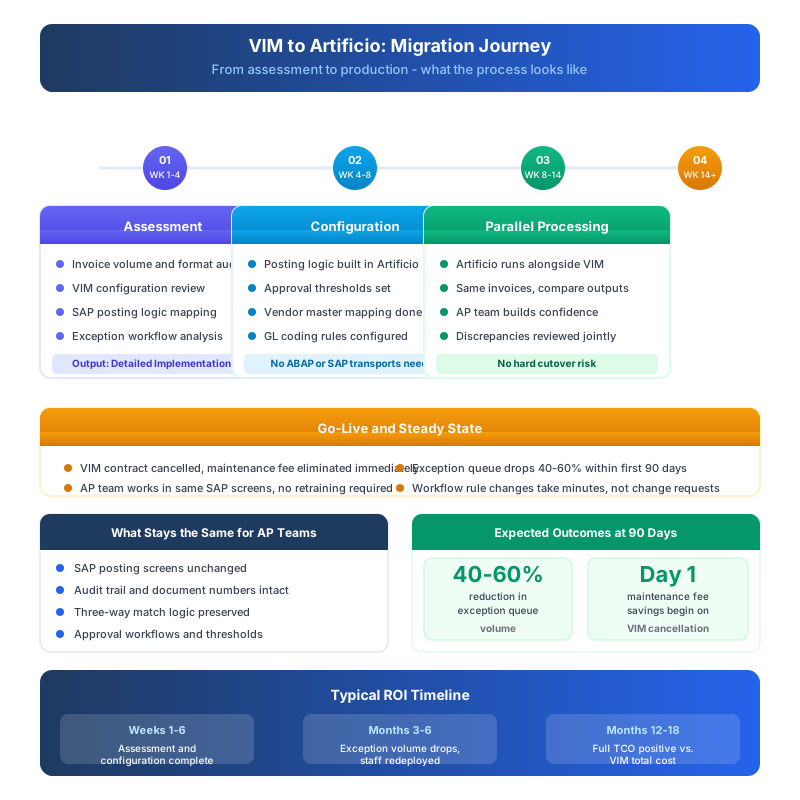
The SAP integration story is equally different. Artificio connects to both SAP ECC and SAP S/4HANA through standard APIs and certified connectors. Invoice data flows into your existing SAP posting workflows without requiring you to rearchitect anything. The AP team sees invoices in the same SAP screens they already use. The difference is that by the time an invoice reaches them, the extraction, validation, and three-way matching has already happened. They are approving, not typing.
Artificio also handles the pre-SAP complexity that VIM pushes back onto your team. Multi-format ingestion from email, shared drives, vendor portals, EDI, and direct API connections all feed into a single processing pipeline. Tax compliance for e-invoicing mandates across different countries is handled at the platform level rather than as a custom implementation project.
The Cost Comparison: VIM's True TCO vs. Artificio
Most VIM customers underestimate their true total cost of ownership because the expenses are distributed across multiple budget lines.
Start with the obvious: annual maintenance fees to OpenText typically run 18-22% of the original license cost per year. For a mid-size enterprise with a VIM license in the $200,000-$500,000 range, that is $36,000-$110,000 annually before you touch anything. Then add what rarely appears in a vendor comparison but absolutely should.
Template maintenance is a hidden labor sink. Every new vendor format, every supplier rebrand, every layout change from an existing vendor requires a VIM admin or consultant to update templates. AP teams routinely estimate 5-15 hours per new template, and active vendor pools often see 20-50 template changes per year. That is developer time that costs real money.
Upgrade projects deserve their own line. When SAP releases a major update, VIM compatibility work typically requires a dedicated project. Customers on older VIM versions who have delayed upgrades often face a $50,000-$200,000 remediation project to get current. Many VIM customers are deliberately running old versions specifically to avoid this cost.
Exception handling is the quietest cost of all. When VIM extraction fails or produces low-confidence output, an invoice goes into an exception queue. Someone on your AP team works that queue. At high invoice volumes, exception handling can consume 20-30% of AP staff capacity. That is a staffing cost directly attributable to extraction limitations.
Artificio's pricing model is transparent and consumption-based. You pay for invoices processed rather than a large upfront license plus annual maintenance. Implementation costs are lower because template configuration does not exist in the same form. And because AI extraction achieves higher accuracy rates on first pass, exception queue volume drops substantially, which reduces ongoing labor cost.
For most organizations processing 20,000+ invoices per year, the math shifts in Artificio's favor within the first 12-18 months.
The most common concern from VIM customers evaluating alternatives is SAP integration. VIM's pitch has always been that it is deeply embedded in SAP. The concern is that any replacement will require rebuilding workflows from scratch.
This concern is understandable but overstated. Here is what the actual integration looks like.
Artificio connects to SAP through standard RFC calls and IDoc processing on ECC, and through the Business Technology Platform APIs on S/4HANA. Invoice header data, line items, tax amounts, payment terms, and vendor master references all post directly to the relevant SAP tables. Three-way matching against purchase orders and goods receipts runs within the Artificio processing pipeline and posts results back to SAP, flagging matches and exceptions before the invoice reaches a human approver.
The approval workflow stays inside SAP if that is what your team prefers. Artificio can route exceptions and approval requests through SAP workflow, through email, or through a standalone web interface. Your AP team does not need to learn a new system for their day-to-day work.
What does change is the configuration model. VIM workflows are configured inside SAP's proprietary environment, which means changes require ABAP knowledge and transport management. Artificio's workflow configuration lives in a web-based interface that AP operations managers can adjust without IT involvement. Adding a new approval threshold, changing a routing rule, or adding a new vendor exception takes minutes rather than a change request.
For organizations running SAP ECC who are not yet on S/4HANA, Artificio provides a migration-proof architecture. The integration layer works with ECC today and will work with S/4HANA when you upgrade, without requiring a parallel VIM remediation project.
Who Switches, and Why Now
The VIM customers who move to Artificio tend to share a few common triggers.
The maintenance renewal conversation is often the catalyst. When the OpenText invoice lands and someone asks what the organization is actually getting for that spend, the honest answer is increasingly unsatisfying. The system works, but it works in the same way it worked five years ago. There has been no meaningful improvement in extraction accuracy. The exception queue is the same size.
Acquisition and consolidation is another driver. When an organization adds a new entity with different ERP infrastructure, VIM's SAP-specific architecture creates a gap. Artificio handles invoices from SAP and non-SAP sources through the same pipeline, which matters when a business unit runs NetSuite or Oracle alongside SAP.
E-invoicing compliance pressure is accelerating the timeline. The wave of global e-invoicing mandates, covering countries across Europe, Latin America, and parts of Asia, requires structured data extraction that maps to country-specific schemas. VIM customers are typically managing this through custom development or third-party add-ons. Artificio handles e-invoice formats natively as part of the core platform.
Finally, there is the AI credibility gap. Finance leadership has watched AI transform adjacent areas of the business. When AP operations are still running on rules-based OCR from the early 2010s, the question of why becomes harder to answer.
What Migration Actually Looks Like
The word "migration" carries more fear than this transition deserves. Here is the practical breakdown.
The assessment phase typically takes two to four weeks. Artificio's team reviews your current VIM configuration, invoice volume and format distribution, SAP posting logic, and existing exception workflows. This produces a concrete implementation plan with no surprises about complexity or timeline.
Data migration is minimal because VIM and Artificio do not share the same data model. Historical invoices stay in SAP, where they always lived. VIM-specific workflow tables are not migrated. What gets configured in Artificio is your posting logic, approval thresholds, vendor master mapping, and GL coding rules. This configuration work typically takes four to eight weeks depending on complexity.
The go-live approach is parallel processing. Artificio runs alongside VIM for three to six weeks, processing the same invoices. Your team compares outputs and builds confidence before VIM is switched off. This eliminates the risk of a hard cutover and lets your AP team develop familiarity at their own pace.
After go-live, the VIM maintenance contract becomes an immediate cost reduction. Organizations that have gone through this process typically report exception queue volume dropping by 40-60% within the first quarter, with AP staff redeployed to higher-value tasks.
The Questions VIM Customers Actually Ask
"What happens to our VIM configuration?" Your ABAP workflow logic gets translated into Artificio's configuration model. The business rules stay the same. The technical implementation is rebuilt in a more maintainable environment.
"Will this break our SAP audit trail?" No. Artificio posts to SAP through standard interfaces. Every posting carries the same SAP document numbers, user references, and timestamps that your auditors expect to see.
"Can we handle our exceptions in SAP still?" Yes. Exception routing through SAP workflow is a supported configuration option.
"How does Artificio handle our high-complexity vendors?" This is the question that usually ends the VIM conversation. Vendors with non-standard invoice formats, handwritten remittance, or inconsistent layouts are exactly where AI extraction outperforms template-based OCR. The harder the invoice, the larger the gap.
"What does support look like after go-live?" Artificio includes dedicated implementation support and an ongoing customer success engagement. Configuration changes do not require raising tickets with OpenText and waiting for a consultant to become available.
Making the Decision
VIM was the right answer for a long time. The installed base is large because the product solved a real problem when it launched. But the technology has not kept pace with the scale of change in invoice processing, and the cost structure reflects a legacy licensing model that does not align with how modern enterprises want to buy software.
If your organization is processing 10,000 or more invoices annually, paying meaningful VIM maintenance fees, and dealing with any combination of exception queue volume, template maintenance burden, or compliance complexity, the math of switching has likely already crossed into positive territory. The question is timing.
Artificio is not a risky bet on an unproven technology. The platform runs in production across enterprise environments in finance, logistics, manufacturing, and healthcare. The SAP integration is certified. The implementation methodology is mature.
The VIM renewal that just landed does not have to be the last one. But it could be.