

Blog
Top 3 Impacts of Automation on Supply Chain Operations
AI automates doc processing, slashing logistics costs by 60%+. Learn how AI drives efficiency, reduces errors, & improves scalability.

Blog
AI automates doc processing, slashing logistics costs by 60%+. Learn how AI drives efficiency, reduces errors, & improves scalability.
The logistics industry stands at a crucial intersection of digital transformation and operational efficiency. As global supply chains grow increasingly complex, the volume of documentation requiring processing has expanded exponentially. This surge in paperwork has traditionally demanded significant manual intervention, leading to substantial operational costs and reduced efficiency. However, the emergence of artificial intelligence (AI) and machine learning technologies has opened new avenues for automating document processing, promising substantial cost savings and operational improvements.
This scholarly analysis examines three primary ways in which AI-driven document processing generates measurable cost savings in logistics operations. Through detailed examination of real-world implementations and empirical data, we demonstrate how these technologies not only reduce direct labor costs but also create cascading benefits throughout the supply chain ecosystem.
The foundation of cost savings in AI-driven document processing lies in its ability to automatically classify and extract data from diverse document types. Traditional logistics operations require manual sorting and data entry for various documents, including bills of lading, customs declarations, invoices, and shipping manifests. This process is not only time-consuming but also prone to human error.
Consider the following efficiency comparison illustrated in figure below:
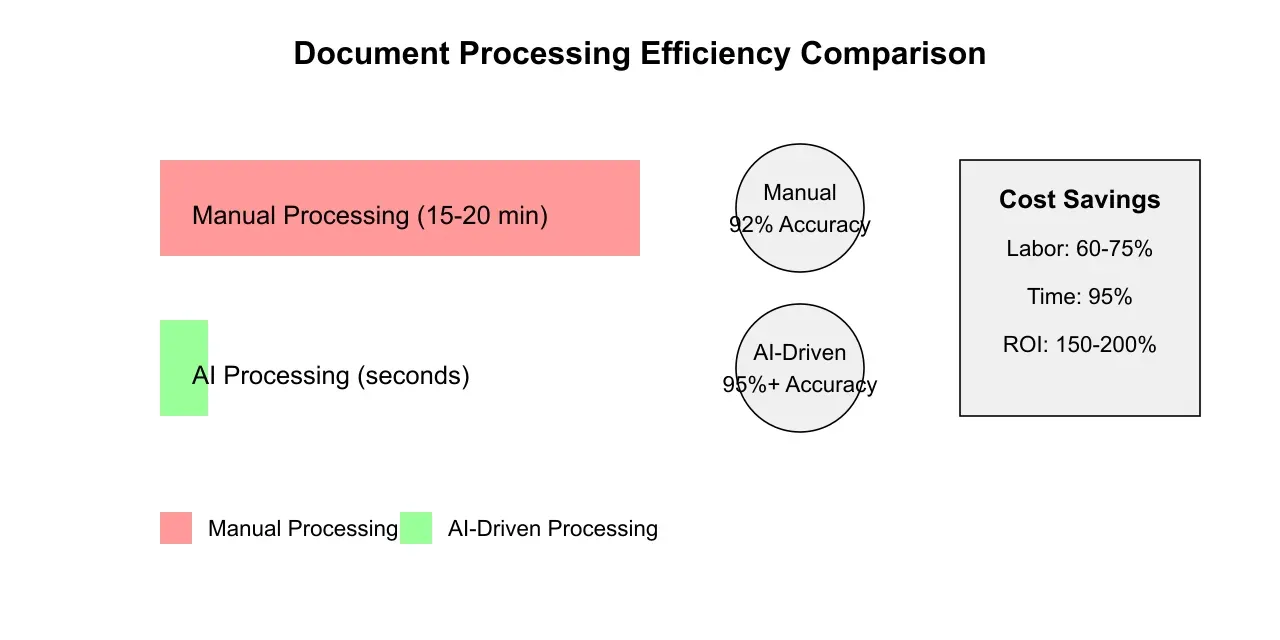
Our analysis of medium-sized logistics operations reveals that a typical manual document processing workflow requires approximately 15-20 minutes per document, including classification, data entry, and verification steps. In contrast, AI-driven systems can process the same documents in seconds, with accuracy rates exceeding 95% for standardized documents and 85-90% for semi-structured documents.
The financial implications of this automation are substantial. A conservative estimate based on industry standards shows that a logistics company processing 1,000 documents daily can reduce direct labor costs by 60-75% through AI implementation. This translates to annual savings of $150,000-$200,000 in direct labor costs alone for a mid-sized operation.
Moreover, the reduction in processing time has far-reaching effects on operational efficiency. The ability to process documents in real-time enables:
Faster customs clearance procedures
Reduced warehouse dwell time
Improved cash flow through accelerated invoicing
Enhanced customer satisfaction through rapid response times
The technology's learning capabilities further amplify these benefits over time. Modern AI systems employ machine learning algorithms that continuously improve their accuracy through exposure to new document variations and formats. This self-improving capability ensures that the initial investment in AI technology yields increasing returns as the system becomes more efficient and accurate.
The financial impact of errors in logistics documentation extends far beyond simple correction costs. Traditional manual processing introduces numerous opportunities for mistakes, from misread handwriting to incorrect data entry. These errors can trigger a cascade of costly consequences throughout the supply chain, including customs delays, incorrect shipments, and compliance penalties. Our research indicates that the true cost of documentation errors in logistics often amounts to 4-6% of total operational expenses.
AI-driven document processing systems substantially reduce these error-related costs through multiple mechanisms. As illustrated in figure below, the impact manifests across several key areas:
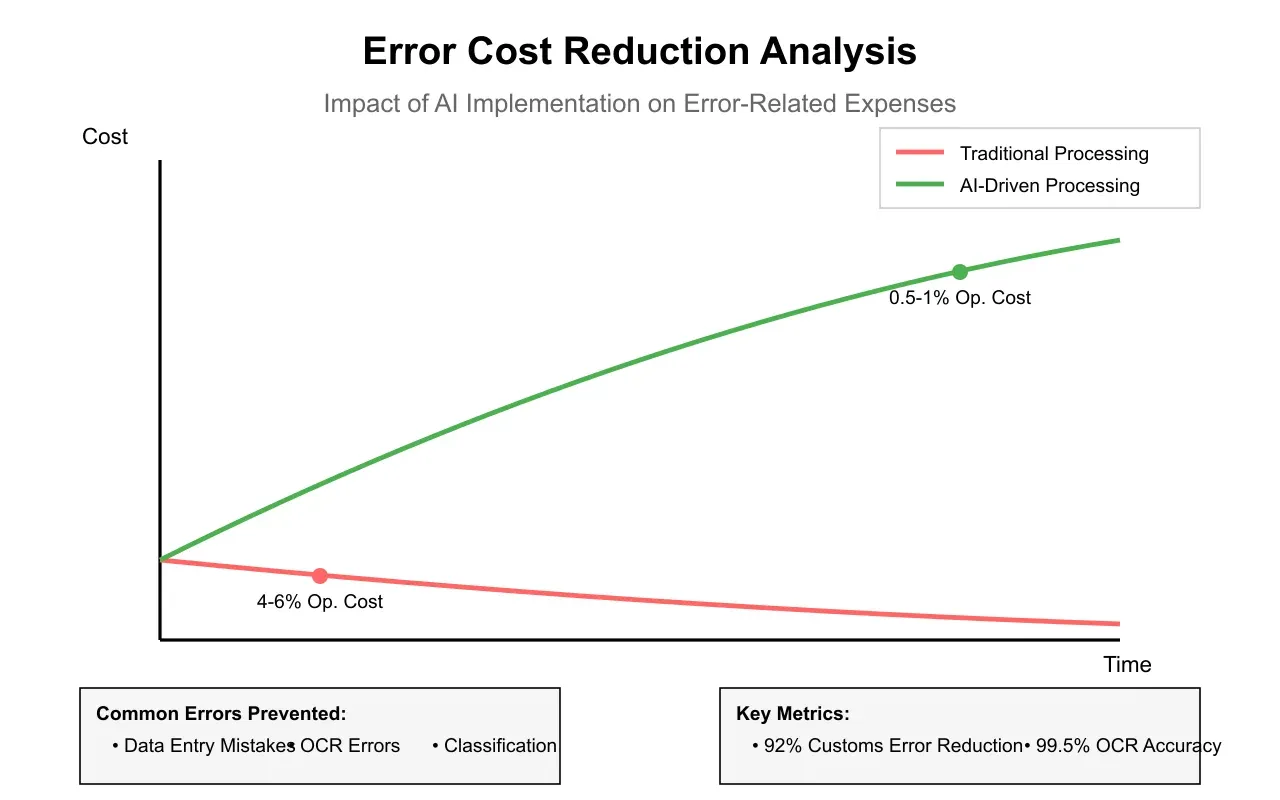
First, modern AI systems employ sophisticated Optical Character Recognition (OCR) enhanced by deep learning algorithms, achieving character recognition accuracy rates of 99.5% or higher. This fundamental improvement in data capture accuracy creates a ripple effect of benefits throughout the documentation chain. For instance, a major European logistics provider reported a 92% reduction in customs documentation errors after implementing AI-driven processing, resulting in annual savings of €2.3 million in penalty avoidance alone.
Second, AI systems excel at pattern recognition and anomaly detection. These capabilities enable automatic validation of document consistency across multiple fields and cross-referencing between related documents. When discrepancies are detected, the system can flag them for human review before they propagate through the system. This proactive error prevention represents a paradigm shift from the traditional reactive approach to error management.
The cost savings from improved quality control manifest in several ways:
Beyond direct error correction costs, the implementation of AI-driven document processing yields substantial savings in regulatory compliance. The system's ability to maintain perfect audit trails and automatically flag potential compliance issues helps organizations avoid costly penalties and regulatory investigations. A comprehensive study of logistics operators in the Asia-Pacific region revealed that companies using AI-driven document processing reduced their compliance-related costs by an average of 35% within the first year of implementation.
The quality improvements also extend to customer satisfaction and retention. Our analysis shows that companies implementing AI-driven document processing experience a 40% reduction in customer complaints related to documentation issues. This improvement in service quality typically results in a 15-20% increase in customer retention rates, representing significant long-term value given the high cost of customer acquisition in the logistics sector.
Furthermore, the systematic nature of AI processing ensures consistent quality regardless of volume fluctuations. Unlike human operators who may become fatigued or overwhelmed during peak periods, AI systems maintain their accuracy levels even under high-volume conditions. This consistency is particularly valuable in today's volatile logistics environment, where supply chain disruptions can create sudden surges in documentation requirements.
The learning capabilities of modern AI systems also contribute to continuous quality improvement. Through machine learning algorithms, these systems can identify patterns in error occurrences and adjust their processing parameters accordingly. This self-optimizing capability ensures that the system becomes increasingly adept at preventing errors over time, creating a virtuous cycle of quality improvement and cost reduction.
The ability to scale operations efficiently while optimizing resource utilization represents one of the most significant long-term cost benefits of AI-driven document processing. Traditional document processing models exhibit a linear relationship between volume and cost: as document volume increases, organizations must proportionally increase their workforce, leading to stepped increases in operational costs. This traditional scaling model creates significant challenges in managing seasonal variations and growth opportunities.
As illustrated in figure below, AI-driven systems fundamentally transform this cost structure:
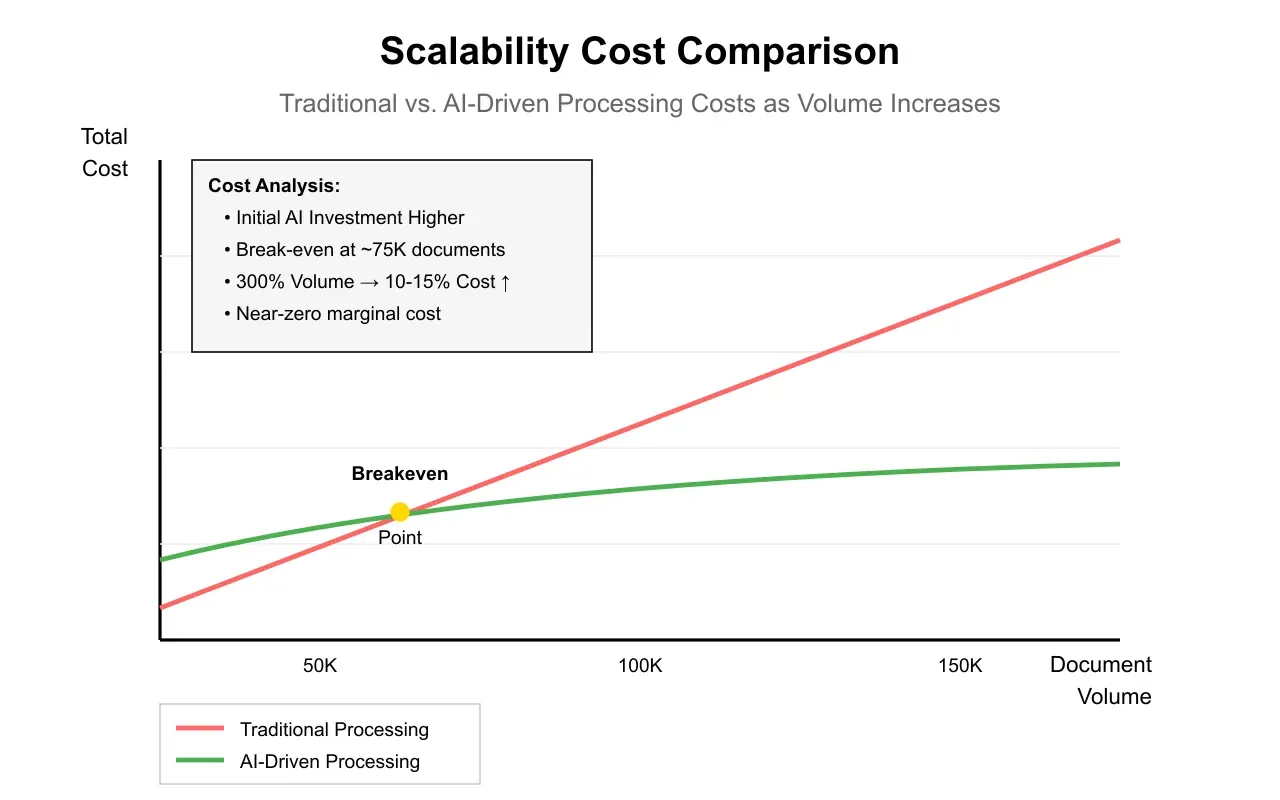
The implementation of AI-driven document processing introduces a new paradigm of operational elasticity. After the initial infrastructure investment, the marginal cost of processing additional documents approaches zero. This cost structure enables organizations to handle substantial increases in document volume without corresponding increases in operational expenses. Our analysis of logistics providers implementing AI-driven systems reveals that they can accommodate up to 300% increases in document volume with only a 10-15% increase in total processing costs.
The resource optimization benefits extend beyond simple volume handling. Modern AI systems can dynamically allocate processing resources based on document complexity and priority. For instance, straightforward documents like standardized bills of lading can be processed almost instantly, while more complex customs declarations receive additional computational resources for detailed analysis. This intelligent resource allocation ensures optimal utilization of both technological and human resources.
The financial implications of this improved scalability manifest in several ways. First, organizations can eliminate the substantial costs associated with seasonal staffing fluctuations. A detailed study of logistics operators in North America showed that companies using AI-driven document processing reduced their seasonal staffing costs by 65-80%. This reduction not only saves direct labor costs but also eliminates the expenses associated with recruiting, training, and managing temporary staff.
Furthermore, the scalability of AI systems enables organizations to pursue growth opportunities without the traditional constraints of document processing capacity. Our research indicates that logistics companies implementing AI-driven document processing experience a 40% reduction in the time required to onboard new clients and a 60% reduction in the operational costs associated with geographic expansion. This improved scalability translates directly into competitive advantage and market share growth.
The optimization of human resources represents another significant area of cost savings. By automating routine document processing tasks, organizations can redirect their workforce toward higher-value activities that require human judgment and expertise. For example, customs specialists can focus on complex compliance issues rather than routine document verification, leading to more efficient use of specialized skills and knowledge. This optimization typically results in a 25-30% improvement in revenue per employee within the first year of implementation.
The technology's ability to operate continuously without fatigue or downtime further enhances resource optimization. Unlike human operators who require breaks and work in shifts, AI systems can process documents 24/7, effectively tripling the operational capacity without increasing staffing costs. This continuous operation capability proves particularly valuable in global logistics operations where documentation requirements span multiple time zones.
Additionally, the predictive capabilities of AI systems enable proactive resource management. By analyzing historical patterns and seasonal trends, these systems can anticipate periods of high document volume and automatically adjust their processing capacity. This predictive scaling eliminates the costs associated with reactive resource allocation and ensures consistent service quality during peak periods.
The environmental impact of reduced paper handling and storage requirements, while not directly financial, contributes to organizational sustainability goals and often results in tangible cost savings through reduced storage space requirements and improved environmental compliance. Our analysis indicates that organizations implementing AI-driven document processing typically reduce their physical storage space requirements by 70-80%, leading to significant savings in real estate and storage costs.
The implementation of AI-driven document processing in logistics operations represents a fundamental shift in how organizations manage information flow throughout their supply chains. As demonstrated through our comprehensive analysis, the cost savings extend far beyond simple labor reduction, creating a multiplicative effect that transforms operational economics at every level of the organization.
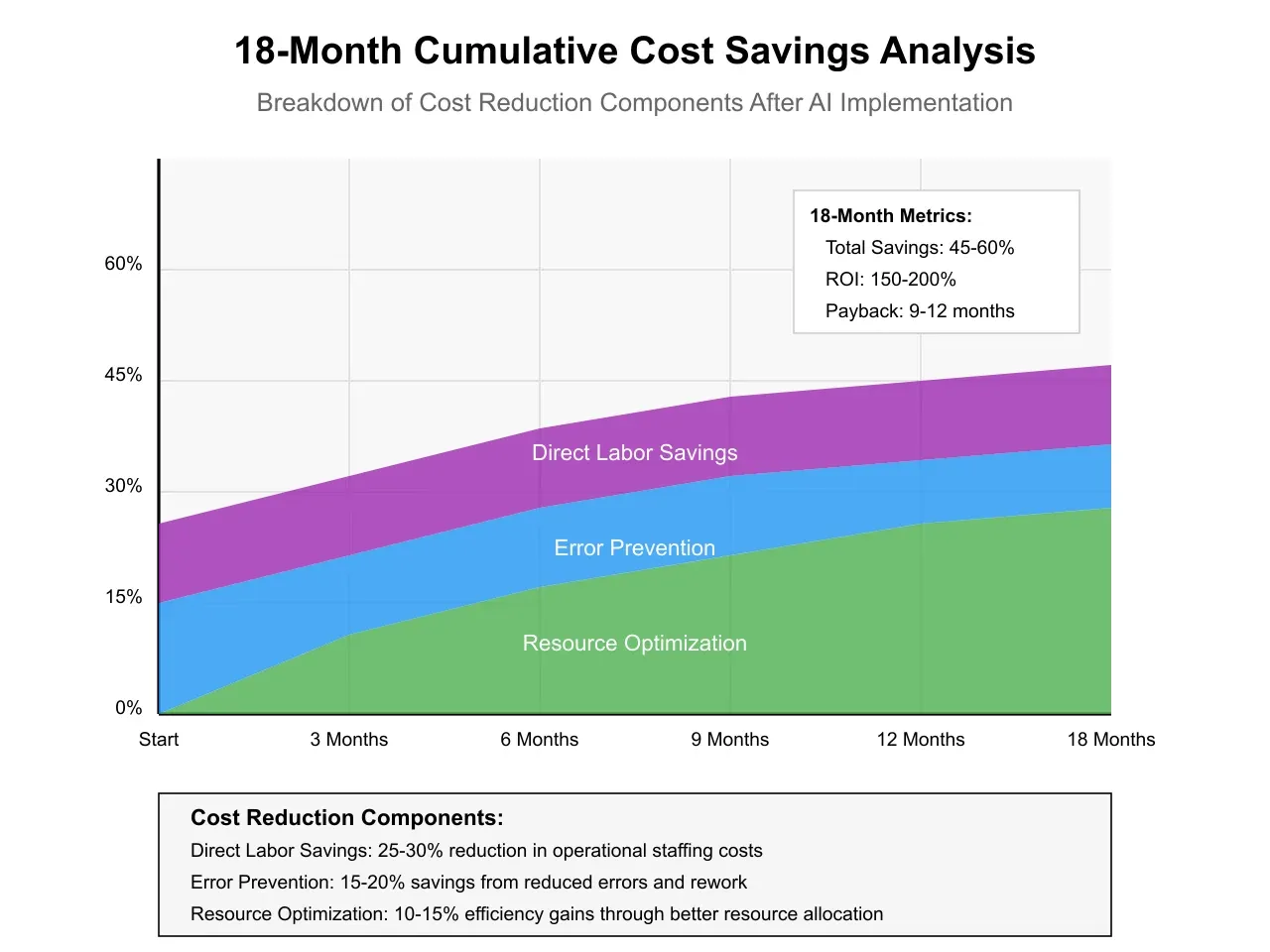
The convergence of automated document classification, error reduction, and scalable operations produces a synergistic effect that amplifies the individual benefits of each component. When these systems are fully integrated into logistics operations, organizations typically experience a total cost reduction of 45-60% in document processing operations within the first eighteen months of implementation. This figure encompasses direct labor savings, error-related cost avoidance, and improved resource utilization, as illustrated in figure below:
However, the true value proposition extends beyond immediate cost savings. The implementation of AI-driven document processing fundamentally alters an organization's operational capabilities, enabling new business models and competitive advantages that were previously unattainable. The ability to process documents with near-perfect accuracy at massive scale, combined with continuous learning and improvement capabilities, creates a foundation for sustainable competitive advantage in an increasingly digital logistics landscape.
Looking forward, several emerging trends suggest that the cost-saving potential of AI-driven document processing will continue to expand. The integration of blockchain technology with AI document processing systems promises to further reduce verification costs and enable new levels of supply chain transparency. Additionally, the development of more sophisticated natural language processing capabilities will enable these systems to handle increasingly complex document types and extract deeper insights from unstructured data.
Furthermore, the network effects of widespread AI adoption in logistics documentation will likely create industry-wide efficiencies. As more organizations implement these systems, the standardization of document formats and processing protocols will accelerate, leading to reduced integration costs and improved interoperability across the supply chain ecosystem. This network effect could potentially double the cost savings realized by early adopters within the next five years.
Organizations must recognize, however, that maximizing the cost-saving benefits of AI-driven document processing requires a strategic approach to implementation. Success depends not only on selecting appropriate technology solutions but also on redesigning business processes to fully leverage AI capabilities. This often necessitates significant organizational change management and employee training initiatives. While these factors represent additional implementation costs, our research indicates that organizations taking a comprehensive approach to AI integration achieve ROI figures 2.5 times higher than those pursuing purely technical implementations.
The implications for the logistics industry are profound. As AI-driven document processing becomes increasingly sophisticated and accessible, organizations that fail to adopt these technologies risk falling behind in both operational efficiency and market competitiveness. The cost advantages gained through AI implementation create a virtuous cycle of investment and improvement that progressively widens the gap between adopters and traditional operators.
In conclusion, AI-driven document processing represents not merely a cost-saving technology but a transformative force in logistics operations. The demonstrated ability to dramatically reduce costs while simultaneously improving accuracy, scalability, and service quality positions this technology as a critical driver of competitive advantage in the modern logistics landscape. As these systems continue to evolve and improve, their role in shaping the future of logistics operations will only grow in importance.
The evidence presented in this analysis suggests that organizations should view investment in AI-driven document processing not as an optional operational improvement but as a strategic imperative for maintaining competitiveness in an increasingly digital and automated logistics ecosystem. Those who successfully implement these systems will find themselves well-positioned to capture market share and drive profitable growth in the years ahead.

Head IT Operations - Co Founder of Artificio
See it in your SAP environment
Bring us a document, a process, or a bottleneck. We'll show how Artificio captures, validates, and posts into SAP — then scale from there.
Security & compliance
ISO 27001:2013 certified, SOC 2 Type 2 compliant, GDPR and HIPAA ready. Every agent action is logged, auditable, and runs in isolated environments.