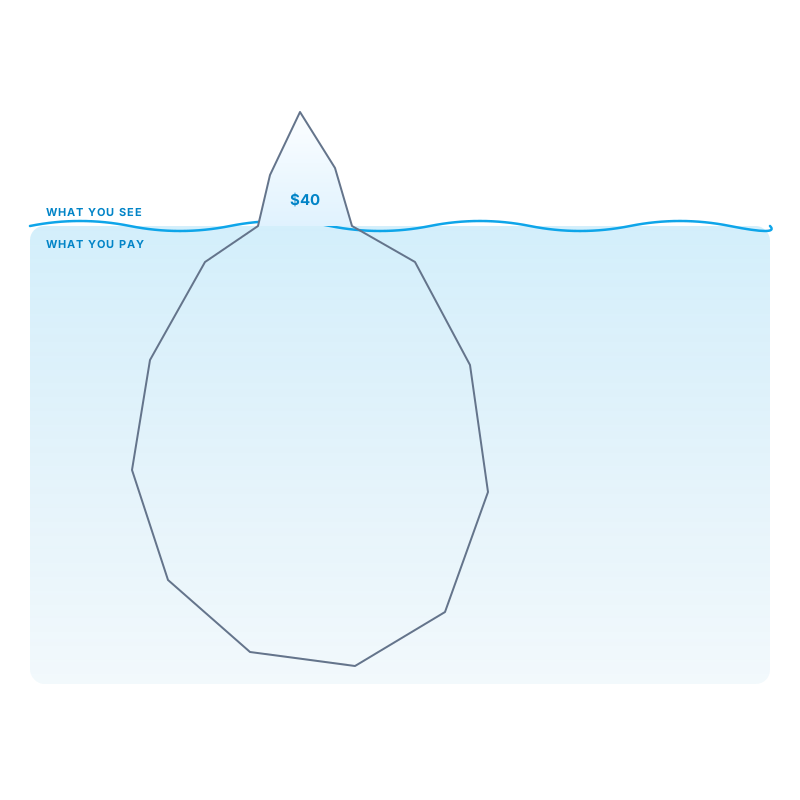
The Real Cost of an Invoice Is Not the Token Price
Focusing only on token price hides the true cost of invoice processing. Discover why real efficiency requires measuring cost per correct invoice, including retries, human review, and costly errors.
Token price is the smallest line on your invoice processing bill. Learn how to measure cost per invoice processed correctly, including retries, human review, and the errors that slip through.
The dashboard looked great. Four tenths of a cent per invoice. The finance operations lead at a mid-sized distribution company had just switched her invoice extraction to the cheapest large language model on the market, and the monthly AI bill dropped to about forty-seven dollars for ten thousand invoices. She sent the screenshot to her CFO with a single line underneath it. "We cracked it."
Three floors down, an AP specialist named Marisol was having a different kind of week. An invoice from a freight carrier had come through with the purchase order number pulled from the remit-to block instead of the reference field. The system matched it to the wrong PO, which belonged to a packaging supplier. The three-way match failed, the invoice landed in her exception queue, and she spent eleven minutes untangling it. It was the fourteenth one that morning.
Then there was the one nobody caught. A utility invoice where the model read $18,420.00 as $1,842.00. It posted, it got paid, and two months later the utility sent a past-due notice with a late fee attached. Someone in treasury spent most of an afternoon on the phone, reissuing payment and requesting a fee waiver that never came.
None of that showed up on the token bill. All of it was part of what the company paid to process an invoice.
This is the trap a lot of finance teams are walking into right now. AI pricing is quoted in tokens, so token price becomes the number everyone tracks. It is easy to see, easy to compare, and almost completely beside the point. The number that actually matters is what you pay for each invoice that ends up processed correctly, after every retry, every human touch, and every error that escapes into your books.
Why Token Price Became the Headline Number
Token pricing is seductive because it is precise. A model provider tells you exactly what a million input tokens cost and exactly what a million output tokens cost. You multiply by the size of an average invoice, and you get a clean, small number. Procurement loves it. It fits neatly into a vendor comparison spreadsheet.
The trouble is that token price measures the cost of an attempt, not the cost of an outcome. It tells you what it costs to ask a model to read an invoice. It tells you nothing about whether the model read it right.
Think about hiring a contractor to paint your house. One painter quotes $2,000. Another quotes $5,000. The cheap quote looks obvious until you learn that the first painter skips the primer, misses the trim, and leaves drips on your windows. You end up paying a second crew to fix it, plus a few hundred dollars in ruined window screens. The real comparison was never $2,000 against $5,000. It was the total cost of a properly painted house.
Invoice processing works the same way. A model call is the quote. A correctly posted invoice is the painted house.
The Four Layers of Invoice Cost
When you follow a single invoice from the moment it hits your inbox to the moment it is paid and reconciled, the costs stack up in four distinct layers. Only the first one appears on your AI vendor's bill.
Layer one is the model call itself. This is the token cost of sending the invoice image or text to a model and getting structured data back. For most invoices, it is measured in fractions of a cent to a few cents, depending on the model and the document length.
Layer two is retries. Models time out. They return malformed output that your system cannot parse. They return a confidence score so low that the pipeline decides to try again, sometimes with a different prompt and sometimes with a bigger model. Every retry is another model call, and some retry loops resend the entire multi-page document each time. A pipeline that retries 18% of invoices quietly pays for 118 calls for every 100 invoices.
Layer three is human review. This is where the money really starts to move. When the system flags an invoice for a person to check, someone opens it, compares the extracted fields against the source document, fixes what is wrong, and pushes it forward. Even a quick review takes several minutes. At a fully loaded labor cost of $36 an hour, a six-minute review costs $3.60. That single review costs as much as roughly 900 model calls at four tenths of a cent each.
Layer four is escapes. These are the errors nobody caught. A wrong amount that got paid. A duplicate invoice that went through twice. A vendor bank detail that was misread. A missed early-payment discount because the payment terms were extracted as Net 60 instead of 2/10 Net 30. Escapes are the most expensive layer and the least visible, because they surface weeks later in a different department, wearing a different label. They show up as a vendor dispute, a credit memo, a reversed journal entry, or an audit finding.
The Metric That Actually Matters: Cost per Correct Invoice
The fix is simple to state and surprisingly rare in practice. Stop measuring cost per invoice attempted. Start measuring cost per invoice processed correctly.
Here is the idea in plain terms. Take everything you spent to process a batch of invoices in a month. That includes model calls, retries, any validation services, the human time spent on review, and the cost of cleaning up errors that slipped through. Add it all together. Then divide by the number of invoices that were actually posted correctly, which means the right vendor, the right amount, the right GL coding, matched to the right PO, posted once, and paid on the right terms.
That is your real cost per invoice.
The denominator matters as much as the numerator. An invoice that a human fixed during review counts as correct, because it went into your books right. An invoice that posted with a wrong amount does not count, even if it sailed through without anyone touching it. That one costs you twice. You paid to process it, and you paid again to clean it up.
This framing changes the conversation instantly. A model that costs ten times more per call can easily be the cheaper option if it cuts the number of invoices that need a person to look at them. A pipeline that adds a validation step, which looks like extra cost on paper, can lower the real number because it catches errors before they become escapes.
A Worked Example: Three Pipelines, 10,000 Invoices
Numbers make this concrete, so here is an illustrative scenario. The assumptions are deliberately simple so you can swap in your own figures.
A company processes 10,000 invoices a month. Human review takes six minutes on average, at a loaded cost of $36 an hour, so each review costs $3.60. An escaped error costs $25 on average to clean up once you count the time to investigate, the vendor call, the correcting entry, and the occasional late fee. Some escapes cost far less. A few cost far more.
The company compares three setups.
Pipeline A uses a budget model. Each call costs $0.004. It gets 82% of invoices fully right on the first try. 18% get retried, 12% end up in human review, and 2% slip through with an error nobody caught.
Pipeline B uses a premium model. Each call costs $0.03, which is seven and a half times more than Pipeline A. It retries 5% of invoices, sends 3% to human review, and lets 0.4% escape.
Pipeline C uses a mid-priced model inside a multi-step pipeline. Each call costs $0.012. On top of extraction, it runs a validation step that checks the math, cross-references the PO and receiving data, and checks vendor details against the vendor master. That validation adds a fifth of a cent per invoice. It retries 6% of invoices, sends 2% to human review, and lets 0.2% escape.
Here is what each one really costs for the month.
Pipeline A (budget)
Pipeline B (premium)
Pipeline C (validated pipeline)
Price per model call
$0.004
$0.03
$0.012
Model spend, including retries
$47
$315
$127
Validation spend
$0
$0
$20
Human review
$4,320
$1,080
$720
Escaped error cleanup
$5,000
$1,000
$500
Total monthly cost
$9,367
$2,395
$1,367
Invoices processed correctly
9,800
9,960
9,980
Cost per correct invoice
$0.96
$0.24
$0.14
Token spend as share of total
0.5%
13%
9%
Look at Pipeline A. The model spend is $47. The total cost is $9,367. Token price represents half of one percent of what the company actually paid. If the finance lead had been watching only the AI bill, she would have believed her cost per invoice was under half a cent. The real number was close to a dollar.
Pipeline B charges seven and a half times more per call and costs four times less per correct invoice.
Pipeline C does even better, and it does it with a cheaper model than Pipeline B. The difference comes from what happens around the model. The validation step costs $20 a month and removes hundreds of reviews and dozens of escapes. That is the cheapest $20 in the whole operation.
The lesson is not "always buy the most expensive model." The lesson is that the model call is one ingredient, and the design of the whole pipeline decides what you really pay.
Retries: The Quiet Multiplier
Retries deserve a closer look, because they hide in plain sight. Most teams know their per-call price. Very few know their calls per invoice.
A retry happens for a handful of ordinary reasons. The model returns output in the wrong format, so the parser fails. A required field comes back empty. The confidence score falls below a threshold. A timeout hits on a long multi-page invoice. Each one triggers another attempt.
On a clean set of single-page invoices from large vendors, retries might be rare. On the real mix that most AP teams see, they are not. Think about scanned invoices printed on colored paper. Handwritten adjustments in the margin. A forty-page utility bill where the total is on page thirty-one. A freight invoice with accessorial charges stacked in a table that spans two pages. A European supplier using commas as decimal separators. These documents drive the retry rate up, and they are exactly the ones a budget model struggles with.
The design of the retry loop matters too. A loop that sends the full document again with the same prompt often gets the same wrong answer. A smarter loop targets only the field that failed, adds context about what went wrong, or routes the document to a different specialist. One approach doubles your model spend for little gain. The other fixes the problem for a fraction of the cost.
If you are not tracking attempts per invoice, start there. It is often the first number that surprises people.
Human Review: The Line Item That Dwarfs Everything
In almost every invoice operation, human time is the single largest cost. That is true even for teams with a lot of automation, and it is the reason the per-call price barely registers.
According to Ardent Partners' 2025 accounts payable research, the average organization spends $9.40 to process a single invoice, while best-in-class teams get that down to $2.78. The same research puts the industry exception rate at 14% and shows that only about a third of invoices are processed without any human touch, with best-in-class teams reaching roughly half. Compare those figures to a token price of a fraction of a cent, and the scale of the gap becomes obvious. The money is in the people time, and people time is driven by how many invoices land in front of them.
So the most valuable thing an AI system can do is not to be cheap per call. It is to send fewer invoices to human review, and to send the right ones.
That second part matters. A system that flags everything as low confidence is safe but useless, because your team ends up checking every invoice anyway. A system that flags nothing is fast but dangerous, because errors flow straight into your ledger. What you want is a system that knows when it is unsure and is honest about it. When it says it is confident, it should be right almost every time. When it is unsure, it should say so, and explain which field is the problem so the reviewer goes straight to it.
Picture two review screens. On the first, the reviewer sees an invoice and a form with twenty-six extracted fields, and the system says "please verify." She has to check all of them. On the second, the screen highlights one field, the invoice total, and shows that the extracted amount does not match the sum of the line items by $1,800. She checks that one number against the source document, corrects it, and moves on. The first review takes six minutes. The second takes forty seconds.
Review time per invoice is a design decision, not a fixed cost.
Escapes: The Errors That Cost the Most
The errors you catch are expensive. The errors you miss are worse.
An escape is any invoice that posts with incorrect data and nobody notices at the time. These are the most damaging failures in an AP operation because the cost does not stop at the fix. It spreads.
Consider what a single escaped error can set in motion. A misread amount leads to an underpayment. The vendor sends a past-due notice. Someone in AP has to research the history, find the original invoice, compare it to what was posted, and work out what happened. Treasury issues a corrected payment. The vendor applies a late fee, and your team spends time asking for it to be waived. If the vendor is a key supplier, the relationship takes a small hit. If it happens often enough, you lose favorable terms.
Now consider an overpayment, or a duplicate. Those are worse, because getting money back from a vendor is slow, awkward, and sometimes not worth the effort. Many companies pay recovery audit firms a percentage of what they find, which is another cost hiding outside the AP budget.
Then there are the compliance costs. Misclassified tax amounts, wrong GL codes, or invoices posted to the wrong period all turn into audit questions. At quarter end, someone has to explain them.
The $25 average escape cost in the worked example above is conservative for many organizations. Even at that modest figure, escapes made up more than half of Pipeline A's total cost. Cut the escape rate from 2% to 0.2%, and you save $4,500 a month on 10,000 invoices, before you count any of the relationship or audit costs.
How to Measure Cost per Correct Invoice in Your Own Operation
You do not need a data science team to start measuring this. You need a few weeks of honest tracking and a willingness to look at numbers that live outside the AI bill.
Start with a gold set. Pull 300 to 500 invoices that represent your real mix, including the messy ones. Have your most experienced AP person record the correct values for every field that matters. This becomes your answer key. Run every pipeline or vendor you are evaluating against it, and score them on fully correct invoices, not on average field accuracy. A system that gets 98% of fields right can still get only 70% of invoices fully right, because one wrong field spoils the whole invoice.
Next, count attempts per invoice. Every model call, every retry, every fallback to a different model. Divide by invoices processed. If the answer is 1.0, you have a very clean pipeline. If it is 1.3, your real model cost is 30% higher than the quote.
Then measure human review honestly. Track how many invoices get touched by a person and how long each touch takes. Most AP platforms log when an invoice enters and leaves a review queue. If yours does not, a two-week time study with a simple spreadsheet will tell you more than any vendor demo. Use a fully loaded labor rate that includes benefits and overhead, not just hourly wages.
Escapes are the hardest to measure, because by definition nobody caught them at the time. You find them by looking downstream. Count credit memos, vendor disputes, reversed or corrected journal entries, duplicate payment recoveries, and late fees over a quarter. Trace a sample of them back to the original invoice and ask whether the extraction was the cause. You will not catch every escape this way, but you will get a realistic floor.
Finally, put it together. Total monthly spend across all four layers, divided by invoices posted correctly. Track it every month. Watch how it moves when you change models, adjust confidence thresholds, or add a new vendor to the mix.
Once you have the number, you also have a far better way to evaluate any AI vendor. You can stop asking "what does it cost per page?" and start asking "what will it cost me per correctly posted invoice, on my documents?"
Questions to Ask Before You Choose an Invoice AI Platform
When a vendor leads with token price or per-page price, it is worth steering the conversation toward outcomes. These questions tend to separate the platforms that have thought about total cost from the ones that have not.
Ask what percentage of invoices are fully correct on the first pass, on a sample of your own documents rather than a curated demo set. Ask how the system decides when to send an invoice to a person, and whether it points the reviewer to the specific field it is unsure about. Ask how many model calls a typical invoice takes, including retries. Ask what happens when a vendor changes its invoice layout, and whether that requires a new template or a support ticket. Ask what checks run after extraction, such as whether line items add up to the total, whether the PO and receipt match, and whether the vendor bank details match what is on file. Ask how the system reports errors that were caught downstream, so you can see the escape rate over time.
A vendor that can answer these with real numbers understands what you are actually buying. A vendor that keeps returning to price per page is selling you the tip of the iceberg.
Artificio was built around the idea that the model call is just one part of getting an invoice right. Instead of a single model reading a document and hoping for the best, Artificio uses a team of AI agents, each with a specific job.
One agent classifies the incoming document, so a credit memo or a statement does not get processed as an invoice. Another extracts the fields, including complex line-item tables that span multiple pages. A validation agent then checks the work. It confirms that line items add up to the subtotal and that tax and freight add up to the total. It matches the invoice against the purchase order and the receiving record. It checks the vendor, the remit-to details, and the bank information against your vendor master, and it flags possible duplicates before anything posts.
When something does not check out, the system does not quietly guess. It routes the invoice to a person with the specific problem highlighted, so review takes seconds instead of minutes. And because the agents read documents the way a person would rather than relying on fixed templates, a new vendor or a changed layout does not trigger a wave of exceptions.
This is the design behind Pipeline C in the example above. The model spend is not the lowest possible. The validation step adds a small cost. But together they push human review and escapes down, and that is where the money is.
For AP teams, that means fewer invoices in the exception queue, less time spent per exception, and far fewer surprises from vendors three months later. For finance leaders, it means a cost per invoice that reflects reality rather than the AI bill.
What This Means for How You Budget
Shifting to cost per correct invoice changes more than vendor selection. It changes how you plan.
When you budget only for token spend, AI looks almost free, and the real costs land in other budgets. AP headcount, treasury time, vendor management, audit prep. Nobody connects them back to the extraction decision made six months earlier. When you budget for cost per correct invoice, those costs come back into view, and you can make honest trade-offs.
It also changes what "improvement" means. Shaving a tenth of a cent off the model call is barely worth a meeting. Cutting human review from 12% of invoices to 3% is worth a project. Cutting escapes in half is worth a celebration. Teams that track the right metric spend their energy on the changes that actually move it.
And it gives you a fair way to compare AI against everything else. Ardent Partners' benchmarks give you an outside reference point for what an invoice costs across the industry. If your fully loaded cost per correct invoice sits well below the best-in-class figure, your automation is earning its keep. If it does not, the AI bill will not tell you why. The other three layers will.
The Number on the Screenshot
Go back to the finance lead and her screenshot of a four-tenths-of-a-cent invoice. She was not wrong about the number. She was wrong about what it measured.
Her model really did cost $0.004 per call. Her invoices really did cost close to a dollar each, once you counted Marisol's exception queue, the retries nobody tracked, and the utility late fee that treasury could not get waived. The cheap model was the most expensive choice she could have made, and the only thing hiding that fact was the metric on her dashboard.
The fix took one change. Divide everything you spend by the invoices you actually got right. Once that number is on the dashboard, the right decisions start to make themselves. The expensive model stops looking expensive. The validation step stops looking like overhead. And the team three floors down finally gets a morning without fourteen exceptions in the queue.
The real cost of an invoice was never the token price. It is the cost of getting it right.
Artificio uses AI agents to classify, extract, and validate invoices so your team reviews fewer of them and catches errors before they reach your books. See how Artificio can lower your cost per correct invoice at artificio.ai.