

Blog
How LLM AI Agents are Helping in the Evolution of Education Admin Management
Discover how LLM AI agents are revolutionizing educational administration. Learn about key applications and their transformative impact.

Blog
Discover how LLM AI agents are revolutionizing educational administration. Learn about key applications and their transformative impact.
Educational institutions worldwide face an ever-increasing administrative burden that diverts precious resources away from their primary mission: providing quality education. From primary schools to universities, administrators spend countless hours managing enrollment processes, maintaining student records, coordinating schedules, ensuring compliance with regulations, responding to inquiries, and analyzing institutional data. According to a 2023 study by the National Center for Education Statistics, administrative tasks consume approximately 30-40% of educators' time, reducing their availability for direct student engagement and curriculum development.
The traditional administrative infrastructure in education has been characterized by manual processes, fragmented systems, and information silos. These inefficiencies not only burden staff but also impact student experiences, institutional agility, and overall educational outcomes. The need for transformation in educational administration has never been more apparent, especially as institutions face increasing competition, evolving student expectations, and tightening budgets.
Enter Large Language Model (LLM) AI agents sophisticated artificial intelligence systems built on transformer-based neural network architectures that can understand, generate, and manipulate human language with remarkable proficiency. These AI systems, exemplified by advanced models like GPT-4, Claude, and Bard, represent a paradigm shift in how administrative tasks can be approached within educational contexts. Unlike traditional automation tools that follow rigid rules, LLM AI agents can understand context, adapt to unique situations, and communicate naturally with human stakeholders.
The journey of administrative technology in education has been evolutionary, moving through distinct phases that have progressively increased in sophistication and capability (see Figure 1). Understanding this trajectory helps contextualize the revolutionary potential of LLM AI agents in contemporary educational settings.
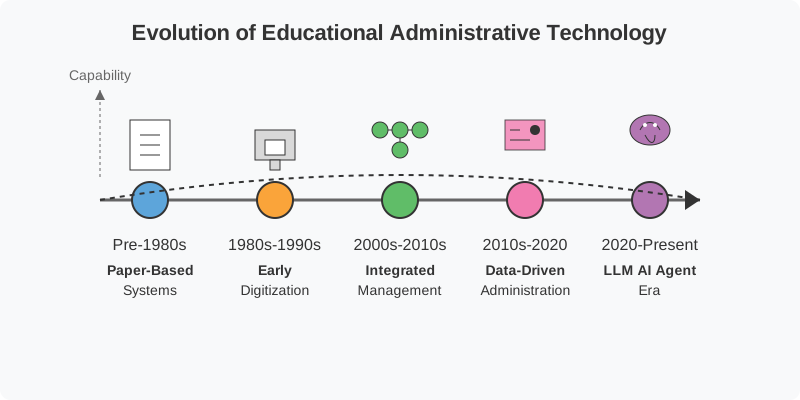
For most of educational history, administrative processes relied heavily on physical paperwork. Student records were maintained in filing cabinets, attendance was tracked in paper registers, and communication occurred through printed memos and letters. While functional, these systems were labor-intensive, prone to errors, and created significant storage challenges. Information retrieval was slow, and cross-referencing data required manual effort, limiting the analytical capabilities of educational institutions.
The introduction of personal computers in the 1980s initiated the first wave of administrative digitization in education. Basic spreadsheet applications and database systems enabled schools to create digital versions of their paper records. Software packages designed specifically for educational administration began to emerge, offering specialized solutions for tasks like grade recording, schedule management, and basic reporting. While this era marked significant progress, the systems remained relatively isolated, with limited integration and accessibility.
The new millennium saw the rise of comprehensive School Management Information Systems (SMIS) and Enterprise Resource Planning (ERP) solutions tailored for educational institutions. These platforms integrated various administrative functions from enrollment and attendance to finance and human resources into unified digital ecosystems. Web-based interfaces enabled broader access, and the growing internet infrastructure facilitated improved communication between administrative stakeholders. Cloud computing further enhanced these capabilities, offering greater scalability, accessibility, and data security.
The past decade witnessed an increasing emphasis on data analytics in educational administration. Advanced systems began incorporating dashboard visualizations, predictive models, and automated reporting tools to transform raw administrative data into actionable insights. This shift enabled more informed decision-making across various domains, from resource allocation to student intervention strategies. However, these systems still largely relied on structured data and predefined analytical frameworks, limiting their ability to process and interpret unstructured information.
The most recent evolutionary stage and the focus of this article involves the integration of Large Language Model AI agents into educational administrative processes. These sophisticated systems transcend the capabilities of previous technologies by understanding natural language, learning from interactions, and adapting to diverse administrative contexts. LLM AI agents can process both structured and unstructured data, engage in natural conversations with stakeholders, and perform complex reasoning tasks without rigid programming. This represents not just an incremental improvement, but a fundamental reimagining of how administrative work can be conducted in educational environments.
In the following sections, we will explore the specific mechanisms through which LLM AI agents are transforming educational administration, examining both their current applications and future potential. We will consider how these technologies address long-standing administrative challenges while creating new opportunities for efficiency, personalization, and innovation in educational management.
The integration of LLM AI agents into educational administration is transforming workflows and creating new possibilities across numerous functional areas. These intelligent systems operate not merely as tools but as collaborative partners that understand context, learn from interactions, and adapt to the unique requirements of educational institutions.
Educational institutions process an enormous volume of documents, from application forms and transcripts to policy manuals and compliance reports. LLM AI agents excel at understanding, categorizing, and extracting relevant information from these diverse document types. Unlike traditional Optical Character Recognition (OCR) systems, these agents comprehend document context and can interpret content even when presented in varied formats or with inconsistent terminology.
At Westfield Academy, the implementation of LLM-powered document processing reduced administrative processing time by 78%, allowing staff to focus on student-centered activities rather than paperwork. The system not only digitizes documents but also intelligently routes them to appropriate departments, extracts key data points for database integration, and even identifies potential issues or inconsistencies that might require human attention.
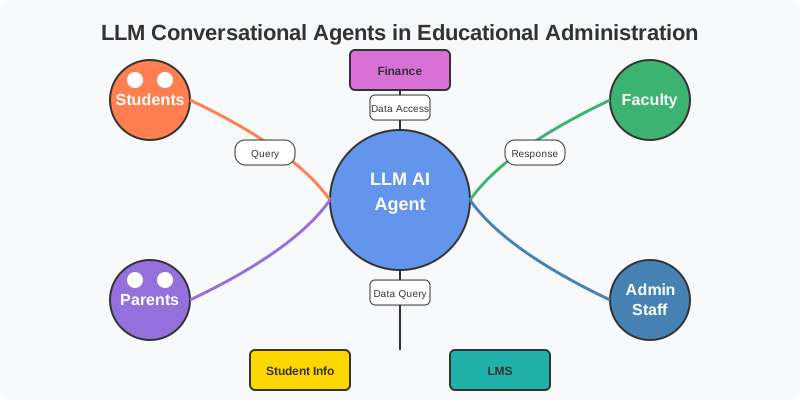
Perhaps the most visible application of LLM AI agents in educational administration is their deployment as conversational assistants that can respond to inquiries from students, parents, faculty, and other stakeholders. These virtual assistants handle routine questions about enrollment procedures, deadlines, institutional policies, financial aid options, and other administrative matters with a nuance and contextual understanding previously impossible with rule-based chatbots.
As illustrated in Figure 2, these conversational agents serve as an intelligent interface between stakeholders and institutional information systems. They can interpret natural language queries, access relevant databases, understand institutional policies, and provide personalized responses that account for the specific circumstances of the inquirer. More importantly, they continuously learn from interactions, improving their response accuracy and extending their knowledge base over time.
LLM AI agents bring unprecedented capabilities to educational data analysis and decision support. Unlike traditional analytics tools that typically require structured data and predefined models, these systems can work with unstructured information, recognize patterns across diverse data sources, and generate insights presented in narrative form that administrators can readily understand.
For example, an LLM AI agent might analyze attendance patterns, assignment completion rates, and engagement metrics to identify students at risk of academic challenges. The system doesn't just flag statistical anomalies but provides contextual analysis, suggesting potential interventions based on successful strategies employed in similar situations. This capability transforms raw data into actionable intelligence that supports proactive, evidence-based decision-making.
Educational administration involves extensive communication with diverse stakeholders, each requiring appropriate tone, content, and delivery methods. LLM AI agents excel at generating and managing personalized communications that maintain institutional voice while addressing the specific needs of different audiences.
These systems can draft personalized acceptance letters, create targeted email campaigns for alumni engagement, generate program-specific informational materials, and even develop customized communication strategies for students with special circumstances. The communications maintain consistency in institutional messaging while adapting to the unique requirements of each situation a balance that would be enormously time-consuming to achieve manually.
The integration of LLM AI agents into educational administration extends beyond task automation to fundamentally transform administrative processes, relationships, and capabilities. This transformation manifests in several critical dimensions that collectively reshape the administrative landscape.
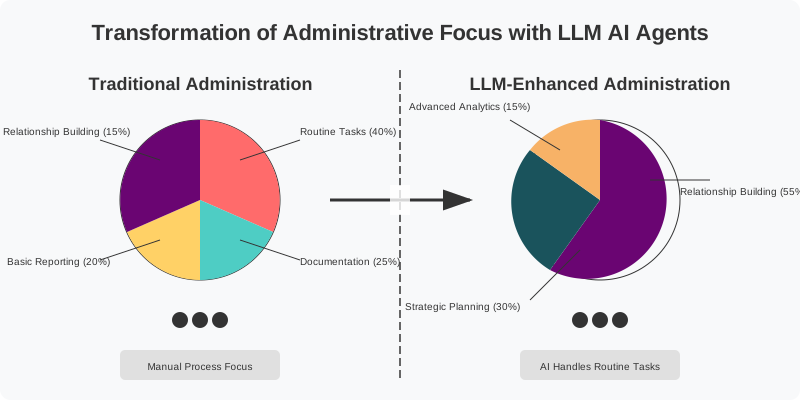
Traditional educational administration has often been constrained to transactional interactions focused on completing specific processes or addressing immediate needs. LLM AI agents enable a shift toward more relational administration by handling routine transactions autonomously, freeing human administrators to focus on relationship building and complex problem-solving that requires emotional intelligence and experienced judgment.
As depicted in Figure 3, this paradigm shift reorganizes administrative priorities and resource allocation. Routine processes become increasingly automated and self-service oriented, while human administrators evolve into strategic relationship managers who provide personalized guidance, resolve complex cases, and develop proactive support programs tailored to specific student populations.
LLM AI agents significantly expand the collective intelligence available for administrative decision-making by serving as institutional knowledge repositories that continuously learn from interactions, policy documents, and operational patterns. This enhanced administrative intelligence manifests in several ways:
One of the most profound impacts of LLM AI agents is their potential to enhance equity and accessibility in educational administration. By providing consistent, 24/7 access to administrative services and information, these systems reduce barriers related to time, geography, language, and individual circumstances.
Language capabilities are particularly significant in this context. LLM AI agents can communicate in multiple languages, making administrative services more accessible to international students and families with limited English proficiency. Similarly, these systems can adapt their communication style to accommodate different cultural backgrounds, learning differences, and accessibility needs, ensuring that administrative processes serve all stakeholders equitably.
The integration of LLM AI agents into educational administration represents not just a technological upgrade but a fundamental reimagining of how administrative functions support educational missions. As these technologies continue to evolve, several key considerations will shape their impact and implementation:
Educational institutions must develop robust governance frameworks for LLM AI systems that ensure transparency, accountability, and alignment with institutional values. Clear policies regarding data privacy, algorithmic bias mitigation, and appropriate decision boundaries between AI and human administrators are essential for ethical implementation.
The most effective administrative environments will be those that thoughtfully integrate LLM AI capabilities with human expertise. This requires redesigning administrative roles and workflows to leverage the complementary strengths of both the efficiency, consistency, and analytical power of AI systems alongside the empathy, judgment, and creative problem-solving abilities of human administrators.
LLM AI technology continues to advance rapidly, with new capabilities emerging regularly. Educational institutions must adopt flexible implementation approaches that allow for continuous evolution, regular reassessment of use cases, and responsive adaptation to both technological advancements and changing administrative needs.
The transformative potential of LLM AI agents in educational administration extends far beyond cost savings or efficiency gains. These technologies offer the opportunity to fundamentally elevate the quality, accessibility, and impact of administrative services in support of educational missions. By embracing these capabilities thoughtfully, educational institutions can redirect administrative focus from paperwork to people, from transactions to transformations, and from operational challenges to educational excellence.
As educators and administrators navigate this evolution, partners like Artificio provide the technological foundation and implementation expertise needed to harness the full potential of LLM AI agents in educational contexts. Through intelligent document processing, natural language understanding, and adaptive learning capabilities, Artificio's platform enables educational institutions to reimagine administrative functions as strategic assets rather than necessary burdens. The result is not just more efficient administration, but more effective education the ultimate goal toward which all educational innovation should strive.

Head IT Operations - Co Founder of Artificio
See it in your SAP environment
Bring us a document, a process, or a bottleneck. We'll show how Artificio captures, validates, and posts into SAP — then scale from there.
Security & compliance
ISO 27001:2013 certified, SOC 2 Type 2 compliant, GDPR and HIPAA ready. Every agent action is logged, auditable, and runs in isolated environments.