

Blog
How AI Agents Achieve Touchless Invoice Processing from Inbox to ERP
Stop settling for 40% automation. AI agents use reasoning to resolve three-way match exceptions, handle handwritten notes, and achieve 85% touchless AP processing.

Blog
Stop settling for 40% automation. AI agents use reasoning to resolve three-way match exceptions, handle handwritten notes, and achieve 85% touchless AP processing.
Your AP manager just forwarded you an email. Another mismatched invoice. The purchase order shows $12,450, the goods receipt says $12,475, and the invoice claims $12,500. Three different amounts, three different systems, and someone needs to figure out what actually happened before you can pay the vendor. This kind of three-way matching exception happens thousands of times each month in mid-sized companies, eating up hours that finance teams can't spare.
Traditional AP automation promised to solve this. Optical character recognition would extract the data, workflow software would route approvals, and integrations would push everything to the ERP. But that promise keeps breaking down at the same spots. The OCR can't handle a handwritten note on the invoice. The workflow rules don't account for split shipments. The ERP integration chokes on a missing cost center code. Each breakdown creates a queue for human review, and those queues grow faster than teams can clear them.
The result? Most companies claiming to have "automated AP" are actually running semi-automated processes where software handles the easy invoices and humans intervene on everything else. Less than 5% of AP departments achieve true touchless processing, where invoices flow from email to payment without manual intervention. The other 95% are stuck in a hybrid model that costs 4x more per invoice than full automation.
The fundamental issue with conventional AP automation is architectural. These systems were built around a pipeline model: extract data, validate data, route data, approve data, post data. Each step is discrete, each step has rules, and each step can fail independently. When a step fails, the invoice stops moving and waits for a person.
This made sense when OCR accuracy was 70-80% and rule-based validation was the only option. But it creates a brittleness problem. A single field extraction error can halt the entire pipeline. A vendor changing their invoice template can tank your straight-through processing rate overnight. A new document type, like a credit memo with adjusted line items, requires someone to write new extraction rules, new validation rules, and new routing rules.
The hidden cost shows up in exception handling. Your AP team isn't processing invoices anymore. They're debugging extraction failures, chasing down missing PO numbers, correcting GL codes, and reconciling discrepancies. Research from IOFM shows manual invoice processing costs $12-15 per invoice, while fully automated processing costs $3-4. That 4x cost premium comes entirely from exception handling labor.
Companies stuck in this pattern often assume they just need better OCR or more sophisticated validation rules. They'll test three different OCR vendors, pick the one with the highest accuracy scores, and still see minimal improvement in touchless rates. The problem isn't the accuracy of individual components. The problem is the architecture that requires perfect accuracy at every step before the invoice can progress.
AI agents treat invoice processing as an end-to-end task that requires reasoning, not just extraction. Instead of breaking the work into discrete steps with handoffs between specialized tools, an agent handles the full lifecycle autonomously. It receives an invoice email, figures out what document type it is, extracts relevant fields, finds the corresponding PO and goods receipt, resolves discrepancies, determines the correct approval path, and posts to the ERP. All without predefined extraction templates, validation rules, or workflow configurations.
This architectural shift changes what's possible. When an agent encounters a handwritten note on an invoice indicating a 2% early payment discount, it doesn't fail extraction and queue the invoice for review. It reads the note, calculates the adjusted amount, checks whether the payment terms allow early payment discounts, and adjusts the invoice total accordingly. When a vendor changes their invoice format from a tabular layout to a narrative description of line items, the agent adapts immediately. No retraining, no new extraction templates, no engineering work.
The key difference is reasoning capability. Agents can interpret ambiguous documents, infer missing information from context, and handle exceptions the same way an experienced AP clerk would. They understand that when an invoice references PO number "12345" but the only open PO in the system is "123456," that's probably a typo, not a non-matching PO. They recognize that when goods were delivered across three separate receipts but invoiced as one line item, the matching process needs to aggregate receipt quantities.
Here's what that looks like in practice. An agent receives an invoice for $8,450 with line items for consulting services. There's no explicit PO number on the invoice, but the invoice references "Project Wintergreen - Phase 2 implementation." The agent searches the ERP for purchase orders related to Wintergreen, finds PO 44892 which covers Phase 2 consulting with a budget of $10,000 and $1,550 remaining, matches the invoice to that PO, determines the correct cost center and GL codes based on the project structure, routes to the appropriate approver based on the project owner, and waits for approval. Zero manual intervention. 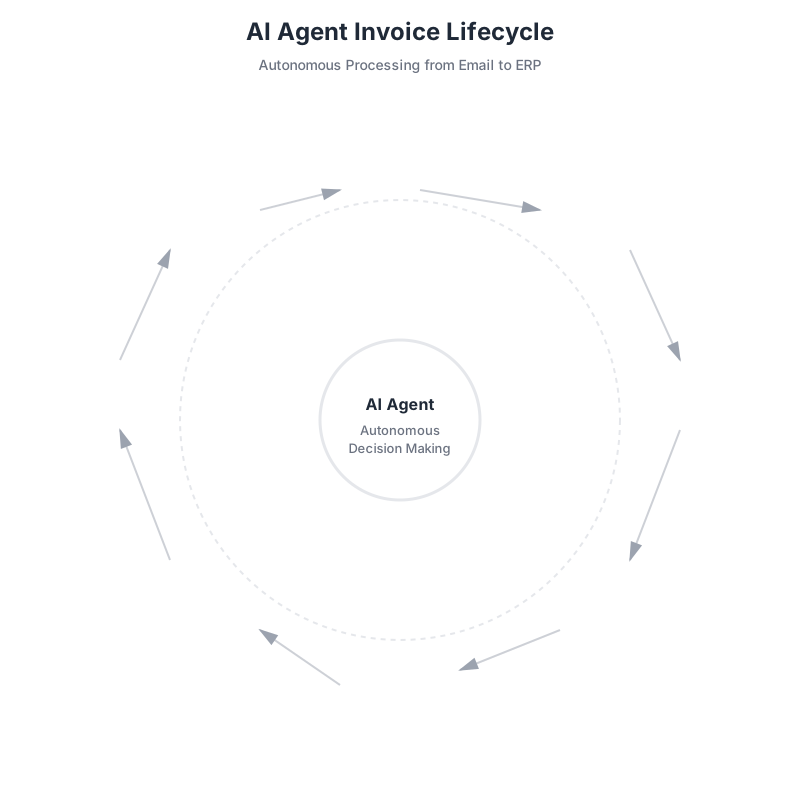
Three-way matching is where traditional automation breaks down most consistently. The concept is simple: match the purchase order, goods receipt, and invoice to verify that what you ordered, what you received, and what you're being charged all align. But in practice, matching involves complex reasoning that rigid rules can't handle.
A typical scenario: the PO says 100 units at $50 each. The goods receipt shows 98 units received because 2 were damaged in shipping. The invoice bills for 98 units but at $51 each, a 2% price increase the vendor mentioned in an email two weeks ago. Traditional AP automation flags this as a three-way mismatch and queues it for review. An AI agent resolves it autonomously.
The agent checks the PO terms to see if price adjustments are allowed, finds the email thread where the vendor announced the price change, calculates that $51 is within the acceptable 2% variance, verifies that the goods receipt quantity matches the invoice quantity, and approves the invoice for payment at the adjusted amount. It also flags the PO to be updated with the new price for future orders. The entire resolution takes seconds, not hours.
Split shipments add another layer of complexity. A company orders 500 SKUs of inventory. The vendor ships 300 units immediately, 150 units two days later, and the final 50 units a week later. Each shipment generates a separate goods receipt. The invoice arrives billing for all 500 units at once. Traditional systems either can't match this automatically or require someone to configure specific rules for how to aggregate multiple receipts against a single invoice. AI agents handle it naturally because they can reason about the relationship between the PO, the three receipts, and the invoice.
The cost impact here is substantial. APQC data shows that companies with high rates of three-way matching exceptions spend 2.5x more per invoice than companies with clean matching. Most of that cost is labor. Finance teams spend hours cross-referencing documents, chasing down receiving departments, and negotiating with vendors about discrepancies. Agents eliminate that labor by resolving matches autonomously in cases where the discrepancy has a clear explanation.
One of the biggest hidden costs in traditional AP automation is template maintenance. Every vendor has a different invoice format. Some put the PO number in the header, others in line item details, others in a reference field at the bottom. When a vendor changes their invoice template, your extraction rules break, accuracy drops, and exception queues spike until someone updates the configuration.
AI agents don't use templates. They understand what an invoice is conceptually and extract information based on semantic understanding, not positional rules. This means when a vendor redesigns their invoice from a single-page format to a multi-page format with detailed line item descriptions, the agent handles it immediately. When a vendor starts sending invoices in German instead of English because your company expanded to a Berlin office, the agent processes them without language-specific configuration.
This adaptability extends to entirely new document types. A vendor sends a debit note instead of a standard invoice. A supplier submits a final invoice with credits for previously returned goods. A partner sends a combined invoice covering multiple purchase orders across different cost centers. Traditional automation treats each of these as exceptions requiring new rules. Agents treat them as variations of the same underlying task: understand what the document says, determine what action is needed, and execute that action.
The business impact shows up in onboarding time. Adding a new vendor to traditional AP automation often requires 2-4 weeks of template configuration, testing, and tuning to achieve acceptable accuracy. With AI agents, new vendors work immediately. The first invoice might require slightly more processing time as the agent figures out the format, but by the third or fourth invoice, processing is as fast as established vendors.
Document drift, where vendors gradually change their invoice formats over time, also disappears as a problem. Traditional OCR systems see accuracy degrade slowly as templates drift from the trained format. Teams often don't notice until exception rates spike, then spend days re-training models and updating configurations. Agents adapt continuously because they're not matching against fixed templates. They're reasoning about content, not parsing positions.
Traditional AP automation creates two queues: a straight-through processing queue for invoices that match all rules perfectly, and an exception queue for everything else. The exception queue becomes the real bottleneck. Finance teams spend their days working through exceptions, one invoice at a time, trying to figure out what went wrong and how to fix it.
AI agents collapse these queues because they handle exceptions during processing, not after. When an agent encounters an invoice with a missing PO number, it doesn't stop and wait for human intervention. It searches the invoice text for project names, vendor references, or service descriptions that might indicate which PO applies. If it finds likely matches, it presents them to the system for confirmation rather than requiring someone to manually search the ERP.
This changes the nature of human involvement. Instead of humans processing exceptions, humans review agent recommendations when the agent isn't confident enough to proceed autonomously. An invoice arrives with an ambiguous PO reference that could match two different purchase orders. The agent flags the ambiguity, presents both options with reasoning for why each might be correct, and waits for a quick confirmation. The human review takes 30 seconds, not 30 minutes.
Duplicate invoice detection becomes more sophisticated with agents. Traditional systems flag duplicates based on exact matches: same vendor, same invoice number, same amount. But vendors sometimes reissue invoices with slightly different amounts, slightly different invoice numbers, or completely different numbers but identical line items. Agents can detect these cases by reasoning about whether two invoices represent the same underlying transaction, even when the exact fields don't match.
The same reasoning capability applies to fraud detection. An invoice arrives from a known vendor but with a new bank account for payment. Traditional systems either auto-approve it, which risks fraud, or flag every bank account change for review, which creates false positives. Agents check whether the bank account change was announced, verify that the email announcing it came from a legitimate domain, and assess the risk level based on invoice amount and vendor history before deciding whether to approve or escalate. 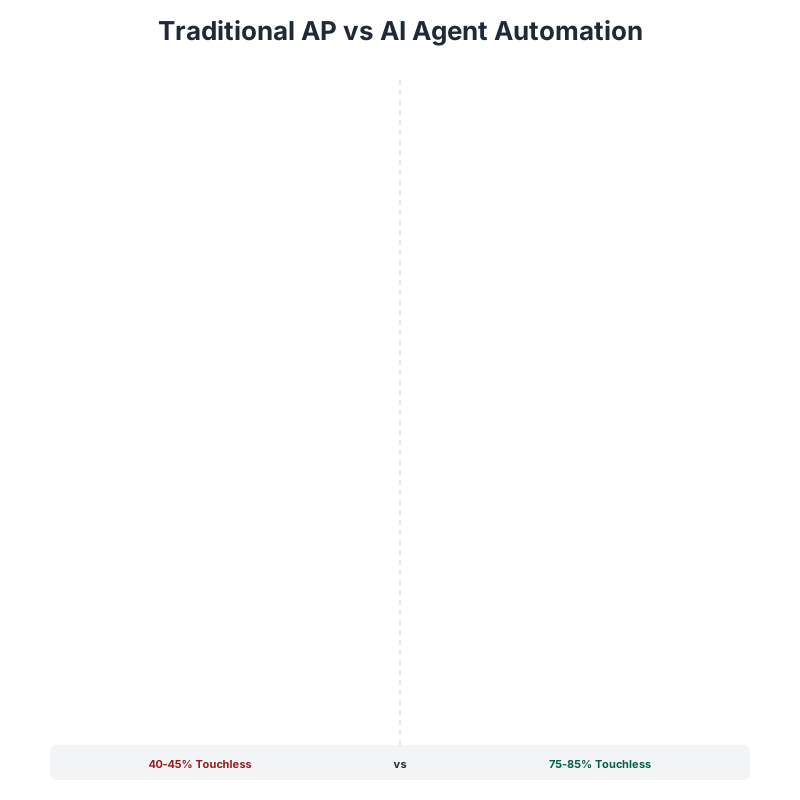
The measurable impact shows up in straight-through processing rates. Industry data from Levvel Research shows that companies using traditional AP automation achieve 40-45% touchless processing on average. The other 55-60% of invoices require some form of manual intervention, whether for extraction errors, matching exceptions, approval routing issues, or ERP posting failures.
Companies deploying AI agent-based AP automation are seeing rates between 75-85% straight-through processing within the first 90 days. The difference comes from how agents handle the cases that traditionally become exceptions. An invoice with 98% confident field extraction that would fail traditional validation rules gets processed autonomously by an agent that understands the context. A three-way match with a 2% quantity variance that would queue for review gets resolved by an agent that checks whether the variance is explained by the goods receipt notes.
The time savings compound across the month. A company processing 5,000 invoices monthly at 40% touchless rate is manually handling 3,000 exceptions. At 15 minutes per exception, that's 750 hours of labor, or roughly five full-time employees. The same company at 80% touchless rate handles 1,000 exceptions at 750 hours total, or just under one full-time equivalent. That's a 80% reduction in exception handling labor.
Cost per invoice follows the same trajectory. The IOFM benchmark of $12-15 for manual processing vs $3-4 for automated processing isn't theoretical. A company processing 5,000 invoices monthly at $12 average cost spends $60,000 monthly on AP processing. Shifting to 80% automation at $3 per touchless invoice and $12 per exception brings the monthly cost to $24,000. That's $432,000 annual savings for a mid-sized AP operation.
The strategic benefit extends beyond cost reduction. Finance teams spending 80% of their time on exception handling can't focus on strategic work like vendor negotiations, payment optimization, or cash flow forecasting. When exception handling drops to 20% of time, AP transforms from a back-office processing function to a strategic finance partner. Teams can analyze early payment discount opportunities, optimize payment timing for cash flow, and negotiate better terms based on payment reliability.
Traditional AP automation requires extensive integration work. Each ERP system has different APIs, different data models, different validation rules, and different posting requirements. SAP requires specific document types and posting keys. NetSuite needs subsidiary and location codes. Dynamics 365 expects dimension combinations. Workday demands cost center and project hierarchies. Each system requires custom integration development that takes weeks to build and months to stabilize.
AI agents learn ERP semantics the same way they learn document formats. They understand that an invoice for consulting services at the Berlin office needs to post to the German subsidiary in NetSuite with EUR currency, German VAT codes, and the Berlin cost center. They know that a Dynamics 365 posting requires the correct combination of legal entity, main account, department, and project dimensions. They can infer missing codes based on context, like determining the correct GL account based on the vendor category and expense description.
This semantic understanding means agents can work across multiple ERP systems with minimal configuration. A company using SAP for manufacturing, NetSuite for retail, and Dynamics 365 for services can deploy a single agent that understands the posting requirements for each system. The agent routes invoices to the appropriate ERP based on the entity, formats the data correctly for that system's API, and handles system-specific validation requirements.
The maintenance burden also shifts. When an ERP system updates its API or changes validation rules, traditional integrations break and require developer time to fix. Agents adapt to API changes because they understand what the system expects semantically, not just what the current API specification says. When SAP introduces a new required field, the agent starts populating it based on context rather than failing all postings until someone updates the integration code.
Cross-system workflows become feasible. An invoice arrives that needs approval from someone in Salesforce, posting to NetSuite, and notification in Slack. Traditional automation requires separate integrations and orchestration logic. An agent handles it as a single workflow: extract invoice data, query Salesforce for the account owner, request approval, wait for response, post to NetSuite with the approval reference, and send the Slack notification. The agent understands the relationships between systems and can coordinate actions across platforms.
Traditional AP automation processes invoices in batches. Invoices arrive throughout the day, extraction runs overnight, validation happens the next morning, and exceptions appear in queues by afternoon. This batching creates lag. A vendor invoice received Monday morning might not show up as an exception until Tuesday afternoon, by which time the AP team has accumulated exceptions from Monday night's batch as well.
Agents process invoices in real-time as they arrive. An email hits the AP inbox, the agent reads it, classifies the attachment, extracts fields, performs matching, routes for approval if needed, and posts to the ERP. The entire process completes in 30-60 seconds for straightforward invoices. If the agent encounters an ambiguity it can't resolve autonomously, it flags the invoice immediately rather than waiting for a batch process to complete.
This real-time processing prevents backlogs from accumulating. Traditional systems create a dynamic where exceptions pile up faster than teams can resolve them, especially during month-end when invoice volumes spike. Teams fall behind, vendors start calling about payment delays, and finance leadership starts asking why processing is taking so long. Real-time agent processing maintains a steady state where exceptions are resolved as they occur.
The workflow integration matters here. When an agent identifies an invoice that needs approval, it doesn't just queue it in the AP system. It sends an approval request directly to the manager via email or Slack, with all relevant context embedded: invoice details, PO information, goods receipt confirmation, and the specific reason approval is needed. The manager approves directly from email without logging into any system. The agent receives the approval, completes the processing, and posts to the ERP. Total cycle time: minutes, not days.
Payment timing becomes more predictable. Vendors expect payment within terms, usually net 30 or net 60. Traditional AP automation introduces unpredictability because invoices sit in exception queues for days or weeks before resolution. With real-time agent processing, invoices are either approved and scheduled for payment the same day they arrive, or they're flagged for resolution immediately. This consistency improves vendor relationships and enables better cash flow management.
The accounts payable automation market hit $1.9 billion in 2025 and continues growing at 17% annually, but most of that spending goes toward tools that still require substantial human oversight. Companies are buying OCR platforms, workflow software, and ERP connectors, then staffing AP teams to handle the exceptions these tools create. The value proposition is marginal: you spend less than full manual processing, but you're still spending significantly on labor.
AI agents change the economic equation. Instead of buying tools that reduce manual work from 100% to 60%, you're deploying agents that reduce it from 100% to 15%. The cost structure shifts from "software plus labor" to "software replacing labor." This doesn't mean eliminating AP teams. It means redirecting them from processing work to strategic work: vendor negotiations, payment optimization, process improvement, and financial analysis.
The implementation path matters. Traditional AP automation requires months of configuration: template training, validation rule definition, workflow design, and integration development. Companies often spend 6-12 months implementing and another 6 months tuning before they see meaningful touchless rates. AI agents compress this timeline. The core agent capability works immediately because it doesn't require configuration. You're spending implementation time on ERP integration, approval workflow design, and change management, not on training extraction models.
The competitive landscape is shifting quickly. Companies that still rely on manual AP processing are falling behind on payment speed, vendor relationships, and cash flow optimization. Companies using traditional automation tools are seeing incremental benefits but not transformation. Companies deploying AI agents are achieving the touchless processing rates that were promised a decade ago but never materialized.
Finance organizations that move first are capturing advantages that compound over time. Faster payment cycles earn early payment discounts. Reliable processing improves vendor relationships and negotiating leverage. Reduced exception handling frees capacity for strategic work. Better visibility into payables enables smarter cash flow management. These advantages accumulate quarter over quarter, creating separation between leaders and laggards.
The immediate opportunity with AI agents is clear: move from 40% touchless processing to 80% within months, eliminate exception backlogs, reduce cost per invoice by 70%, and free AP teams for strategic work. But the longer-term opportunity is more significant. As agents improve, the 80% touchless rate moves toward 95%, then 98%. The remaining exceptions shift from "agent couldn't handle this" to "this requires genuine business judgment" like resolving a contract dispute or approving a significant price increase.
At that point, AP stops being a processing function and becomes a monitoring function. Agents handle all routine work autonomously. Humans oversee, audit, and intervene only when legitimate business questions arise. The finance team's role becomes ensuring agents are operating correctly, investigating anomalies, and making strategic decisions about vendor relationships and payment policies.
This future isn't theoretical. Companies deploying AI agents today are already seeing what becomes possible when exception handling stops consuming all available capacity. AP teams are analyzing payment patterns to identify early payment discount opportunities. They're negotiating better terms based on payment reliability. They're working with procurement to rationalize vendor relationships. They're providing treasury with accurate cash flow forecasts based on real-time payables data.
The technology path forward is clear. Current AI agents are already achieving 75-85% touchless rates on typical business documents. As models improve, agents will handle increasingly complex cases autonomously: multi-currency consolidation, intercompany eliminations, complex allocation rules, and sophisticated matching logic. The agents will also become better at learning organizational preferences, so a company's specific way of handling vendor discrepancies or approval routing gets encoded implicitly through usage patterns.
The question for finance leaders isn't whether AI agents will transform accounts payable. They already are. The question is whether your organization will be among the first to deploy them and capture the competitive advantages, or whether you'll wait until the technology becomes standard and the advantages disappear. The $1.9 billion AP automation market is shifting from traditional tools to autonomous agents. The window to move ahead of competitors is closing.

Head IT Operations - Co Founder of Artificio
See it in your SAP environment
Bring us a document, a process, or a bottleneck. We'll show how Artificio captures, validates, and posts into SAP — then scale from there.
Security & compliance
ISO 27001:2013 certified, SOC 2 Type 2 compliant, GDPR and HIPAA ready. Every agent action is logged, auditable, and runs in isolated environments.