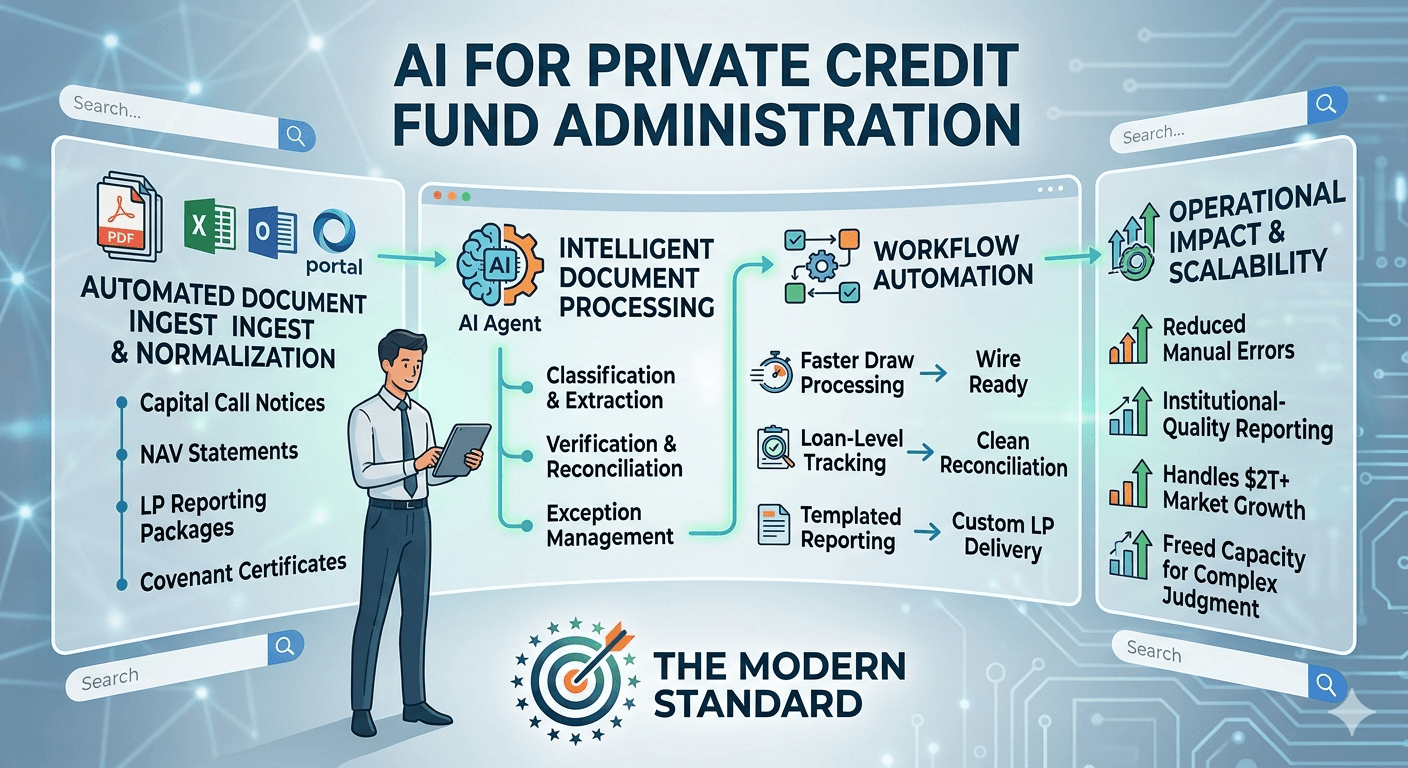
Every quarter, a private credit fund administrator faces the same bottleneck. Hundreds of LP reporting packages, capital call notices with tight settlement windows, and NAV statements that need to be cross-verified across multiple source systems, all landing at once. The documents look different depending on who originated them. The data lives in PDFs, Excel attachments, and portal exports. And the deadline pressure doesn't move.
The traditional answer has been more headcount and more hours. Larger operations teams, careful manual reconciliation, and a lot of late nights before quarter-end. That worked when private credit was a niche corner of the alternatives market. It doesn't scale to where the asset class is today.
Private credit has grown into one of the largest segments of private markets, with global assets under management crossing $2 trillion and still expanding. The operational complexity that comes with that growth, specifically the document processing complexity, is one of the defining challenges facing fund administrators right now.
The Document Problem in Private Credit Administration
Private credit generates a distinctive document workload compared to other alternative asset classes. The loan-level activity is continuous, not just quarterly. A fund with 40-50 portfolio companies might process draw notices, repayment confirmations, interest payment details, and covenant compliance certificates every single month. Add in the fund-level documents, capital call notices, distribution notices, NAV statements, and quarterly LP reports, and the volume adds up fast.
The deeper problem is that these documents aren't standardized. A capital call notice from one borrower won't follow the same format as the next. LP reports are templated internally but customized per investor based on allocation size, co-investment participation, and specific reporting agreements. NAV statements pull from loan administration systems, custody records, and valuation memos that each live in separate places.
Manual extraction from these documents introduces several failure points. Data entry errors on capital call amounts cause wire miscalculations. NAV figures that don't reconcile between the fund accountant and the fund administrator create back-and-forth that delays sign-off. LP reports built from manually copied data inherit every upstream error and take hours to prepare per investor.
The operational risk is real, and so is the reputational risk. LPs increasingly expect institutional-quality reporting delivered on time. If your fund administration operation is visibly strained at quarter-end, that becomes a due diligence conversation.
AI-powered intelligent document processing (IDP) platforms approach fund administration documents differently from traditional OCR tools. Rather than applying template-based extraction that breaks the moment a document format changes, AI agents read documents the way an analyst would, understanding context, identifying fields by meaning rather than position, and flagging discrepancies for human review.
For fund administrators, this matters across three core document categories. 
Capital Call Notices and Subscription Processing
Capital call notices need to be processed accurately and fast. When a borrower issues a draw request, or when the fund calls capital from its LPs, the downstream wire instructions and settlement timelines depend entirely on the figures extracted from that notice: the call amount, the due date, the pro-rata allocation per LP, and the funding account details.
AI document processing can extract these fields from unstructured capital call notices regardless of format, validate the figures against LP commitment records and prior call history, and flag any mismatches before they reach the wire desk. The same logic applies to subscription documents during fund closes, where investor information, commitment amounts, and KYC documentation all need to be matched and verified at scale.
The time savings here aren't trivial. A mid-sized private credit fund running a capital call across 60 LPs might spend two to three days on manual extraction and verification. An AI-powered workflow compresses that to hours, with human review focused only on exceptions rather than routine verification.
NAV Statement Processing and Reconciliation
NAV statements in private credit are more complex than their public market equivalents. Loan values reflect fair value estimates, not market prices. PIK interest accruals need to be tracked separately. Origination fees get amortized over the life of the loan. Each of these components appears differently across different fund accounting systems and custodian reports.
Fund administrators typically receive NAV packages from multiple sources: the fund accountant, the administrator's own systems, and sometimes a third-party valuation agent. Reconciling these isn't just about matching totals. You need to trace individual line items, loan by loan, to find where discrepancies originated.
AI document processing platforms can ingest NAV statements from heterogeneous sources, normalize the data into a common structure, and run automated reconciliation checks. When numbers don't match, the system identifies the specific loan or line item causing the break, rather than leaving analysts to hunt through spreadsheets. Reconciliation exceptions get escalated for human review. Clean items clear automatically.
This changes the capacity equation significantly. Instead of one accountant per X NAV packages, a smaller team handles a much larger book by focusing on genuine exceptions. The work gets more interesting too. The mechanical reconciliation disappears, and the human oversight concentrates where judgment actually matters.
LP Reporting and Investor Documents
LP reporting is where the document complexity really compounds. A private credit fund with 80 limited partners might produce 80 customized quarterly reports, each pulling from the same underlying portfolio data but presenting it differently based on investor preferences, side letter agreements, and allocation specifics.
The source documents for LP reports include portfolio company financials, loan performance data, distribution waterfall calculations, and fund-level performance metrics. In a traditional workflow, an analyst assembles all of this manually, pulling from multiple systems and formatting to LP-specific templates. At 3-4 hours per report, the quarterly reporting cycle consumes weeks of staff time.
AI document processing changes this by automating the extraction and normalization of source data. Once the underlying portfolio and fund data is cleanly structured, LP report generation can run largely automatically, with human review focused on narratives, commentary sections, and any figures that fall outside expected ranges. The 80 reports that used to take three weeks can be drafted in three days.
The quality improvement matters as much as the time savings. Reports built from AI-extracted and reconciled data carry fewer transcription errors. Consistency across investor packages improves. And the audit trail is cleaner, with every data point traceable to its source document.
The Workflow That Makes This Work
Getting from documents to clean fund administration data isn't just about extraction. The workflow needs to handle classification, extraction, validation, and exception routing in a coherent sequence.
When a batch of fund documents arrives, an AI document processing platform first classifies each document: capital call notice, distribution notice, loan repayment confirmation, audited financial statement, LP subscription agreement. Classification accuracy at this stage determines everything downstream, so it needs to be high.
After classification, field extraction runs on each document according to the document type. Capital call notices get fund name, call amount, due date, LP allocation table, and wire instructions extracted. NAV statements get fund totals, per-loan values, and accrual breakdowns. LP reports get commitment amount, funded capital, return figures, and distribution history.
Extracted data then runs through validation rules: cross-checking against prior period data, comparing against master records in the fund administration system, and flagging any values that fall outside expected ranges. Items that pass validation move forward automatically. Items that fail route to a human reviewer with the discrepancy highlighted.
What This Means for Fund Administration Teams
The practical implication for fund administrators isn't that staff get replaced. It's that the same team can service more funds, handle more LPs, and maintain higher accuracy without burning out at quarter-end.
Private credit fund administration has a real capacity problem. The asset class is growing faster than trained professionals can be hired and onboarded. Experienced fund accountants who understand private credit structures are genuinely scarce. The answer can't just be "hire more people." The operational model needs to scale differently.
AI document processing creates that scale by automating the mechanical work: extraction, reconciliation, report population. It preserves the human work that matters: reviewing exceptions, managing LP relationships, understanding complex credit situations, and maintaining the judgment that no system can replace.
For fund administrators pitching new clients, this also becomes a competitive differentiator. Institutional LPs, sovereign wealth funds, and pension allocators are asking detailed questions about operational infrastructure during due diligence. Showing that your document processing and reporting workflow runs on modern AI infrastructure, with clear exception handling and audit trails, carries weight.
The Accuracy Requirement
It's worth being direct about the accuracy bar here. Fund administration documents move money. A wrong figure on a capital call notice or a reconciliation error in an NAV statement has real consequences. Any AI document processing system used in this context needs to meet a higher accuracy standard than typical enterprise document workflows.
The right architecture for fund administration isn't fully automated processing with occasional human review. It's AI-first processing with systematic human oversight at defined checkpoints, and a clear escalation path for anything the system isn't confident about. Confidence scoring on extracted fields lets the system distinguish between high-confidence extractions that can move forward automatically and lower-confidence extractions that need human sign-off.
This hybrid approach captures most of the efficiency gains while preserving the oversight that fund administration requires. In practice, well-trained AI systems handle 85-90% of document processing without exception. The human team focuses on the 10-15% that genuinely needs judgment.
A New Standard for Private Credit Operations
The private credit market isn't slowing down. Direct lending, mezzanine debt, specialty finance, and infrastructure credit are all pulling in institutional capital at scale. The fund administrators who serve this market need operational infrastructure that can grow with it.
Continuing to process capital call notices, NAV statements, and LP reports through manual workflows creates a ceiling on growth. It also creates concentration risk when experienced staff leave and institutional knowledge walks out the door with them.
AI document processing gives fund administration operations a way to break through that ceiling. The documents that used to take teams a week now take a day. The reconciliation breaks that used to require hours of hunting now surface in minutes. The LP reports that used to go out with quiet uncertainty about data quality now get built from verified, traceable sources.
That's not a marginal improvement. For fund administrators operating at scale in private credit, it's the difference between a business that grows sustainably and one that strains under its own success.