

Blog
Using AI in Educational Workflows: The Artificio Approach
Discover how Artificio's AI-driven platform revolutionizes education with smart forms, communication, and workflows.

Blog
Discover how Artificio's AI-driven platform revolutionizes education with smart forms, communication, and workflows.
Educational institutions today face unprecedented challenges. From managing increasing application volumes to maintaining personalized communication with diverse stakeholders, traditional workflows are buckling under the pressure of modern educational demands. A 2023 survey by the National Center for Education Statistics revealed that administrative staff at higher education institutions spend approximately 30% of their time on repetitive document processing tasks that could be automated. This inefficiency not only impacts operational costs but also affects the quality of student and faculty experiences.
In this landscape of increasing complexity, artificial intelligence (AI) offers a transformative pathway forward. Artificio, with its advanced document processing and workflow automation capabilities, presents a comprehensive solution specifically tailored to address the unique challenges faced by educational institutions. By leveraging AI-driven forms, smart communications, and orchestrated workflows, Artificio enables schools, colleges, and universities to dramatically enhance their operational efficiency while improving stakeholder experiences.
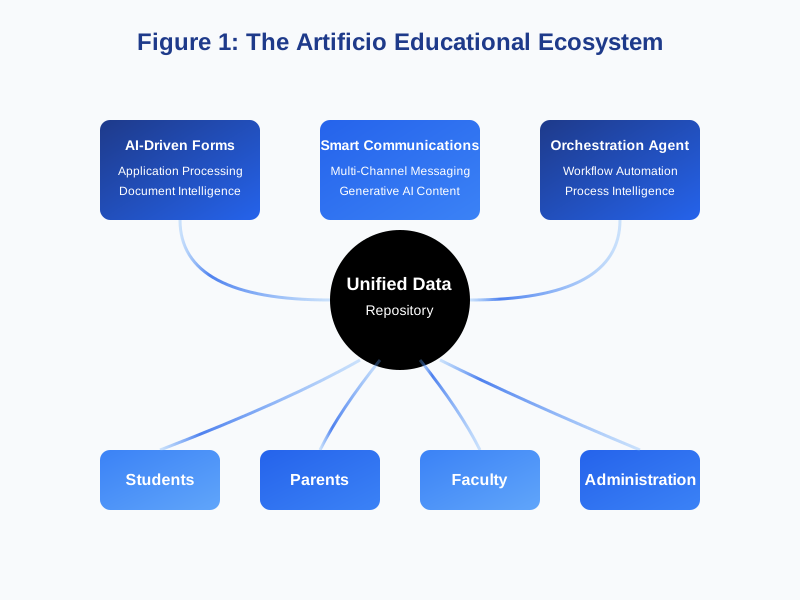
This article explores how Artificio's integrated AI ecosystem creates a seamless experience from application processing to ongoing communications and workflow management. We will examine the three core components of the Artificio educational solution AI-driven forms for application processing, smart communications for stakeholder engagement, and orchestration agents for workflow automation and how they work in concert to transform educational operations. Throughout this analysis, we will reference visual representations (see Figure 1: The Artificio Educational Ecosystem - presented as an SVG diagram in the graphics section) that illustrate these interconnected systems and their collective impact on educational workflows.
The application process represents one of the most document-intensive and time-consuming workflows in any educational institution. Admissions officers at universities report spending an average of 15-20 minutes per application on manual data entry and verification alone, with high-volume institutions processing tens of thousands of applications annually. This translates to thousands of staff hours dedicated to tasks that are largely repetitive and prone to human error.
Traditional application systems typically suffer from several critical limitations:
Artificio's AI-driven forms address these challenges through a sophisticated document intelligence approach that goes far beyond traditional form digitization.
At the heart of Artificio's application processing solution is its advanced document intelligence engine. Unlike conventional form builders that simply digitize paper processes, Artificio's system combines natural language processing, computer vision, and machine learning to create truly intelligent application forms.
The system begins by analyzing existing application documents and processes to identify key information requirements. Using this analysis, it automatically generates intelligent digital forms that not only capture structured data but also adaptively respond to applicant inputs. For instance, when a prospective student indicates a specific academic interest, the form dynamically adjusts to request relevant information about related experiences or qualifications.
More importantly, Artificio's document processing extends to supporting materials that accompany applications. The platform can automatically extract relevant data from transcripts, recommendation letters, financial documents, and identification papers. For educational institutions, this capability is transformative what once required hours of manual review can now be accomplished in seconds with greater accuracy.
As illustrated in Figure 1 (refer to the comprehensive ecosystem SVG diagram), the document intelligence layer serves as the foundation for the entire Artificio ecosystem. By creating a unified data structure from diverse application inputs, it establishes a single source of truth that powers all subsequent communications and workflow processes.
Artificio's application processing extends beyond simple data extraction to include sophisticated verification and enrichment capabilities. The system can automatically cross-reference applicant-provided information against internal databases and, where appropriate, external verification sources. This helps identify discrepancies or missing information early in the process, reducing the administrative burden of follow-up communication.
Additionally, the AI engine enriches captured data by inferring valuable insights from application materials. For example, by analyzing a student's academic history, extracurricular activities, and personal statement, the system can generate preliminary assessments of fit with different programs or identify candidates for specific scholarships. These enrichments are presented to admissions staff as actionable insights rather than raw data, further streamlining the decision-making process.
For faculty applications, the system performs similar intelligence functions but adapts to the different documentation requirements. It can analyze academic CVs to extract publication histories, teaching experience, and research specializations, creating structured profiles that simplify the hiring committee's review process.
The transformative impact of this approach is evident in institutions that have implemented Artificio's solution. One midsize liberal arts college reported a 65% reduction in application processing time and a 40% decrease in data entry errors after deploying Artificio's AI-driven forms. Perhaps more significantly, the admissions staff reported being able to shift their focus from data processing to more meaningful applicant evaluation, leading to improved selection outcomes.
Communication lies at the heart of educational operations, serving as the connective tissue between institutions and their diverse stakeholders students, parents, faculty, and administrative staff. Yet many educational institutions struggle with communication challenges that undermine their effectiveness. According to a recent study by the Educational Communications Consortium, 67% of educational institutions report difficulties in maintaining personalized, timely communications across their stakeholder ecosystem.
Traditional communication approaches in education suffer from several limitations:
Educational institutions typically manage separate communication channels (email, SMS, postal mail) through disconnected systems, creating fragmented stakeholder experiences. Communications often follow rigid templates that fail to reflect the unique relationship between the institution and each stakeholder. Many institutions lack the data infrastructure to effectively segment and target communications based on stakeholder profiles and historical interactions. Manual communication workflows create bottlenecks that delay time-sensitive information, particularly during peak periods like application seasons or semester transitions.
Artificio's smart communications platform addresses these challenges by creating an integrated, AI-powered system that leverages stakeholder data to deliver personalized, contextually relevant communications across multiple channels.
Artificio revolutionizes educational communications by shifting from document-centric to relationship-centric models. The platform builds comprehensive stakeholder profiles by integrating data from application forms, academic records, communication histories, and interaction patterns. These profiles serve as the foundation for intelligent communication that recognizes the multidimensional nature of each stakeholder's relationship with the institution.
As illustrated in Figure 2: The Artificio Smart Communications Framework (see the communication flow diagram in the SVG section below), the system creates a dynamic relationship map that connects students, parents, faculty, and administrative staff. This relationship mapping allows communications to reflect not only direct relationships (e.g., between student and instructor) but also indirect relationships (e.g., between parent and instructor) with appropriate contextual awareness.
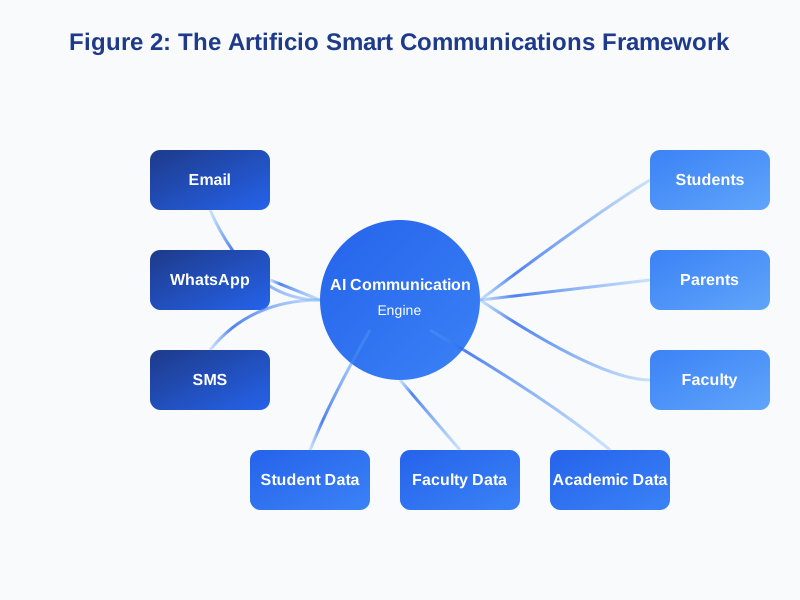
The impact of this approach is particularly evident in complex educational scenarios. For instance, when a student requests academic accommodation, the system can automatically generate different but coordinated communications to the student, relevant faculty members, academic advisors, and administrative staff each message containing information appropriate to the recipient's role while maintaining a coherent overall narrative.
At the technical heart of Artificio's communication platform is its advanced generative AI engine, which transforms basic communication intents into richly contextualized messages optimized for different delivery channels. The system moves beyond simple template substitution to true content generation, creating messages that authentically reflect the institution's voice while adapting to each stakeholder's communication preferences and history.
For example, when notifying students about registration deadlines, the system might generate:
A detailed email explaining the registration process with personalized course recommendations based on the student's academic history A concise WhatsApp message highlighting critical deadlines with direct links to registration resources A calendar integration containing scheduled reminders that align with the student's demonstrated planning patterns
This multi-channel approach reflects the reality of modern communication preferences. Generation Z students overwhelmingly prefer messaging platforms like WhatsApp for operational communications, while parents often prefer email for substantive updates about academic progress or financial matters. Artificio's platform respects these preferences while maintaining communication coherence across channels.
The generative AI capabilities extend beyond channel optimization to include contextual sensitivity. The system recognizes different communication scenarios and adapts accordingly distinguishing, for instance, between routine operational messages, academic performance discussions, and community-building communications. Each scenario triggers different tonal and content parameters in the generative process.
One of the most significant challenges in educational communications is maintaining personal connection while operating at institutional scale. Artificio's platform achieves this balance through sophisticated personalization that operates at multiple levels:
Content personalization based on stakeholder data ensures that communications reflect each recipient's specific situation, preferences, and history with the institution. Timing personalization analyzes historical engagement patterns to identify optimal delivery windows for different stakeholders and message types. Frequency management prevents communication fatigue by coordinating across departments and message types to maintain appropriate overall communication volume. Feedback loops capture explicit and implicit responses to communications, continuously refining the system's understanding of stakeholder preferences.
This multi-layered personalization creates communications that feel handcrafted despite being generated at scale. A mid-sized community college implementing Artificio's communication platform reported that student survey responses to the question "The college communicates with me in a personal way" increased from 34% positive to 78% positive after six months of implementation—despite sending approximately the same volume of communications.
Artificio's communication platform achieves its full potential through seamless integration with academic workflows. The system connects directly to learning management systems, student information systems, and other educational platforms to ensure communications reflect real-time academic contexts.
For faculty members, this integration dramatically simplifies routine communications. When a professor grades assignments in the learning management system, Artificio can automatically generate personalized feedback messages that combine the professor's assessment with relevant learning resources based on each student's performance pattern. The professor reviews these generated messages before sending, making adjustments as needed, but the cognitive burden of crafting individualized feedback is substantially reduced.
Similarly, for administrative staff, the platform automates contextual communications triggered by workflow events. When a student submits a financial aid application, for example, the system generates appropriate acknowledgment messages, updates on processing status, and requests for additional information if needed all personalized to the student's specific situation and delivered through their preferred channels.
This integration of communications with academic workflows represents a significant advancement over traditional approaches, where communication typically functions as a separate, often disconnected process layered on top of educational operations. By embedding intelligent communication directly into these workflows, Artificio creates a more cohesive, responsive educational environment that enhances both operational efficiency and stakeholder experience.
Educational institutions operate through a complex web of interdependent workflows that span academic, administrative, and operational domains. These workflows frequently cross departmental boundaries, involve multiple stakeholders, and require specialized handling based on contextual factors. Research from the Institute for Educational Management indicates that the average higher education institution maintains over 200 distinct operational workflows, with many of these workflows evolving annually in response to policy changes, technological shifts, and evolving student needs.
Traditional approaches to workflow management in education face several significant limitations:
Many educational workflows remain paper-based or rely on basic digital forms without true process automation. Cross-departmental workflows often create handoff problems when transitioning between different institutional systems. Most workflow solutions lack the flexibility to accommodate the numerous exceptions and edge cases common in educational contexts. Workflow visibility is typically limited, making it difficult for stakeholders to understand process status or expected timelines.
Artificio's orchestration agent technology addresses these challenges by creating a conversation-driven approach to workflow management specifically designed for the complex, nuanced environment of educational institutions.
At the center of Artificio's workflow solution is the orchestration agent an AI-powered system that coordinates educational workflows through natural language interactions rather than rigid process maps. As depicted in Figure 3: The Artificio Workflow Orchestration Model (see SVG diagram in the graphics section), this agent serves as the central nervous system for institutional operations, intelligently routing information, automating decisions where appropriate, and facilitating human intervention when necessary.
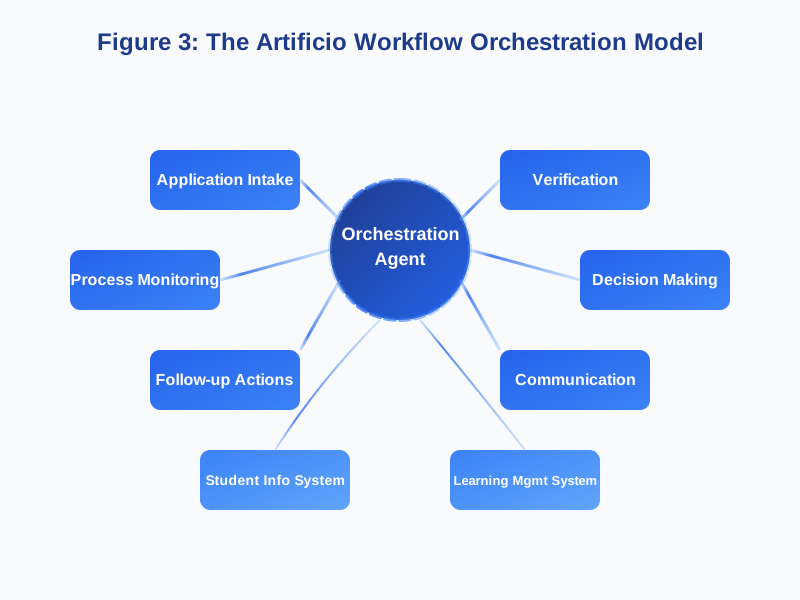
The conversation-driven approach represents a fundamental departure from traditional workflow automation. Rather than forcing educational processes into predefined paths, the orchestration agent adapts workflows dynamically based on contextual understanding of the specific case at hand. This fluid approach allows educational institutions to maintain process consistency where beneficial while accommodating the nuanced handling that educational scenarios often require.
For example, in a student registration workflow, the orchestration agent might:
This intelligent routing occurs through natural language interpretation of contextual factors rather than rigid rule sets, enabling the system to handle the ambiguity and complexity inherent in educational operations.
Educational institutions vary tremendously in their organizational structures, policies, and operational approaches. Recognizing this diversity, Artificio provides a flexible framework for defining custom workflows that reflect each institution's unique requirements and organizational culture.
The workflow definition process itself embodies Artificio's conversation-driven philosophy. Rather than requiring technical modeling of process flows, the platform allows administrators to describe workflows in natural language, with the AI system interpreting these descriptions and translating them into executable processes. For more complex workflows, the system engages in iterative dialogues, asking clarifying questions to resolve ambiguities and ensure accurate implementation.
This approach dramatically reduces the technical barriers to workflow automation, empowering educational administrators to directly translate their operational knowledge into functional systems without extensive technical mediation. A registrar can, for instance, describe the nuanced process for handling transfer credit evaluations, including all the conditional paths and exception handling, and have that process implemented within the Artificio system without writing a single line of code or creating a traditional process model.
The resulting workflows combine structured process elements with AI-powered decision points, creating systems that are simultaneously consistent and adaptable. As shown in Figure 3, these workflows connect seamlessly with the document processing and communication components of the Artificio ecosystem, ensuring that relevant information flows freely between systems without manual intervention.
Beyond basic process automation, Artificio's orchestration agent provides sophisticated decision support capabilities that enhance human judgment rather than attempting to replace it. The system analyzes historical workflow patterns, identifies decision factors that have influenced similar cases in the past, and presents this contextual intelligence to human decision-makers at appropriate points in the process.
For faculty promotion workflows, for instance, the orchestration agent might analyze patterns from previous promotion cases to identify factors that commonly influence outcomes, helping committee members ensure consistent application of evaluation criteria. Similarly, for financial aid decisions, the system might highlight comparable cases that establish precedent for handling unusual financial circumstances.
This decision support functionality extends to process optimization through continuous analysis of workflow performance. The orchestration agent automatically identifies bottlenecks, recurring exceptions, and process variations, providing administrators with actionable insights to refine workflows over time. This creates a virtuous cycle of continuous improvement, with each workflow iteration becoming more efficient and effective based on operational experience.
Perhaps the most powerful aspect of Artificio's workflow orchestration is its thoughtful integration of human and artificial intelligence. Rather than pursuing full automation as an end goal, the platform explicitly recognizes the complementary strengths of human and machine intelligence in educational contexts.
The orchestration agent serves as an intelligent assistant that handles routine aspects of workflows while deferring to human judgment for decisions requiring empathy, ethical consideration, or institutional wisdom. This collaboration is facilitated through conversational interfaces that allow administrators, faculty, and staff to naturally interact with the system, providing guidance that shapes automated processes.
For example, in a student intervention workflow triggered by identification of academic risk factors, the orchestration agent might:
In this scenario, the system handles the computational complexity of identifying risk patterns and coordinating responses, while human advisors provide the empathetic judgment necessary to determine the most appropriate intervention for each student's unique circumstances.
This harmonious integration of human and artificial intelligence represents the future of educational operations combining the efficiency and consistency of automated systems with the wisdom and compassion of experienced educators. As illustrated throughout the Artificio ecosystem diagram (Figure 1), this integration creates a continuous feedback loop between human and machine intelligence, with each enhancing the effectiveness of the other.
To illustrate the transformative impact of Artificio's orchestration approach, consider the experience of a medium-sized state university that implemented the platform across its enrollment management division. Prior to implementation, the university maintained 47 distinct workflow systems to manage applications, registration, financial aid, and student services. These disconnected systems created numerous handoff problems, data inconsistencies, and communication challenges.
After implementing Artificio's orchestration agent, the university consolidated these disparate workflows into a unified ecosystem with the orchestration agent coordinating processes across departmental boundaries. The impact was profound:
Beyond these operational improvements, the university reported significant cultural benefits. Staff members described shifting from "document processors" to "student success agents" as the orchestration system freed them from routine tasks and allowed them to focus on meaningful student interactions. Faculty noted improved collaboration with administrative departments as workflow visibility increased, creating greater procedural transparency.
The university's experience exemplifies the holistic benefits of Artificio's approach—not merely making existing processes more efficient but fundamentally transforming how educational institutions operate and how staff members engage with their work. This transformation extends beyond technical systems to encompass the human experience of education, creating an environment where technology enhances rather than constrains educational relationships.
The educational landscape is undergoing profound transformation, driven by increasing operational complexity, evolving stakeholder expectations, and the imperative to deliver personalized educational experiences at institutional scale. In this environment, the fragmented, document-centric approaches of the past are rapidly becoming untenable, creating an urgent need for integrated, intelligent operational systems.
Artificio's comprehensive approach combining AI-driven forms, smart communications, and conversation-driven workflow orchestration represents a new paradigm for educational operations. By creating a unified ecosystem where these components work in concert (as visualized in Figure 1), the platform enables educational institutions to achieve operational excellence while enhancing the human experience of education for all stakeholders.
The power of this integrated approach lies not merely in the sophistication of its individual components but in the synergies created through their interconnection. Data captured through intelligent forms flows seamlessly into personalized communications. Communication patterns inform workflow optimization. Workflow insights enhance document processing. These interconnections create a continuously evolving system that becomes more effective over time, adapting to the unique operational characteristics of each institution.
Perhaps most importantly, Artificio's approach recognizes that technology serves human purposes in educational contexts. The platform is designed not to replace human judgment but to enhance it handling routine processes at scale while creating space for educators to focus on the relational aspects of education that truly transform lives. By embedding this philosophy throughout its design, Artificio creates educational technology that serves rather than subverts the fundamental human purpose of education.
As educational institutions navigate an increasingly complex operational environment, this integrated, human-centered approach offers a compelling path forward—one that embraces the efficiency of modern technology while preserving the essential humanity of educational relationships. Through Artificio's innovative platform, educational institutions can transcend operational constraints to fulfill their most important mission: creating transformative learning environments where every student can thrive.

Head IT Operations - Co Founder of Artificio
See it in your SAP environment
Bring us a document, a process, or a bottleneck. We'll show how Artificio captures, validates, and posts into SAP — then scale from there.
Security & compliance
ISO 27001:2013 certified, SOC 2 Type 2 compliant, GDPR and HIPAA ready. Every agent action is logged, auditable, and runs in isolated environments.