

Blog
How Artificio's Resume API Transforms Talent Acquisition
Artificio's Resume API automates data extraction, improving hiring efficiency and candidate experience.

Blog
Artificio's Resume API automates data extraction, improving hiring efficiency and candidate experience.
In today's competitive talent marketplace, organizations face unprecedented challenges in efficiently identifying, evaluating, and securing top-tier candidates. The traditional recruitment process characterized by manual resume screening, data entry, and candidate evaluation has become increasingly unsustainable as application volumes grow and talent expectations evolve. Human resources departments and recruitment professionals find themselves dedicating substantial time to administrative tasks rather than strategic talent acquisition activities, resulting in prolonged hiring cycles, increased costs, and potential missed opportunities with exceptional candidates.
Artificio, leveraging its expertise in artificial intelligence and machine learning for document processing, has developed a revolutionary Resume API designed to address these fundamental challenges. This sophisticated solution represents a paradigm shift in how organizations process, analyze, and leverage candidate information throughout the recruitment lifecycle. By automating the extraction and standardization of critical resume data, Artificio's Resume API enables recruitment teams to dramatically improve operational efficiency while enhancing decision-making quality and candidate experience.
This article explores the transformative capabilities of Artificio's Resume API, examining its technical foundations, practical applications, and strategic benefits for organizations seeking to optimize their talent acquisition processes in an increasingly competitive landscape.
The recruitment landscape has undergone significant transformation in recent years, driven by several converging factors that have fundamentally altered how organizations approach talent acquisition:
Increasing Application Volumes: Digital job platforms have dramatically expanded candidate reach, resulting in substantial increases in application volumes. According to recent industry research, corporate job openings receive an average of 250 applications per position, with this number increasing substantially for roles in high-demand sectors or with prominent employers. Recruitment teams must efficiently process this volume while maintaining high standards of candidate evaluation.
Rising Candidate Expectations: Today's candidates expect streamlined, responsive recruitment processes. Research indicates that 60% of job seekers have abandoned applications due to their length or complexity, while 72% report that their impression of a company is significantly influenced by the application experience. Organizations with cumbersome application processes risk losing high-quality candidates before even reaching the evaluation stage.
Resource Constraints: Despite growing application volumes and expectations, recruitment teams often face resource limitations. The Society for Human Resource Management estimates that the average cost-per-hire exceeds $4,000, with a significant portion attributed to administrative processing. This creates pressure to maximize efficiency without compromising evaluation quality.
Data Quality Challenges: Traditional resume processing methods produce inconsistent results, with studies showing error rates between 5-15% in manual data entry. These inconsistencies undermine comparative analysis, introduce bias, and compromise data-driven decision-making throughout the recruitment process.
These challenges converge to create a complex operational environment where traditional, manual-intensive approaches to resume processing have become increasingly untenable. The limitations of conventional methods are illustrated in Figure 1, which depicts the efficiency gaps in traditional resume processing workflows.
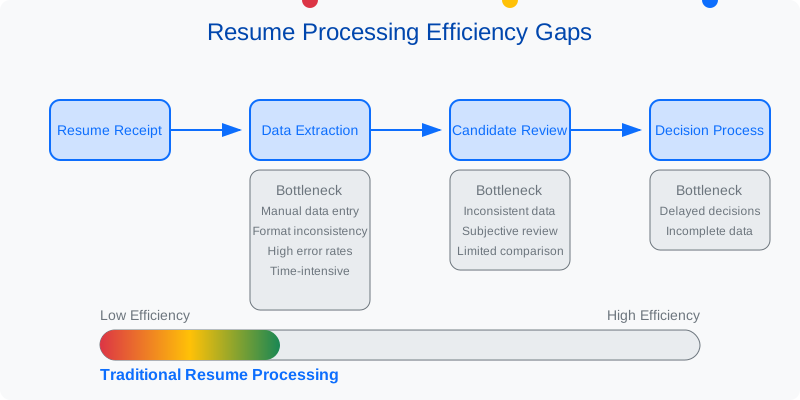
As shown in Figure 1, traditional resume processing creates multiple bottlenecks throughout the recruitment workflow, with particularly significant inefficiencies in initial data extraction and standardization. These inefficiencies not only increase administrative burden but also delay candidate evaluation, potentially resulting in the loss of high-quality candidates to more responsive competitors.
Artificio's Resume API represents the culmination of advanced technological capabilities developed through years of research and practical application in document processing. The system architecture leverages multiple artificial intelligence disciplines to deliver exceptional accuracy and comprehensiveness in resume data extraction:
Advanced Optical Character Recognition (OCR): The foundation of the Resume API is a sophisticated OCR system specifically optimized for the diverse formatting, typography, and layout characteristics common in professional resumes. Unlike general-purpose OCR solutions, Artificio's system has been trained on tens of thousands of resume examples across industries, professional levels, and geographic regions. This specialized training enables the system to accurately process complex resume layouts, including multi-column formats, graphical elements, and varied typographical styles that often confuse standard OCR systems.
Natural Language Processing (NLP): Building upon the extracted text, Artificio's NLP engine analyzes the semantic content of resumes to identify and categorize information. The system employs contextual analysis to distinguish between different types of information—differentiating, for example, between a university where a candidate studied versus one where they were employed. This contextual understanding enables accurate categorization even when standard section headings are absent or non-conventional terminology is used.
Machine Learning Classification: Artificio's Resume API utilizes multiple specialized machine learning models to classify and validate extracted information. These models have been trained on millions of data points to recognize patterns in how information is presented across different resume styles and professional domains. This enables the system to correctly identify and categorize information even when it appears in unexpected locations or formats within the document.
Structured Data Transformation: Once information has been extracted and classified, the API transforms unstructured resume content into consistently structured data objects. This transformation process applies standardization rules to create normalized representations of complex information such as employment histories, educational qualifications, and skill sets. The resulting structured data conforms to standardized schemas that facilitate seamless integration with applicant tracking systems, HRIS platforms, and other recruitment technologies.
The technical architecture of the Resume API is illustrated in Figure 2, which depicts the multi-stage processing pipeline from document input to structured data output.
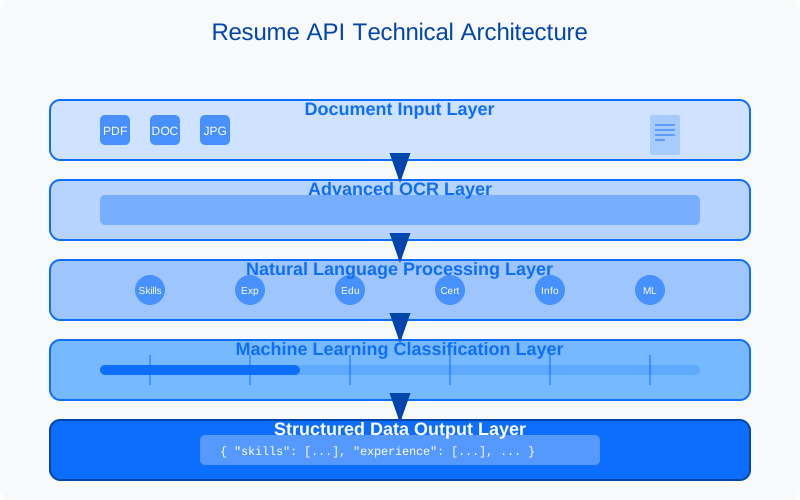
As shown in Figure 2, the Resume API employs a sequential processing approach that progressively refines raw document input into increasingly structured and validated information. This architecture ensures both comprehensiveness in data extraction and consistency in output formatting, addressing two critical requirements for effective resume processing in enterprise recruitment environments.
The technical sophistication of Artificio's Resume API translates directly into practical advantages for recruitment operations. The following section examines these advantages in detail, exploring how the API's capabilities address specific operational challenges in modern talent acquisition processes.
The technical capabilities of Artificio's Resume API translate into substantial operational advantages for recruitment teams across organizations of all sizes. These advantages address the core challenges of modern recruitment workflows, enabling transformative improvements in efficiency, accuracy, and candidate experience.
One of the most immediate and significant benefits of Artificio's Resume API is the complete elimination of manual data entry from the resume processing workflow. Traditional approaches to resume handling typically involve recruitment team members manually transferring information from candidate documents into applicant tracking systems or other recruitment databases. This process is not only time-consuming but also introduces substantial risk of transcription errors, omissions, and inconsistencies.
Artificio's Resume API automates this process entirely, accurately extracting all relevant information from resume documents regardless of their format, layout, or complexity. The system processes resumes in multiple file formats including PDF, DOCX, JPEG, and PNG, accommodating the diversity of document types commonly submitted by candidates. This automation delivers multiple operational benefits:
Time Efficiency: Organizations implementing Artificio's Resume API have reported time savings of 75-90% in resume processing compared to manual methods. For a typical corporate recruitment team processing 1,000 resumes monthly, this can translate to 120-180 hours of reclaimed professional time equivalent to a full-time position that can be redirected toward value-added recruitment activities.
Consistency and Standardization: The API processes all resumes using consistent extraction and classification rules, eliminating the variability inherent in manual processing. This standardization ensures that all candidate information is captured with the same level of detail and organized according to consistent structural patterns, facilitating fair and comprehensive comparison.
Volume Scalability: While manual processing capacity is directly constrained by available human resources, Artificio's Resume API offers virtually unlimited scaling capability. The system can process hundreds or thousands of resumes simultaneously without degradation in extraction quality or processing speed, enabling recruitment teams to efficiently handle volume fluctuations without operational disruption.
Error Reduction: Comparative analysis has demonstrated that Artificio's Resume API reduces data extraction errors by over 95% compared to manual methods. This dramatic improvement in accuracy ensures that recruitment decisions are based on complete and correct candidate information, reducing the risk of overlooking qualified candidates due to data capture errors.
Beyond mere automation, Artificio's Resume API distinguishes itself through the comprehensiveness of its data extraction capabilities. The system is engineered to identify and capture all relevant information presented in candidate resumes, even when this information is presented in non-standard formats or unconventional document structures.
The exhaustive nature of this data collection enables the creation of remarkably comprehensive candidate profiles, encompassing not only basic biographical and contact information but also detailed professional histories, educational qualifications, technical and interpersonal skills, certifications, language proficiencies, and other relevant attributes. The completeness of these profiles delivers significant advantages throughout the recruitment process:
Enhanced Candidate Matching: Complete candidate profiles enable more sophisticated matching algorithms to identify optimal alignment between candidate qualifications and position requirements. This improves the quality of candidate shortlists and increases the probability of successful placement.
Deeper Candidate Insights: Comprehensive data extraction reveals patterns and connections within candidate histories that might be overlooked in less thorough analyses. For example, the system can identify progressive responsibility growth across multiple positions or recognize transferable skills developed across different industry contexts.
Improved Compliance Documentation: The exhaustive capture of candidate information ensures that recruitment teams maintain complete records of all submitted qualifications and claims. This comprehensive documentation supports compliance with record-keeping requirements and provides reference information for background verification processes.
Data-Driven Recruitment Analytics: Rich, structured candidate data enables sophisticated analytics that can reveal valuable insights about candidate pools, qualification distributions, and market trends. These analytics support strategic recruitment planning and process optimization beyond individual hiring decisions.
The extensive field coverage of Artificio's Resume API is illustrated in Figure 3, which shows the comprehensive range of data points extracted from candidate resumes.
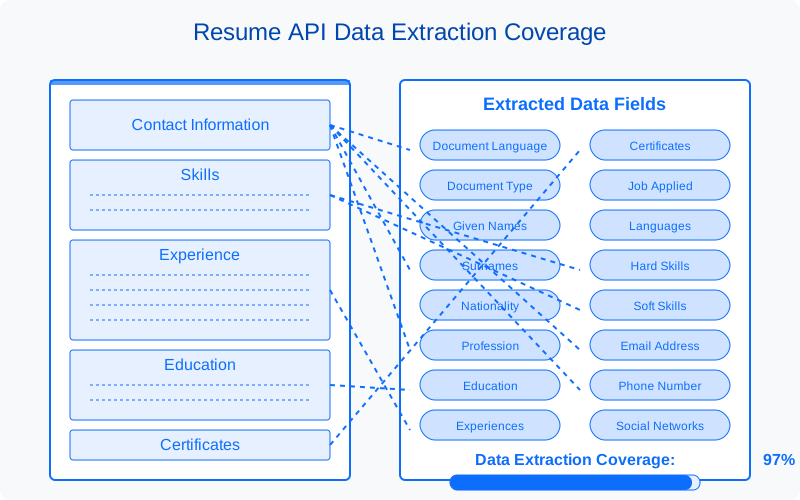
As illustrated in Figure 3, Artificio's Resume API captures a substantially broader range of data points than conventional resume processing systems. This comprehensive data capture ensures that recruitment teams have access to the complete set of information needed for thorough candidate evaluation and comparison.
A particularly significant advantage of Artificio's Resume API is its ability to maintain exceptional accuracy across the diverse range of resume formats and layouts encountered in real-world recruitment scenarios. Traditional resume parsing systems often struggle with non-standard document structures, creative layouts, or industry-specific formatting conventions. These limitations frequently result in missed information, incorrect categorization, or complete processing failures when handling complex resume documents.
Artificio's system addresses these limitations through a combination of advanced computer vision techniques, specialized OCR optimization, and contextual analysis capabilities. These technologies enable the API to accurately process resumes regardless of their visual presentation or organizational structure. This layout-independent processing delivers several key advantages:
Consistent Performance Across Document Types: The system maintains high accuracy regardless of whether resumes follow traditional chronological formats, functional structures, combination approaches, or creative designs. This consistency eliminates the need for candidates to conform to specific template requirements, improving the candidate experience and broadening the accessible talent pool.
Industry-Specific Terminology Recognition: Artificio's Resume API includes specialized models trained to recognize and correctly interpret industry-specific terminology, abbreviations, and credentials across multiple professional domains including technology, healthcare, finance, legal, engineering, and creative fields. This specialized recognition ensures accurate processing of industry-specific resumes that often confuse general-purpose parsers.
International Format Accommodation: The system effectively processes resumes conforming to international formatting conventions from diverse geographic regions, including variations in date formats, educational qualification descriptions, and professional title nomenclature. This international capability is particularly valuable for organizations recruiting across multiple countries or regions.
Complex Element Handling: Artificio's Resume API accurately processes complex resume elements that challenge conventional parsers, including tables, bullet point hierarchies, sidebar information, header/footer content, and graphical skill representations. This comprehensive element processing ensures that no relevant information is overlooked regardless of how it is presented visually.
Comparative accuracy testing has demonstrated that Artificio's Resume API maintains extraction accuracy above 97% across all common resume formats, with particularly significant performance advantages when processing complex or non-traditional document layouts. This exceptional accuracy ensures that recruitment decisions are based on complete information regardless of candidates' resume formatting choices or design preferences.
A critical consideration in evaluating any recruitment technology is the ease with which it can be integrated into existing workflows and systems. Artificio has designed its Resume API with implementation efficiency as a core priority, providing multiple integration approaches to accommodate diverse technical environments and operational requirements.
The API offers comprehensive client libraries for all major programming languages including Python, JavaScript, Java, Ruby, and .NET, enabling straightforward implementation across diverse technology stacks. These libraries provide intuitive interfaces for API interaction, incorporating best practices for error handling, request optimization, and response processing.
In addition to client libraries, Artificio provides detailed implementation documentation, sample code repositories, and integration tutorials that accelerate the development process. The company's technical support team offers personalized implementation guidance, including architecture consultation and integration planning for complex environments.
For organizations with limited technical resources, Artificio also offers pre-built integrations with major applicant tracking systems and recruitment platforms. These ready-to-use connectors enable rapid deployment without custom development requirements, allowing recruitment teams to begin benefiting from automated resume processing with minimal technical overhead.
The implementation efficiency of Artificio's Resume API delivers several notable advantages:
Rapid Time-to-Value: Organizations typically achieve full production implementation within 2-4 weeks, significantly faster than the 3-6 month timeframes common for comparable recruitment technologies. This accelerated deployment enables organizations to quickly realize the operational benefits of automated resume processing.
Minimal Resource Requirements: The straightforward integration approach requires limited technical resources, with implementation typically requiring 20-40 hours of developer time for standard scenarios. This efficiency minimizes implementation costs and reduces competition for scarce technical resources.
Flexible Architecture Accommodation: The API's modular design and multiple integration options enable effective implementation across diverse technical architectures, including cloud-native environments, on-premises systems, and hybrid deployments. This flexibility ensures compatibility with existing technology investments.
Incremental Adoption Options: Organizations can implement the Resume API incrementally, beginning with specific recruitment workflows or departments before expanding to enterprise-wide deployment. This phased approach manages change effectively while demonstrating value to stakeholders.
The implementation efficiency of Artificio's Resume API significantly reduces the barriers to adoption typically associated with advanced recruitment technologies. This accessibility enables organizations to rapidly transform their resume processing workflows without disruptive technical projects or significant resource investments.
While the operational efficiencies delivered by Artificio's Resume API are significant, the strategic value of the solution extends far beyond process automation. By fundamentally transforming how organizations capture, structure, and leverage candidate information, the Resume API enables strategic improvements throughout the recruitment ecosystem from initial candidate experience through final placement and ongoing talent relationship management.
In today's competitive talent market, candidate experience has emerged as a critical differentiator in successful recruitment strategies. Research by the Talent Board indicates that candidates who report positive application experiences are 38% more likely to accept job offers and 78% more likely to refer others to the organization, creating substantial competitive advantages in talent acquisition.
Artificio's Resume API significantly enhances candidate experience through several complementary mechanisms:
Simplified Application Process: By extracting comprehensive information directly from submitted resumes, the API dramatically reduces or eliminates the need for candidates to manually re-enter information that already exists in their documents. This reduction in redundant data entry has been shown to increase application completion rates by 35-50% in implementations across various industries.
Faster Response Cycles: The automated extraction and structuring of candidate information enable recruitment teams to evaluate applications more rapidly and provide faster feedback to candidates. Organizations implementing Artificio's Resume API have reported 40-60% reductions in initial response times, substantially improving candidate perceptions of organizational responsiveness.
Improved Information Accuracy: The API's accurate extraction ensures that candidates are evaluated based on their actual qualifications rather than potentially error-prone manual data entry. This accuracy reduces frustrating scenarios where candidates must correct misinterpreted information during later stages of the recruitment process.
Personalized Communication: The structured data produced by the Resume API enables more sophisticated personalization in candidate communications. Recruitment teams can reference specific qualifications, experiences, or skills extracted from resumes, demonstrating careful attention to candidate information and increasing engagement throughout the process.
The impact of these experience enhancements extends beyond individual candidate satisfaction to generate substantial benefits for organizational recruitment outcomes. By improving application completion rates and candidate engagement, organizations expand their effective talent pools and increase the likelihood of identifying optimal candidates for open positions.
The structured, consistent data generated by Artificio's Resume API enables significant process optimizations throughout the hiring workflow. Traditional recruitment processes are frequently hampered by inconsistent information formats, manual handoffs between stages, and redundant evaluation activities. By providing a standardized information foundation, the Resume API facilitates streamlined workflows that reduce time-to-hire while improving decision quality.
Key process improvements enabled by the Resume API include:
Automated Initial Screening: The comprehensive structured data extracted from resumes enables sophisticated automated screening based on precise qualification requirements. This automation allows recruitment teams to quickly identify candidates who meet core criteria, reducing the initial candidate pool to a manageable size without manual review.
Comparative Evaluation Frameworks: The consistent data structure across all candidate profiles facilitates side-by-side comparison using standardized evaluation frameworks. This structured comparison reduces subjectivity in candidate assessment and ensures that all candidates are evaluated against consistent criteria.
Streamlined Handoffs Between Stages: As candidates progress through the recruitment process, structured profile data enables efficient handoffs between different stakeholders. Hiring managers, interview teams, and HR personnel all access the same comprehensive, structured information, eliminating redundant data collection and reducing communication gaps.
Data-Driven Process Optimization: The structured data generated through the Resume API creates a foundation for sophisticated process analytics. Organizations can analyze progression metrics, identify process bottlenecks, and implement targeted optimizations based on quantitative insights rather than subjective impressions.
Organizations implementing Artificio's Resume API have reported average reductions in time-to-hire of 30-40%, with some achieving improvements of over 50% for specific role categories. These efficiency gains translate directly into competitive advantages in securing top talent and reducing vacancy costs, particularly in high-demand professional domains where candidate availability windows are often limited.
The high-accuracy extraction provided by Artificio's Resume API significantly reduces error rates throughout the recruitment process. Traditional manual data entry typically produces error rates between 5-15% when transferring resume information into recruitment systems. These errors create substantial downstream consequences including:
Candidate Misclassification: Errors in qualification data may cause qualified candidates to be incorrectly screened out or unqualified candidates to progress unnecessarily through evaluation stages.
Wasted Interview Resources: Inaccurate candidate profiles may result in interview invitations for candidates who lack required qualifications, wasting valuable interview team time and creating negative candidate experiences.
Compliance Risks: Errors in data capture may create gaps in compliance documentation, potentially exposing organizations to regulatory risks or limiting defensibility in hiring decisions.
Correction Overhead: Identifying and correcting data errors consumes significant recruitment team time and introduces delays in the hiring process.
Artificio's Resume API addresses these issues through its exceptionally accurate extraction capabilities. Comparative testing has demonstrated error reduction of over 95% compared to manual processing, with particularly significant improvements in complex data categories such as employment histories, educational qualifications, and technical skills.
This dramatic error reduction delivers multiple strategic benefits:
Improved Decision Quality: Hiring decisions based on accurate candidate information are more likely to identify optimal candidates for open positions, improving placement success rates and reducing turnover.
Resource Optimization: Recruitment teams spend significantly less time on error correction and data validation, allowing redirection of these resources toward high-value activities such as candidate engagement and relationship development.
Enhanced Candidate Trust: Accurate data handling throughout the recruitment process builds candidate confidence in organizational competence and attention to detail, positively influencing offer acceptance rates.
Reduced Compliance Exposure: Comprehensive and accurate candidate data provides robust documentation for compliance purposes, reducing regulatory risks associated with recruitment processes.
The error reduction achieved through Artificio's Resume API represents not merely an operational improvement but a fundamental enhancement to recruitment decision quality. By ensuring that all stakeholders work from accurate, complete candidate information, organizations can make more informed hiring decisions with greater confidence in outcomes.
One of the most significant strategic benefits of Artificio's Resume API is its contribution to improved job matching the process of identifying optimal alignment between candidate qualifications and position requirements. Traditional manual matching processes are inherently limited by subjective interpretation, inconsistent terminology, and the practical challenges of comparing complex qualification profiles across large candidate pools.
The Resume API addresses these limitations through several complementary capabilities:
Standardized Skill Taxonomies: The API applies consistent skill classification taxonomies when extracting and categorizing candidate capabilities. This standardization ensures that similar skills are recognized as equivalent despite variations in terminology or description, creating a foundation for accurate matching.
Comprehensive Qualification Capture: The exhaustive extraction capabilities of the Resume API ensure that all relevant qualifications are captured and made available for matching algorithms. This completeness eliminates the risk of overlooking valuable candidate attributes that may not be immediately apparent in manual review.
Structured Experience Validation: The API's structured approach to employment and education histories enables sophisticated validation of experience claims and chronological analysis. This structured validation improves the accuracy of experience-based matching criteria such as years of relevant experience or progression patterns.
Contextual Understanding: Artificio's advanced NLP capabilities enable contextual interpretation of qualifications, distinguishing between passing mentions and substantive experience in specific domains. This contextual awareness improves the precision of matching by differentiating between varying levels of expertise.
Organizations implementing Artificio's Resume API for job matching have reported substantial improvements in placement outcomes, including:
Reduced Time-to-Fill: Enhanced matching accuracy identifies qualified candidates more quickly, reducing average time-to-fill metrics by 25-35% across implementation organizations.
Improved Retention Rates: The enhanced precision in job matching contributes to improved fit between candidates and positions, with implementation organizations reporting 15-25% improvements in 12-month retention rates for positions filled using API-enhanced matching.
Increased Offer Acceptance: Candidates presented with well-matched opportunities demonstrate higher offer acceptance rates, with implementation organizations reporting increases of 10-20% compared to traditional matching approaches.
Expanded Internal Mobility: The structured qualification data enables more sophisticated internal candidate matching, with organizations reporting 30-40% increases in successful internal placements after implementation.
These outcome improvements translate directly into substantial financial benefits, with implementation organizations reporting average recruitment cost reductions of $1,500-3,000 per successful placement when factoring in reduced time-to-fill, improved retention, and higher offer acceptance rates.
Beyond immediate operational and process benefits, Artificio's Resume API contributes to the development of valuable strategic data assets that can inform broader talent acquisition and workforce planning initiatives. The structured, standardized candidate data generated through the API creates a foundation for sophisticated analytics that can reveal market insights, qualification trends, and competitive positioning.
Key strategic analytics enabled by the Resume API include:
Talent Pool Analysis: The structured qualification data enables detailed analysis of available talent pools, including qualification distributions, experience patterns, and geographic concentrations. These insights inform sourcing strategies and realistic expectation setting for open positions.
Competitive Positioning Assessment: Analysis of candidate backgrounds and previous employers provides insights into competitive talent flows, enabling organizations to identify key talent sources and competitive recruitment relationships.
Qualification Trend Identification: Longitudinal analysis of candidate qualifications reveals emerging skill trends and qualification patterns, informing proactive adjustment of job requirements and targeted recruitment initiatives.
Predictive Success Modeling: The structured, consistent data enables development of predictive models that identify qualification patterns associated with successful placement and performance, informing targeted recruitment criteria and evaluation frameworks.
Organizations leveraging these strategic analytics capabilities have reported substantial improvements in higher-level talent acquisition outcomes, including more accurate workforce planning, improved alignment between recruitment strategies and business requirements, and enhanced ability to adapt to changing talent market conditions.
The strategic value of Artificio's Resume API thus extends far beyond immediate process automation to encompass fundamental transformation of how organizations understand and engage with their talent ecosystems. By converting unstructured resume data into structured, analyzable information assets, the API enables a shift from reactive recruitment activities to proactive, insight-driven talent acquisition strategies.
While Artificio's Resume API delivers substantial benefits across multiple dimensions of the recruitment process, maximizing these benefits requires thoughtful implementation planning and execution. Organizations that achieve the greatest value from the Resume API typically follow a structured implementation approach that addresses technical integration, process optimization, and change management considerations.
The technical implementation of Artificio's Resume API should begin with a comprehensive assessment of the existing recruitment technology ecosystem, including applicant tracking systems, candidate relationship management platforms, HRIS solutions, and any custom recruitment applications. This assessment should identify all systems that currently process or store resume data, as well as the data flows between these systems.
Based on this assessment, organizations should develop an integration architecture that leverages the Resume API's capabilities while maintaining compatibility with existing systems. Artificio recommends a phased integration approach that typically includes the following stages:
Initial Proof of Concept: A limited implementation focusing on a specific recruitment workflow or department, allowing the organization to validate technical integration, measure performance against expectations, and build internal support for broader deployment.
Core System Integration: Integration of the Resume API with primary recruitment systems, typically beginning with the organization's applicant tracking system and expanding to related platforms. This stage establishes the foundation for enterprise-wide resume processing automation.
Workflow Optimization: Refinement of recruitment workflows to leverage the structured data provided by the Resume API, including development of automated screening rules, standardized evaluation frameworks, and data-driven decision support tools.
Advanced Analytics Implementation: Development of analytics capabilities that leverage the structured candidate data to provide strategic insights, predictive modeling, and ongoing process optimization.
This phased approach manages implementation complexity while delivering incremental value throughout the deployment process. Organizations typically complete initial proof of concept implementations within 2-4 weeks, with full enterprise deployment timelines ranging from 2-6 months depending on ecosystem complexity and process change requirements.
To maximize the value of Artificio's Resume API, organizations should conduct a comprehensive review of their recruitment processes, identifying opportunities to leverage the API's capabilities for process optimization. This review should encompass all stages of the recruitment lifecycle, from initial application through final placement and onboarding.
Key process optimization opportunities typically include:
Application Process Streamlining: Redesign of candidate application flows to eliminate redundant data entry requirements, leveraging the Resume API's extraction capabilities to minimize candidate effort while maximizing information capture.
Screening Criteria Standardization: Development of structured, consistent screening criteria that can be automatically applied to the structured data produced by the Resume API, reducing manual review requirements and ensuring consistent evaluation.
Interview Preparation Enhancement: Creation of structured candidate briefing materials that leverage the comprehensive information extracted by the Resume API, enabling more informed and focused interview processes.
Data-Driven Decision Frameworks: Development of structured decision frameworks that incorporate the full range of candidate information extracted by the Resume API, reducing subjectivity and improving consistency in evaluation.
Feedback Process Integration: Incorporation of structured candidate feedback mechanisms that connect evaluation outcomes with specific qualification attributes, creating a foundation for continuous improvement in matching and selection.
Organizations that successfully implement these process optimizations typically realize substantially greater value from the Resume API compared to those that simply automate existing processes without fundamental redesign. The combination of advanced technology and optimized processes creates multiplicative benefits that transform recruitment effectiveness.
The implementation of Artificio's Resume API represents a significant change in how recruitment teams interact with candidate information. Successful implementations address this change through comprehensive change management strategies that ensure user understanding, adoption, and effective utilization of the new capabilities.
Effective change management strategies for Resume API implementation typically include:
Stakeholder Education: Comprehensive education for all stakeholders about the capabilities, benefits, and limitations of the Resume API, ensuring realistic expectations and understanding of how the technology transforms recruitment workflows.
User Training: Role-specific training for recruitment team members, hiring managers, and other users who will interact with the structured data produced by the Resume API, focusing on how to effectively leverage this information in decision-making.
Process Transition Support: Guided transition from existing processes to optimized workflows that leverage the Resume API's capabilities, including side-by-side comparison of outcomes to demonstrate value and build confidence.
Success Measurement and Communication: Establishment of clear success metrics for the implementation, with regular measurement and communication of results to maintain momentum and demonstrate value to stakeholders.
Continuous Improvement Mechanisms: Development of feedback channels and improvement processes that enable ongoing refinement of how the organization leverages the Resume API based on user experiences and evolving requirements.
Organizations that invest in comprehensive change management typically achieve full user adoption within 2-3 months of implementation, compared to 6-12 months for organizations that neglect these considerations. This accelerated adoption translates directly into faster realization of benefits and stronger return on investment.
The business case for implementing Artificio's Resume API is compelling, with organizations typically achieving substantial return on investment within the first year of implementation. The ROI calculation incorporates multiple value dimensions including operational efficiency, hiring quality, candidate experience, and strategic insights.
Quantitative ROI analysis for the Resume API typically focuses on four primary value dimensions:
Process Efficiency Gains: The automation of resume data extraction and structuring typically reduces processing time by 75-90% compared to manual methods. For a mid-sized organization processing 5,000 resumes annually, this can translate to 1,500-2,000 hours of recovered recruitment team time equivalent to 0.75-1.0 full-time positions that can be redirected toward higher-value activities.
Time-to-Hire Improvements: The streamlined processing, enhanced screening, and improved matching capabilities typically reduce time-to-hire by 30-40%. With average vacancy costs estimated at $500-1,000 per day for professional positions, this acceleration can generate savings of $4,500-12,000 per position filled.
Quality of Hire Enhancements: The improved matching accuracy and comprehensive candidate evaluation enabled by the Resume API typically increase 12-month retention rates by 15-25% for positions filled. With replacement costs averaging 100-150% of annual salary for professional positions, this improvement generates substantial savings approximately $15,000-37,500 per retained employee for positions with average salaries of $100,000.
Candidate Volume Optimization: The enhanced application experience and faster processing enabled by the Resume API typically increase application completion rates by 35-50% while improving the quality of candidates entering the pipeline. This optimization can reduce external recruiting costs by 20-30% through decreased reliance on active sourcing for high-quality candidates.
The combined impact of these quantitative benefits typically delivers first-year ROI of 300-500% for organizations implementing Artificio's Resume API, with accelerating returns in subsequent years as process optimizations mature and indirect benefits accumulate.
Beyond the quantifiable financial returns, Artificio's Resume API delivers substantial qualitative benefits that contribute to organizational success in talent acquisition:
Enhanced Employer Brand: The improved candidate experience enabled by the Resume API strengthens employer brand perception, with implementation organizations reporting 15-25% improvements in candidate satisfaction metrics and corresponding enhancements in employer review ratings.
Increased Recruitment Team Satisfaction: The elimination of tedious manual data entry and reduction in error correction tasks typically improves recruitment team satisfaction and engagement, contributing to reduced turnover and improved performance in high-value activities.
Strategic Talent Insights: The structured data and analytics capabilities enabled by the Resume API provide valuable strategic insights that improve long-term talent acquisition planning and execution, creating competitive advantages in workforce development.
Improved Hiring Manager Satisfaction: The more comprehensive candidate information and improved matching accuracy typically increase hiring manager satisfaction with the recruitment process and outcomes, strengthening the partnership between recruitment teams and operational leadership.
While these qualitative benefits are more challenging to quantify precisely, they represent substantial additional value that extends beyond the direct financial returns captured in standard ROI calculations.
Organizations typically experience accelerating returns as implementation progresses from initial automation through process optimization and strategic analytics. The cumulative value over a three-year implementation substantially exceeds the investment required, creating compelling financial justification for adoption.
Artificio maintains an active development roadmap for the Resume API, continuously enhancing capabilities based on evolving market requirements, technological advancements, and customer feedback. This ongoing development ensures that the solution remains at the forefront of resume processing technology and continues to deliver expanding value to implementation organizations.
Key future capabilities currently in development include:
Enhanced Multilingual Processing: Expansion of the API's language capabilities to support comprehensive processing of resumes in additional languages, with particular focus on Asian languages including Japanese, Korean, and simplified/traditional Chinese. This enhancement will further strengthen the solution's value for global recruitment operations.
Advanced Skills Inference: Development of sophisticated inference capabilities that identify implied skills and competencies based on described experiences and achievements, expanding the depth of candidate profiles beyond explicitly stated qualifications. This inference will enable more nuanced matching and reduce the impact of varied self-presentation styles across candidates.
Predictive Performance Modeling: Integration of machine learning models that correlate extracted resume attributes with post-hire performance data, enabling predictive insights about candidate potential based on career patterns, skill combinations, and progression trajectories. These predictions will support more informed selection decisions and optimize long-term hiring outcomes.
Interactive Disambiguation: Implementation of interactive capabilities that enable candidates to review, clarify, and enhance extracted information through guided feedback processes. This interaction will further improve data accuracy while enhancing candidate engagement and perceptions of transparency.
Expanded Integration Ecosystem: Development of additional pre-built integrations with recruitment technology platforms, further reducing implementation complexity and expanding the accessibility of the Resume API across diverse technical environments.
These future capabilities will be delivered through Artificio's continuous development process, with new functionality released quarterly and made available to all customers through the cloud-based API platform. This ongoing enhancement ensures that implementation organizations continue to realize increasing value from their Resume API investment over time.
The recruitment landscape continues to evolve at an accelerating pace, with organizations facing unprecedented challenges in attracting, evaluating, and securing top talent. Traditional approaches to resume processing characterized by manual handling, inconsistent data capture, and subjective evaluation have become increasingly untenable in this competitive environment. Organizations that cling to these approaches face significant disadvantages in recruitment efficiency, candidate experience, and decision quality.
Artificio's Resume API represents a transformative solution to these challenges, applying advanced artificial intelligence capabilities to automate and enhance the foundation of the recruitment process. By extracting comprehensive, accurate, and structured information from candidate resumes, the API enables fundamental improvements across multiple dimensions of talent acquisition:
Operational Efficiency: The elimination of manual data entry and reduction in error correction dramatically improve the productivity of recruitment teams, allowing redirection of resources toward high-value candidate engagement activities.
Candidate Experience: The streamlined application process and faster response cycles enabled by automated processing enhance candidate perceptions and increase engagement throughout the recruitment journey.
Decision Quality: The comprehensive, structured candidate data improves matching accuracy and enables more informed evaluation, leading to better placement outcomes and improved retention.
Strategic Insight: The standardized data foundation creates opportunities for sophisticated analytics that inform broader talent acquisition strategies and workforce planning initiatives.
Organizations implementing Artificio's Resume API achieve these benefits through a combination of advanced technology, optimized processes, and effective change management. The resulting transformation extends beyond mere automation to fundamentally reshape how organizations identify, evaluate, and secure the talent required for business success.
In an era where talent has emerged as perhaps the most critical factor in organizational performance, Artificio's Resume API provides a powerful competitive advantage. By transforming unstructured resume data into structured, actionable intelligence, the solution enables a more strategic, data-driven approach to recruitment that delivers substantial returns across operational, financial, and strategic dimensions.
For organizations seeking to optimize their talent acquisition capabilities in an increasingly competitive landscape, Artificio's Resume API represents not merely a technological enhancement but a fundamental reimagining of how recruitment can and should function in the modern business environment.

Head IT Operations - Co Founder of Artificio
See it in your SAP environment
Bring us a document, a process, or a bottleneck. We'll show how Artificio captures, validates, and posts into SAP — then scale from there.
Security & compliance
ISO 27001:2013 certified, SOC 2 Type 2 compliant, GDPR and HIPAA ready. Every agent action is logged, auditable, and runs in isolated environments.