A mortgage underwriter pulls a loan file processed by an AI platform. The borrower's stated income is $112,000 per year. The AI extracted $112,000. So far, so good. But the source document was a pay stub showing $112,000 monthly. The AI didn't misread the number. It just filled in the wrong context, quietly and confidently, with no flag or warning.
That's an AI hallucination. And in document processing, it's one of the most dangerous failure modes you can encounter.
Buyers evaluating AI document platforms often focus on accuracy benchmarks and processing speed. But the sharper question is: when the AI gets it wrong, how does it get it wrong? A system that misreads a value and says so is manageable. A system that fabricates plausible-sounding information and presents it with the same confidence as correct output is a liability.
This post breaks down what hallucination actually looks like in document workflows, why it happens, and what a well-designed platform does to catch and prevent it.
What Hallucination Means in a Document Context
The term "hallucination" comes from the broader AI research world, where it describes a model generating information that isn't grounded in its input. In general-purpose language models, this might mean inventing a citation or misattributing a quote. In document processing, the stakes are more concrete and the failure modes are more specific.
Document hallucination usually takes one of three forms.
The first is fabrication. The model generates a value that doesn't exist anywhere in the source document. This happens most often when the model is trained to expect certain fields and the document doesn't contain them. Rather than flagging the field as empty, the model fills it in with something plausible.
The second is misattribution. The model finds a real value in the document but assigns it to the wrong field. The $112,000 monthly income scenario above is a classic example. The number is real. The label is wrong. The result is a confidently incorrect extraction.
The third is interpolation. The model blends information from multiple sources, or from its training data, to produce a synthesized value that wasn't explicitly stated in any single document. This is particularly dangerous in multi-document workflows where an AI is summarizing across a contract set or a patient record.
All three are distinct from simple OCR errors. Traditional systems that misread text at least fail at the character level, which is easier to audit. AI systems can fail at the meaning level, producing well-formed, field-appropriate, plausible output that passes casual review.
The core issue is that modern AI document platforms don't read documents the way humans do. They don't process text sequentially and check each extracted value against an explicit source location. They generate outputs based on pattern recognition across training data combined with the content of the specific document.
This works extraordinarily well most of the time. A system trained on tens of thousands of mortgage applications learns that "gross monthly income" appears near a specific kind of numerical pattern, formatted a certain way, in a certain section. For standard documents, this produces extraction accuracy that exceeds manual data entry.
The problem arises at the edges. When a document is non-standard, partially damaged, structured differently than expected, or when a required field genuinely isn't present, the model faces a choice. It can return a null value with a low-confidence flag, or it can generate something that "fits" the expected pattern. Many systems, especially those optimized purely for extraction rate, default toward the latter.
There are also context window constraints. Long documents get chunked, and important context for interpreting a value in section 4 might sit in section 1. If those chunks are processed independently, the model loses relational context that a human reader would naturally carry forward.
Finally, there's training distribution. A model trained heavily on US-standard document formats will struggle with international variants. A healthcare model trained on clinical notes from large academic hospitals may behave unexpectedly on community clinic records with different formatting conventions. Any time production documents drift from training distribution, hallucination risk increases. 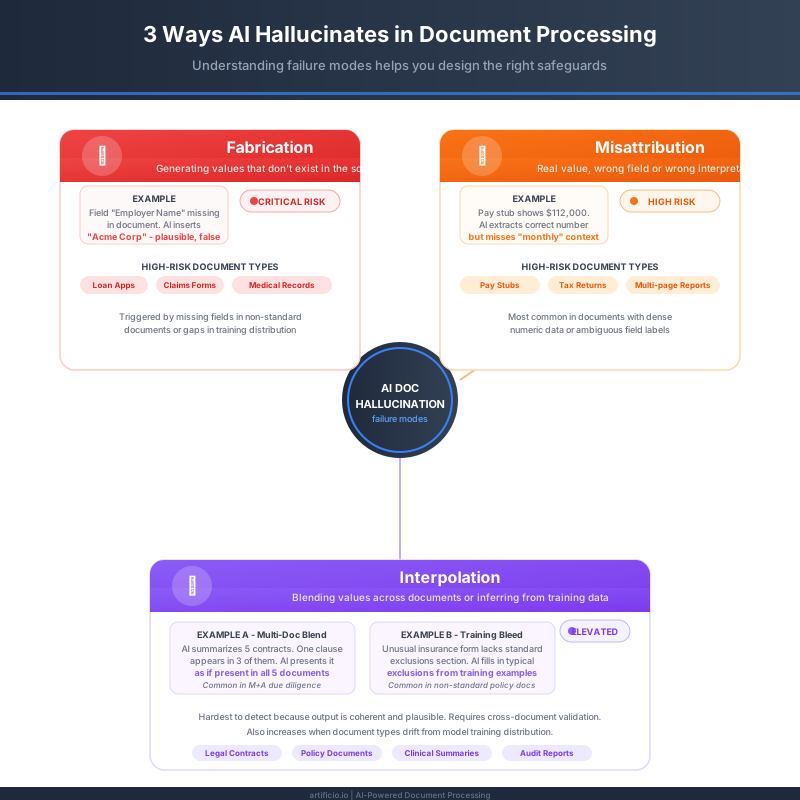
How to Catch It: Detection Layers That Matter
Prevention matters more than detection, but no system is perfectly preventive. The question for buyers is whether the platform surfaces hallucinations before they cause downstream harm, and what the audit trail looks like when they do.
Confidence scoring with thresholds
Every mature document AI platform should output confidence scores at the field level, not just the document level. A document-level accuracy score of 97% can still hide individual fields where confidence is 40%. Those are exactly the fields most likely to contain hallucinated values.
The configuration question is what happens when confidence falls below a threshold. Does the system flag for human review? Does it return null with an explanation? Does it process silently and log the uncertainty in a place nobody checks? The right answer involves the first two options, and the best platforms let you configure different threshold behaviors by field type and by downstream consequence.
Source attribution and grounding verification
A well-designed extraction system should be able to point to exactly where in the source document a value came from. Not just the page, but the bounding box or text span. This makes hallucination auditable because if a field value has no credible source attribution, that's an immediate flag.
This is a meaningful differentiator between platforms. Some systems extract and store the value. Better systems extract, store the value, and maintain a link to the exact source location that enables downstream verification. When an underwriter, claims adjuster, or compliance reviewer needs to check a value, they shouldn't have to go back to the original document manually. The platform should surface it.
In multi-document workflows, the same values often appear across multiple sources. A loan application might have income stated on a 1003 form, on pay stubs, and on tax returns. An insurance claim might have dates appearing on a police report, a repair estimate, and a medical record. If the AI extracts different values from documents that should agree, that disagreement is a hallucination signal.
Platforms that build cross-document validation into their pipeline catch a significant class of hallucinations that single-document confidence scoring would miss. The discrepancy doesn't always mean hallucination, since documents legitimately conflict sometimes, but it always warrants review.
Automation should not mean blind processing. Good platforms define explicit conditions under which processing pauses and routes to a human reviewer. High-stakes fields, low-confidence scores, format anomalies, cross-document discrepancies, and document types outside normal distribution are all appropriate triggers.
The goal isn't to route everything to humans. That defeats the purpose. The goal is to route the right things to humans, which requires the platform to be honest about its own uncertainty.
How to Prevent It: Architecture and Design Choices
Detection catches problems after they occur. Prevention reduces how often they occur in the first place, and the difference compounds at scale. At 10,000 documents per month, a 1% hallucination rate that requires human review is 100 reviews. At a quarter million documents, it's 2,500. Platforms that take prevention seriously at the architecture level cost less to operate.
Grounded extraction over generative inference
The most important design choice is whether the platform grounds extraction in the actual document text. Systems built on pure generative AI apply language model reasoning broadly, which enables flexible extraction but also opens the door to inference-based hallucination. Systems with grounded extraction constrain the model to values that can be directly located in the source.
This doesn't mean grounded systems are inflexible. It means they treat extraction and inference as distinct operations, and they're explicit about which one they're doing at any given step. "The document states $112,000" and "the document implies this is monthly income" are different claims requiring different levels of scrutiny.
Schema-enforced validation
Every document type in a production workflow has a known schema: expected fields, expected data types, expected value ranges, expected cross-field relationships. A good platform enforces this schema at extraction time. If a date field contains a value that doesn't parse as a valid date, that's caught immediately. If an income figure falls outside the statistically normal range for that document type, it triggers a review flag rather than passing silently.
Schema enforcement sounds basic, but many early-generation document AI systems don't do it consistently. They extract and present. Validation is left to downstream systems or human reviewers who are already past the point where catching an error is cheap.
Continuous feedback loops
A platform that learns from corrections gets better over time and reduces its own hallucination rate. When a human reviewer corrects an extracted value, that correction should feed back into the model's understanding. This is how production hallucination rates drop from 2-3% at deployment to sub-0.5% after six months of operation.
Platforms that treat each document as a stateless transaction don't improve. Every correction that doesn't feed back is a missed opportunity to make the next ten thousand documents more accurate.
Anomaly detection at document intake
Some hallucinations are predictable because they're triggered by predictable document characteristics. Documents with poor scan quality, unusual formatting, heavy redaction, or non-standard languages are higher-risk inputs. A platform with intake anomaly detection can identify these documents before processing and apply additional scrutiny, different model configurations, or direct routing to human review.
This is operationally significant because it shifts hallucination management earlier in the pipeline, where the cost of intervention is lowest. 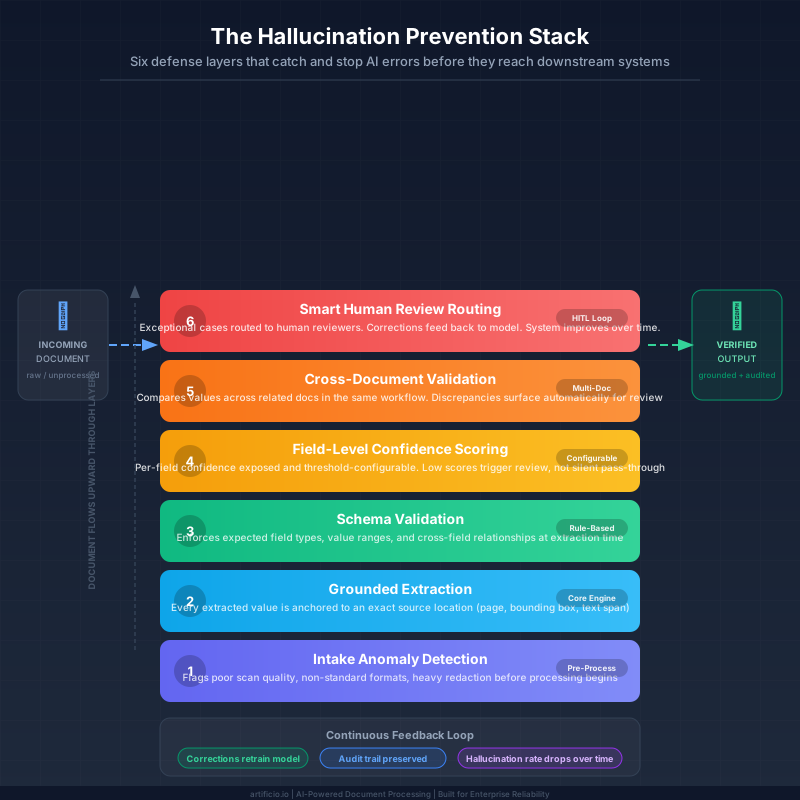
What to Ask Your AI Document Vendor
Most vendors will tell you their accuracy is high. The more revealing questions go beyond top-line metrics.
Ask how the platform behaves when a required field isn't present in the source document. Does it return null with an explanation, or does it generate a plausible fill-in? The answer tells you a lot about how the system was designed.
Ask to see field-level confidence scores, not just document-level summaries. Ask whether source attribution is maintained and accessible, and what format that attribution takes. Ask what triggers human review routing and whether those triggers are configurable.
Ask about the feedback loop. When reviewers correct an extraction, what happens to that correction? Is it logged, used for model retraining, or discarded?
Ask what the platform does differently for document types that fall outside its training distribution. Can you see how performance varies across document formats, scan quality levels, and language variants?
These questions don't require deep AI knowledge to ask. They require a clear-eyed view of where these systems fail and what a responsible vendor does about it.
The Cost of Getting This Wrong
The specific harm from document hallucination varies by vertical, but the pattern is consistent. In mortgage, an AI that silently misreads income causes loans to be underwritten incorrectly, regulatory findings, and potential repurchase demands. In insurance, hallucinated claim details lead to incorrect payouts and fraud exposure. In healthcare, fabricated values in patient records create treatment risk and compliance liability. In legal, misattributed terms in contract extraction can materially misrepresent agreement obligations.
What makes this especially tricky is that AI-generated document summaries and extractions carry an implicit authority that paper-based workflows don't. When a system presents a value confidently, reviewers trust it more than they should. The failure mode isn't just the hallucination itself. It's the combination of a confident presentation and a reduced review posture that together allow the error to travel further through the pipeline before anyone catches it.
Platforms that take hallucination seriously build systems where uncertainty is explicit, audit trails are complete, and human review is a designed part of the workflow rather than an afterthought. That's not a limitation of the technology. It's a sign of maturity in how the technology gets deployed.
At Artificio, we built our document processing platform with these failure modes in mind from the start. Our extraction architecture grounds outputs in verifiable source locations, so every field value can be traced back to its exact position in the original document. Field-level confidence scoring is exposed by default, not hidden behind aggregate metrics. And our validation layer enforces schema rules at extraction time, catching type mismatches and range anomalies before they reach downstream systems.
For high-stakes document types, cross-document validation runs automatically when multiple sources are present. Human review routing is fully configurable by field, confidence threshold, and document type. Reviewer corrections feed back into the model, which means the system gets genuinely better over time on the specific document variants your organization actually processes.
We don't claim zero hallucinations. Any platform that does is lying to you. But we do claim clear mechanisms for catching the ones that occur and a designed feedback loop for reducing them over time. That's what responsible AI document processing looks like in practice.
If you're evaluating platforms and hallucination risk is on your list, we're happy to walk through our architecture in detail. The transparency should give you what you need to make an informed comparison.