

Blog
How AI Can Rescue Decades of Government Records from Digital Obsolescence
AI rescues government records from digital obsolescence. Decades of vital documents, from deeds to court records, are becoming inaccessible. AI/ML offers a solution.

Blog
AI rescues government records from digital obsolescence. Decades of vital documents, from deeds to court records, are becoming inaccessible. AI/ML offers a solution.
Walk into any government building's basement storage area and you'll discover a quiet crisis unfolding. Rows of file cabinets hold millions of documents that are slowly becoming digitally extinct. These aren't just old papers gathering dust. Property deeds from the 1980s still determine ownership rights today. Environmental impact studies from decades past continue to influence current development decisions. Court records establish legal precedents that shape ongoing cases. Vital statistics prove citizenship and identity for countless citizens seeking government services.
Every year that passes makes these documents harder to access. The software that once opened them becomes obsolete. The hardware needed to read old storage formats breaks down without replacement parts. When experienced government employees retire, they take with them decades of informal knowledge about where critical information lives within complex filing systems and database structures.
This isn't just an administrative inconvenience. When government records become inaccessible, real barriers emerge that block transparency and slow public services. Legal proceedings can grind to a halt when crucial evidence exists somewhere in the archives but can't be located efficiently. Picture a city planning department trying to evaluate a new construction proposal while struggling to access environmental assessments conducted twenty years earlier. Those historical studies might reveal soil contamination issues or flood risks that directly impact current safety decisions, but the information remains trapped in formats that modern systems can't easily read.
Property owners face delays proving clear title to their land because original deeds exist only as deteriorating paper files stored in basement archives. Veterans seeking benefits discover their service records are locked in computer systems that no longer have technical support. Emergency response teams can't access historical flood data or disaster plans that exist in obsolete digital formats, leaving communities vulnerable during crises when historical knowledge could save lives.
The challenge goes beyond simple document storage problems. Legacy records often contain critical information that current government systems need to reference regularly, but that data stays trapped in formats that modern applications can't interpret. Think about microfilm readers that require specialized equipment no longer manufactured. Consider proprietary database formats created by software companies that went out of business years ago. Imagine scanned documents that appear as static images to computer systems, hiding searchable information that could solve current problems if only it were digitally discoverable.
Government documents carry unique complications that private sector organizations rarely face. These records aren't just information repositories. They function as legal instruments with specific requirements for authenticity, chain of custody, and audit trails. Unlike private companies that might simply migrate data without worrying about legal validity, government agencies must ensure that modernized documents maintain their legal standing while becoming more accessible to both staff and citizens who depend on them.
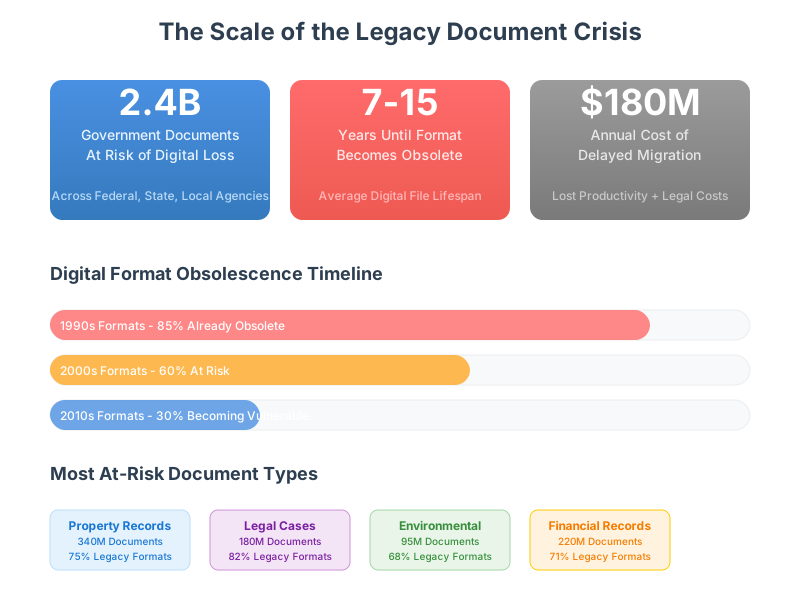
Digital obsolescence happens much faster than most people anticipate. Documents created just fifteen years ago already present significant access challenges today. Software that seemed state-of-the-art in 2010 might refuse to run on current operating systems. Hardware that filled government offices has been replaced multiple times, leaving agencies without equipment to read older storage media.
The vendors who created specialized government software systems complicate this problem further. Many have been acquired by larger companies, merged with competitors, or simply disappeared from the market entirely. This leaves government agencies managing systems they can't update, replace, or even get technical support for when problems arise. The institutional knowledge about how these systems work often exists only in the minds of longtime employees who may be approaching retirement.
The problem extends well beyond just opening old files. Many legacy systems stored documents with embedded metadata, linking relationships, and contextual information that disappears when files get copied to new formats. A budget document from 1995 might have been connected to corresponding legislative records, audit reports, and implementation notes through a sophisticated database structure. When that document gets saved as a basic PDF to preserve it, the document survives but loses all the rich contextual relationships that made it truly valuable for understanding government decision-making processes.
Government agencies often discover the full extent of their legacy document challenges only during urgent situations. A legal team preparing for an important court case might realize crucial evidence exists somewhere in their archives but can't locate it efficiently within reasonable time constraints. An environmental review might require referencing scientific studies conducted decades earlier, but those studies exist only as poor-quality photocopies of documents originally created on typewriters. Emergency response teams might need historical flood data or evacuation plans during an active crisis, only to find the information stored in formats their current systems can't access.
The human element makes this crisis particularly complex. Government employees develop informal expertise over years of work about where specific types of documents are stored, how to interpret filing systems that follow outdated logic, and which records tend to be most reliable for different purposes. When these experienced workers retire, they take irreplaceable institutional memory with them. New staff inherit systems they don't fully understand, filing structures that follow organizational logic from previous decades, and document collections that might be comprehensive but aren't easily navigable without experienced guidance.
This knowledge gap creates a destructive cycle that accelerates over time. As documents become harder to access, staff naturally rely more heavily on recent information and digital systems they understand well. The older documents become even more isolated and forgotten, despite often containing exactly the information needed to make better current decisions. Historical precedents get overlooked when making new policy. Past mistakes get repeated because the lessons learned aren't accessible. Institutional wisdom accumulated over decades becomes effectively lost to current operations.
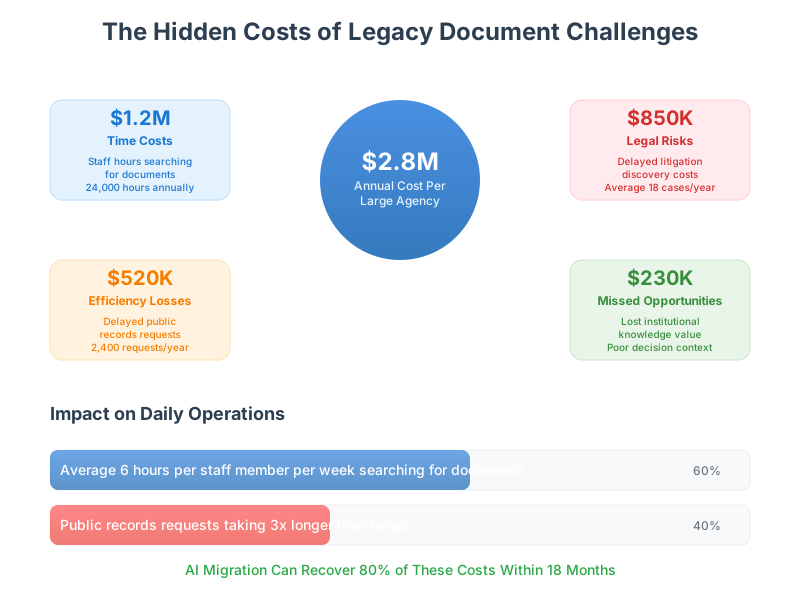
The financial implications of legacy document inaccessibility stretch far beyond the obvious storage and maintenance costs. When government workers can't efficiently locate historical information, they spend hours or even full days manually searching through archives for documents that should be instantly accessible through modern search capabilities. This represents more than mere inefficiency. It functions as a hidden tax on public services that diverts resources from citizen-facing activities to administrative archaeology.
Consider the ripple effects of this time drain. Hours spent hunting through old environmental assessment files could have been used to review new development proposals that create jobs and expand tax bases. Effort required to manually transcribe information from illegible historical documents could have been directed toward processing more citizen requests for services. When experienced staff spend their time as document detectives rather than policy experts, the entire organization operates below its potential capacity.
Legal costs multiply when agencies struggle to produce required documents for court proceedings. Legal cases get delayed when crucial evidence exists but can't be retrieved efficiently. Outside counsel fees accumulate while lawyers wait for government agencies to locate historical records that might determine case outcomes. Settlement negotiations often proceed from positions of weakness simply because relevant evidence can't be accessed quickly enough to inform legal strategy. Property disputes, environmental litigation, and administrative appeals all depend heavily on historical records that might contain the key facts needed to resolve expensive legal conflicts.
The reputational damage might prove even more costly in the long run. Citizens reasonably expect government agencies to maintain organized access to public records. When simple requests for historical information require weeks or months to fulfill, public trust in government competence erodes steadily. A business owner researching environmental permits for a property development shouldn't face indefinite delays because relevant documents exist somewhere in formats that require specialized equipment to read. These experiences shape public perception of government effectiveness and influence citizen willingness to engage constructively with public agencies.
Policy-making suffers when historical context becomes inaccessible. Urban planners making flood management decisions need comprehensive historical data spanning decades, not just recent digital records that might miss important patterns. Public health officials responding to disease outbreaks benefit enormously from understanding how similar situations were handled previously, including detailed documentation of what interventions worked and which approaches failed. Environmental regulators need complete historical records of industrial sites, including permits, violations, and remediation efforts that might predate current digital systems by many years.
The knowledge trapped in legacy documents often represents the most valuable institutional learning available to government agencies. These records document not just what decisions were made, but the reasoning behind those decisions, what alternatives were seriously considered, and what real-world outcomes resulted from different approaches. Current staff trying to address similar challenges could benefit enormously from understanding how previous colleagues approached comparable situations, but only if that historical wisdom remains accessible and searchable.
Most troubling, inaccessible records can lead to genuinely dangerous policy decisions. Emergency management plans might overlook historical vulnerabilities because the relevant documentation can't be efficiently reviewed. Infrastructure maintenance might miss critical issues because inspection records from previous decades aren't readily available. Environmental protection might fail because contamination histories remain buried in obsolete filing systems. When institutional memory becomes inaccessible, communities face increased risks that proper historical analysis could have prevented.
Artificial intelligence technologies create unprecedented opportunities for rescuing and modernizing legacy government documents in ways that go far beyond traditional document conversion approaches. While older methods simply changed file formats without adding value, AI-powered solutions can actually understand document content, extract meaningful information, and create rich metadata that makes historical records searchable and useful in ways that weren't possible even when the documents were originally created.
Modern optical character recognition systems powered by machine learning can handle document challenges that would have been completely impossible to address just a few years ago. Faded typewriter text that human eyes strain to read becomes clearly legible to AI systems. Handwritten annotations in margins get converted to searchable text. Documents with coffee stains, water damage, or physical deterioration that would defeat traditional scanning methods can now be accurately digitized and converted into fully searchable formats. The AI doesn't just recognize individual characters in isolation. It understands context, makes intelligent inferences about unclear text based on surrounding words and document structure, and can even identify and correct obvious errors that existed in the original documents.
AI systems can understand document structure and extract meaning in sophisticated ways that traditional scanning completely misses. A budget document from 1985 might contain complex tables, charts, and numerical data that conventional scanning would treat as static images. AI-powered systems can recognize these elements as functional data structures, extract the underlying numbers and relationships, and convert everything into formats that modern spreadsheet and database applications can work with directly. This means historical budget data can be integrated seamlessly into current financial analysis tools, allowing agencies to track spending trends and policy impacts across multiple decades with unprecedented analytical power.
The semantic understanding capabilities of modern AI enable identification of relationships and patterns within and across documents that even careful human reviewers might miss entirely. An AI system processing decades of environmental permits might identify subtle patterns in approval processes, notice gradual changes in regulatory requirements over time, or flag potential inconsistencies that warrant closer examination. This kind of comprehensive analysis would be prohibitively expensive and time-consuming for human reviewers to conduct manually across large document collections, but AI can perform it automatically as part of the normal document processing workflow.
Document classification represents another area where AI capabilities exceed human performance while dramatically reducing costs. Legacy document collections often contain thousands of files with inconsistent naming conventions, unclear organizational schemes, and mixed content types that evolved over decades of changing administrative practices. AI systems can analyze document content automatically and classify materials according to current organizational standards, apply consistent metadata tags, and identify documents that relate to ongoing projects or current concerns. This automated classification transforms chaotic legacy collections into organized, searchable resources.
AI can enhance documents during the migration process by adding valuable information that wasn't captured in the original filing systems. Dates mentioned within document text can be converted into searchable date fields that enable chronological analysis. Geographic locations mentioned in reports can be linked to current mapping systems for spatial analysis. Names of people mentioned in historical documents can be cross-referenced with staff directories or other historical records to build comprehensive relationship maps. This enrichment process makes legacy documents not just accessible, but significantly more useful than they were in their original format.
Quality assurance represents a critical aspect of AI-powered document migration that distinguishes it from simple automation approaches. AI systems can identify potential problems like missing pages, corrupted text, or documents that might require special handling due to security classifications or privacy concerns. They can flag documents where text recognition confidence falls below acceptable thresholds, suggesting manual review might be beneficial. This ensures the migration process maintains the integrity and legal validity that government documents require while still achieving dramatic efficiency improvements.
Government document migration must address legal requirements that rarely apply to private sector document management projects. Public records laws, evidence preservation requirements, and audit standards impose specific obligations on how government documents can be modified, stored, and accessed. AI-powered migration systems must be designed to meet these stringent requirements while still delivering the accessibility and functionality improvements that justify the modernization effort.
Chain of custody documentation becomes particularly critical when historical documents undergo processing and conversion. AI systems must create detailed logs of every action taken on each document, including when it was accessed, what processing was performed, who authorized the migration, and what quality assurance steps were completed. This comprehensive audit trail ensures that modernized documents can be used as evidence in legal proceedings without questions about their authenticity or concerns about the integrity of the conversion process.
Digital signatures and authentication mechanisms must preserve the legal standing of original documents while enabling modern verification methods. AI systems need to create cryptographic hashes of original documents before processing begins, maintain those digital fingerprints throughout the migration process, and provide mechanisms for verifying that converted documents accurately represent their original versions. This technical foundation supports legal requirements while enabling the enhanced functionality that makes modernization worthwhile.
Metadata preservation presents both technical and legal challenges that require careful attention. Original creation dates, modification histories, and access logs from legacy systems need to be maintained and properly integrated into modern document management systems. AI must extract this metadata from obsolete formats and translate it into contemporary standards without losing information that might prove legally significant in future proceedings. This preservation ensures continuity of legal validity across the technological transition.
Version control becomes particularly complex when dealing with documents that might have been modified multiple times over decades using different systems and administrative processes. AI systems need to identify which version of a document represents the official record, understand how different versions relate to each other historically, and determine whether past modifications were properly authorized according to the administrative standards that existed at the time. This analysis preserves the legal integrity of government record-keeping while enabling modern access.
Privacy and security considerations require special attention during legacy document migration projects. Historical documents might contain personally identifiable information that was handled according to different privacy standards when it was originally created. They might include security classifications that need updating according to current protocols. AI systems must identify sensitive information automatically, apply appropriate redactions or access controls, and ensure that modernized documents meet current privacy and security requirements without losing essential content that serves legitimate government functions.
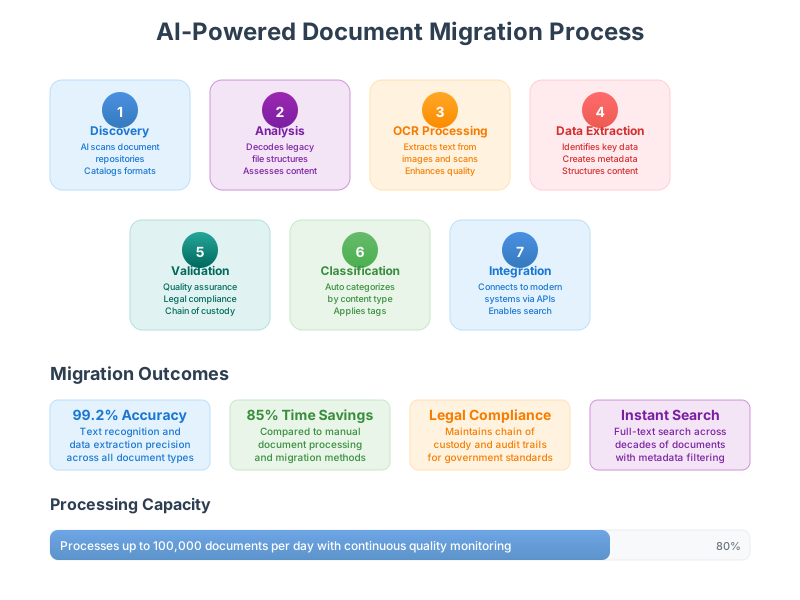
The technical complexity of legacy document migration extends far beyond what most organizations encounter in typical digitization projects. Government agencies often possess documents spanning multiple decades, created using technologies that manufacturers no longer support, stored in proprietary formats that require specialized software to access, and organized according to filing systems that reflect administrative structures from different historical periods.
File format obsolescence represents one of the most immediate technical hurdles that traditional approaches struggle to overcome. Documents might be stored in proprietary formats created by software companies that disappeared years ago, embedded in database systems that haven't received updates in decades, or trapped in custom applications that were developed specifically for individual agencies using programming languages that are no longer commonly used. Traditional document conversion tools often can't handle these obscure formats, but AI-powered systems can be trained to recognize and interpret even the most unusual file types by analyzing underlying file structures, identifying data patterns, and making intelligent inferences about how information was originally organized.
Character encoding problems frequently plague legacy digital documents in ways that create significant barriers to access. Text that was created using older computer systems often uses encoding schemes that don't display properly on modern equipment, resulting in garbled characters, missing symbols, or completely unreadable content. AI systems can identify these encoding inconsistencies automatically and apply appropriate conversion algorithms, often recovering text that appears completely corrupted when viewed with standard contemporary software.
Image quality restoration represents another area where AI capabilities far exceed traditional approaches to document preservation. Historical documents that were scanned using early digital equipment often suffer from resolution limitations, contrast problems, or color distortions that make them difficult for both humans and computers to read effectively. Modern AI can enhance these images systematically, remove digital noise and scanning artifacts, adjust contrast and brightness levels optimally, and even repair physical damage like missing corners, torn pages, or water stains that affected the original documents.
Handwriting recognition presents particular challenges for government documents, which frequently contain handwritten notes, signatures, and annotations that provide crucial context for understanding official actions and decision-making processes. Modern AI systems can be trained on historical handwriting samples to recognize cursive writing styles, personal signatures, and even specialized notation systems that government employees commonly used in different eras. This capability allows handwritten information to become searchable and analyzable alongside typed content, dramatically expanding the useful information that can be extracted from historical records.
Language evolution creates subtle but important challenges for automated document processing that require sophisticated AI capabilities to address properly. Technical terminology, legal language, and administrative jargon have all evolved significantly over the decades, and words that carried specific meanings in historical government contexts might have different connotations today. AI systems can be trained to understand these historical language patterns and provide modern translations or explanations of outdated terms, making legacy documents more accessible to current staff who need to understand historical decisions and their rationale.
Cross-reference reconstruction represents one of the most valuable technical capabilities that AI brings to legacy document migration. Historical documents often reference other files, regulations, or administrative decisions using numbering systems or organizational schemes that are no longer current or easily understood. AI can analyze these references systematically, identify what documents they point to based on content analysis and contextual clues, and create modern hyperlinks or cross-reference systems that preserve the original document relationships in formats that current staff can navigate easily and efficiently.
Successful legacy document migration extends well beyond converting old files into newer formats. The true value emerges from integrating historical information into current government workflows and systems in ways that make decades of institutional knowledge immediately useful for ongoing operations. This integration requires AI systems that understand both the content structure of historical documents and the data requirements of modern government applications.
Enterprise resource planning systems used by government agencies often have specific data structure requirements that don't align naturally with how information was organized in legacy documents created under different administrative frameworks. AI can extract relevant information from historical records and reformat it appropriately for integration into current financial systems, human resources databases, or project management applications. This allows historical data to inform current decision-making processes directly without requiring staff to manually research and transcribe information from old documents during time-sensitive operations.
Geographic information systems present particularly valuable integration opportunities for government agencies that make location-based decisions regularly. Historical documents often contain detailed location information, property descriptions, and geographic references that remain highly relevant for current planning and regulatory activities. AI can identify these geographic elements automatically and convert them into modern mapping coordinates, allowing historical information to be visualized on current maps and integrated into sophisticated spatial analysis workflows that support better decision-making.
Case management systems used by legal departments, regulatory agencies, and social service organizations can benefit enormously from integration with historical document collections that contain relevant precedents and background information. AI can identify documents related to ongoing cases automatically, extract relevant precedents from historical decisions, and provide contextual information about how similar situations were handled previously. This integration allows current staff to build systematically on institutional knowledge rather than approaching each new situation as if no relevant experience existed.
Workflow automation represents another significant integration opportunity that can transform how government agencies operate. AI systems can be configured to route newly discovered historical documents to appropriate staff members automatically based on sophisticated content analysis. Environmental documents get tagged for the attention of current environmental review teams. Legal precedents get flagged for agency counsel. Policy documents get directed to staff working on related current initiatives. This automated routing ensures that relevant historical knowledge reaches the people who can use it most effectively.
Search and discovery capabilities must work seamlessly across both historical and current document collections to maximize their value for daily operations. Staff shouldn't need to use different systems or learn different search strategies to find information based on when it was originally created. AI-powered search systems can provide unified access to information spanning decades, with intelligent relevance ranking that considers both content matching and historical context of search results.
Notification and alert systems can leverage historical document content to provide proactive information that prevents problems before they develop. If historical documents indicate that a particular property has environmental concerns, AI systems can automatically flag those issues when current staff access information about that property for permitting or development review purposes. This proactive approach helps government agencies avoid repeating past mistakes and ensures that important historical knowledge influences current decisions appropriately.
Legacy document migration projects offer government agencies unique opportunities to demonstrate genuine commitment to transparency and meaningful public access to information. When historical records become easily searchable and accessible through modern interfaces, citizens gain unprecedented insight into government decision-making processes, policy development, and administrative actions that shaped their communities over many decades.
Public records requests often focus specifically on historical information that citizens need to understand property histories, environmental decisions, or policy changes that continue to affect their daily lives. When these records remain trapped in inaccessible formats, citizens face unreasonable delays and sometimes complete inability to obtain information they have clear legal rights to access. AI-powered document migration can transform the public records request process fundamentally by making historical information available through user-friendly online portals that citizens can search independently without requiring government staff assistance for routine inquiries.
The enhanced searchability that AI provides can reveal important patterns and trends in government actions that weren't apparent when documents could only be reviewed individually by human researchers. Citizens and academic researchers can analyze decades of permit decisions, budget allocations, or policy changes to understand how government priorities have evolved over time and identify areas where additional oversight or policy modifications might benefit the community. This analytical capability supports more informed public participation in democratic processes.
Proactive disclosure becomes feasible when historical documents are properly digitized and indexed with comprehensive metadata. Rather than waiting for public records requests to surface specific information, agencies can publish searchable databases of historical decisions, policy documents, and administrative actions that allow citizens to research government activities independently. This proactive approach builds public trust by demonstrating that the agency values transparency and has nothing to hide from public scrutiny.
Educational opportunities emerge naturally when historical government documents become accessible to schools, universities, and research institutions. Students studying public administration, urban planning, environmental science, or local history can access primary source materials that illustrate concretely how government decisions were made and what factors influenced policy development during different historical periods. This educational access builds long-term civic engagement and helps prepare future public servants with deeper understanding of how government actually functions.
Digital equity considerations become important when designing public access systems for historical documents. AI-powered migration processes should include features that make documents accessible to citizens with disabilities, available in multiple languages where appropriate for diverse communities, and usable on various devices and internet connection speeds. Historical information shouldn't become accessible only to citizens with advanced technical skills or high-speed internet access.
Community engagement opportunities can be built directly into the migration process itself. Local historical societies, community organizations, and volunteer groups might be able to assist with document identification, provide valuable context about local events referenced in government documents, or help verify the accuracy of AI-generated transcriptions for documents related to their areas of historical expertise. This collaborative approach builds community investment in government transparency while improving the quality of the migration results.
Successful legacy document migration requires careful planning that balances technical capabilities, legal requirements, budget constraints, and operational needs effectively. Government agencies must develop implementation strategies that deliver immediate value while building systematically toward comprehensive long-term solutions that transform how historical information supports current operations and serves citizen needs.
Pilot project selection plays a crucial role in building internal support and demonstrating concrete value to stakeholders who might be skeptical about new technology investments. Agencies should identify document collections that have clear business value, manageable scope, and strong stakeholder interest to maximize chances of early success. Environmental permit files, property records, or legal case files often make excellent pilot candidates because they have obvious ongoing relevance, clear success metrics, and direct connections to current operational needs. Starting with high-value, lower-risk collections allows agencies to refine their processes and build institutional confidence before tackling more complex or politically sensitive document types.
Resource allocation must account realistically for both technology costs and staff time requirements during the migration period. While AI significantly reduces the manual effort required for document processing, the project still requires substantial subject matter expertise to guide classification schemes, validate processing results, and make informed decisions about how historical information should be integrated into current systems. Agencies need to plan carefully for temporary increases in staff workload during migration periods and ongoing maintenance requirements after migration completion.
Vendor selection criteria should emphasize not just technical capabilities, but also demonstrated understanding of government requirements and proven experience with public sector clients. The ideal AI solution provider should understand public records laws thoroughly, have experience with government security requirements, and be able to adapt their technology to meet specific agency needs rather than requiring agencies to modify their operations to fit inflexible software solutions. References from similar government agencies and evidence of successful large-scale migrations should weigh heavily in vendor evaluation processes.
Change management becomes particularly important because legacy document migration affects how staff access and use information they depend on for daily operations. Comprehensive training programs should help employees understand new search capabilities, learn to use enhanced document features effectively, and adapt their workflows to take full advantage of improved access to historical information. Regular communication about project progress and demonstrated benefits helps build support and encourages adoption of new capabilities throughout the organization.
Quality assurance processes must be built systematically into every stage of the migration project. This includes validating AI processing results against known accurate samples, verifying that legal requirements are met consistently, testing integration with existing systems thoroughly, and confirming that migrated documents maintain their integrity and usefulness for intended purposes. Government agencies typically require more rigorous quality assurance than private sector organizations because of legal accountability requirements and intense public scrutiny of government operations.
Timeline development should be realistic about the inherent complexity of government document collections and the need for thorough testing and validation at each stage. While AI significantly accelerates the migration process compared to manual approaches, government agencies often have approval processes, security reviews, and compliance requirements that add time to implementation schedules. Building appropriate buffer time into project timelines helps ensure that quality standards aren't compromised in efforts to meet aggressive deadlines that might have been set without full understanding of the technical challenges involved.
Government agencies need clear, quantifiable metrics to evaluate the success of legacy document migration projects and justify continued investment in modernization efforts. These metrics should capture both quantitative improvements in operational efficiency and qualitative benefits like improved public service delivery and enhanced decision-making capabilities that might be harder to measure but provide substantial long-term value.
Time savings represent the most immediate and easily measurable benefit of AI-powered document migration. Agencies can track systematically how long it takes staff to locate specific historical information before and after migration, measure reductions in time spent fulfilling public records requests, and calculate direct labor cost savings from automated document processing. These metrics provide clear financial justification for migration investments and help agencies prioritize future modernization efforts based on demonstrated returns.
Access improvement metrics can demonstrate the concrete public value of migration projects beyond internal efficiency gains. Agencies can measure increases in successful public records request fulfillment rates, track reductions in average request processing time, and monitor improvements in citizen satisfaction with government information services. These metrics help demonstrate that migration projects deliver value not just to government operations, but directly to the citizens those operations are designed to serve.
Decision quality improvements might be harder to quantify precisely but represent significant long-term value for government effectiveness. Agencies can track instances where historical information directly influenced current decisions, measure improvements in policy development processes that incorporate systematic historical analysis, and evaluate whether access to historical precedents leads to more consistent and well-informed administrative actions. These qualitative benefits often justify migration investments even when direct cost savings are modest.
Legal and compliance benefits can be measured through concrete reductions in discovery costs for litigation, improvements in audit preparation time, and enhanced ability to respond quickly to oversight requests from legislative bodies or regulatory agencies. These metrics are particularly important for agencies that frequently face legal challenges or regulatory review, where access to comprehensive historical records can significantly affect case outcomes and compliance costs.
Integration success metrics should evaluate how effectively historical information becomes part of routine workflows rather than remaining an isolated resource that gets consulted only occasionally. Agencies can measure adoption rates for new search capabilities, track how frequently historical documents are accessed during current project work, and evaluate whether staff report improved confidence in their decision-making based on access to relevant historical context.
Long-term strategic value might be the most important but hardest to measure benefit of comprehensive legacy document migration. This includes improvements in institutional memory preservation, enhanced organizational ability to learn systematically from past experiences, and better preparation for future challenges based on thorough historical analysis. While these benefits might not appear prominently in immediate cost-benefit calculations, they represent the foundation for more effective government operations over extended time periods.
Cost-benefit analysis should account carefully for avoided costs as well as direct operational savings. This includes reduced risk of losing irreplaceable historical information to further deterioration, avoided costs of emergency manual document recovery for urgent legal or operational needs, and prevention of expensive delays in legal proceedings due to inaccessible evidence. These avoided costs often exceed the direct operational savings from improved day-to-day efficiency.
Legacy document migration represents just the beginning of a broader transformation in how government agencies manage, access, and utilize the vast information resources accumulated through decades of public service. As AI capabilities continue advancing rapidly and agencies become more comfortable with automated document processing, the possibilities for enhancing government operations through intelligent information management will expand dramatically.
Predictive analytics based on systematic historical document analysis will enable agencies to anticipate trends, identify emerging patterns, and make proactive decisions based on comprehensive understanding of past experiences and their outcomes. Environmental agencies might predict areas at high risk for future contamination based on detailed analysis of historical industrial activity patterns. Urban planning departments could anticipate infrastructure needs more accurately based on historical development trends and demographic changes. Social service agencies might identify early intervention opportunities based on historical patterns of community needs and documented program effectiveness.
Real-time integration of historical and current information will transform fundamentally how government decisions are made at all levels. Instead of treating historical records as archives to be consulted only occasionally, agencies will integrate historical context seamlessly into daily workflows. Staff reviewing permit applications will automatically see relevant historical environmental data for specific properties. Budget analysts will have immediate access to comprehensive spending patterns and policy outcomes from previous years. Legal teams will have instant access to relevant precedents and related cases that inform current proceedings with complete historical context.
Artificial intelligence will evolve to provide increasingly sophisticated analysis of government document collections, identifying policy implications, suggesting process improvements, and even recommending policy changes based on systematic analysis of historical effectiveness data. This evolution will transform AI from primarily a document processing tool into a comprehensive decision support system that helps government agencies learn systematically from their institutional experience and apply that knowledge effectively.
Cross-agency information sharing will become much more feasible as document collections become standardized and universally searchable across different government departments. Historical information from multiple agencies can be integrated to provide comprehensive views of complex issues that naturally span departmental boundaries. Environmental, health, and economic data can be combined systematically to understand the full impact of industrial activities over time. Law enforcement, social services, and education records can be integrated to support comprehensive community development strategies based on complete historical understanding.
Citizens will benefit from dramatically enhanced access to government information that helps them understand how decisions affecting their communities were made, what alternatives were seriously considered, and what real-world outcomes resulted from different policy choices. This comprehensive transparency will support much more informed public participation in government processes and help build stronger public trust through demonstrated accountability and openness.
The transformation from legacy document crisis to comprehensive information asset represents one of the most significant opportunities available to government agencies today. With AI-powered migration and analysis tools, agencies can rescue decades of institutional knowledge from digital obsolescence and transform it into a strategic resource that enhances every aspect of government operations while serving citizens more effectively.
The investment required for comprehensive legacy document migration is substantial, but the cost of continued inaction grows larger every year. Each year that passes makes some historical information more difficult to recover permanently, and the operational inefficiencies of inaccessible information continue to tax agency resources while frustrating citizens seeking government services they have every right to expect.
Government agencies that embrace AI-powered document migration today will position themselves as leaders in public service innovation, demonstrating concrete commitment to transparency, efficiency, and citizen service that sets new standards for government operations. They'll preserve and enhance institutional knowledge that represents decades of public investment in effective governance, ensuring that future government leaders can build systematically on the experiences and wisdom of their predecessors rather than starting fresh with each new challenge.
The technology exists today to solve the legacy document crisis that threatens government information collections worldwide. The question isn't whether agencies can afford to invest in comprehensive document migration, but whether they can afford not to take decisive action while effective solutions are available and historical information can still be recovered. The time for action is now, before more irreplaceable institutional knowledge disappears forever into digital obsolescence.

Head IT Operations - Co Founder of Artificio
See it in your SAP environment
Bring us a document, a process, or a bottleneck. We'll show how Artificio captures, validates, and posts into SAP — then scale from there.
Security & compliance
ISO 27001:2013 certified, SOC 2 Type 2 compliant, GDPR and HIPAA ready. Every agent action is logged, auditable, and runs in isolated environments.