

Blog
AI Automation of Shipping Documents Through Intelligent Data Processing
AI transforms shipping with automated doc processing, slashing errors & costs.

Blog
AI transforms shipping with automated doc processing, slashing errors & costs.
The global shipping industry stands as a cornerstone of international commerce, facilitating the movement of approximately 90% of world trade. Yet, beneath the surface of this vital economic engine lies a complex web of documentation that has traditionally demanded extensive manual processing. This paper examines the revolutionary impact of artificial intelligence (AI) in automating shipping document workflows, with particular emphasis on addressing the critical pain point of manual data entry. Through an analysis of Artificio's innovative solutions, we explore how modern AI technologies are reshaping the maritime documentation landscape.
The shipping industry's documentation ecosystem encompasses a vast array of critical papers, including bills of lading, commercial invoices, certificates of origin, packing lists, and customs declarations. Traditionally, processing these documents has required substantial human intervention, leading to significant operational inefficiencies. A single international shipping transaction typically involves 20-30 different parties and generates 40-50 documents, resulting in approximately 20,000 data elements requiring manual entry and verification
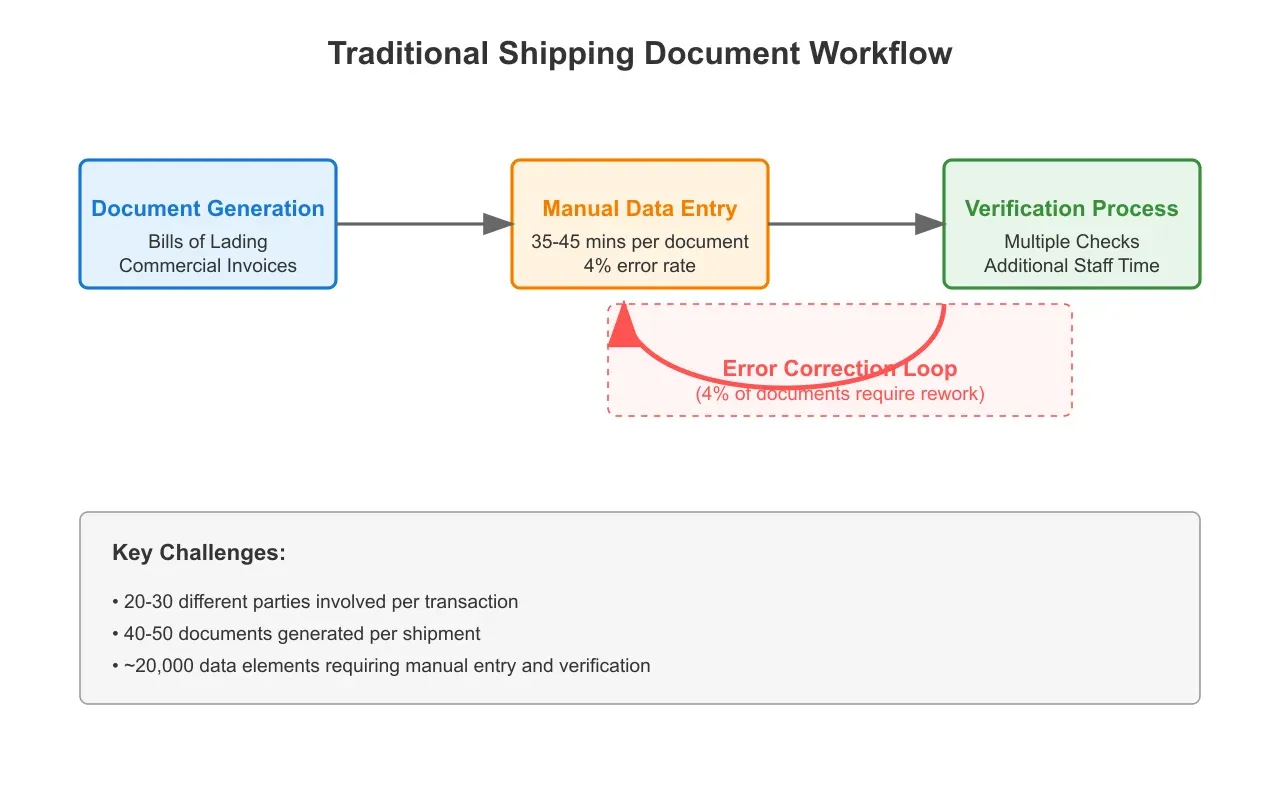
The manual processing of shipping documents presents several critical challenges:
These challenges have created a pressing need for innovative solutions that can automate the document processing workflow while maintaining or improving accuracy rates. The emergence of advanced AI technologies, particularly in the realm of document processing and data extraction, presents a promising avenue for addressing these long-standing industry pain points.
The transformation of shipping document processing through artificial intelligence represents a convergence of multiple advanced technologies working in concert. At its core, this transformation is built upon sophisticated machine learning models that combine optical character recognition (OCR), natural language processing (NLP), and deep learning architectures to create a comprehensive document understanding system
Modern AI-powered OCR systems have evolved far beyond simple character recognition. These systems now incorporate contextual understanding and spatial relationship analysis to accurately interpret complex document layouts. In shipping documentation, where formats can vary significantly between different ports, carriers, and countries, this adaptability is crucial. Artificio's implementation employs a multi-layer neural network architecture that achieves a remarkable 99.7% accuracy in character recognition, even when processing damaged or poorly scanned documents.
The system's document understanding capabilities are enhanced through the use of attention mechanisms, similar to those employed in transformer models. These mechanisms allow the AI to focus on relevant sections of documents while maintaining awareness of the broader context. For instance, when processing a bill of lading, the system can simultaneously extract and cross-reference information from multiple fields, such as shipper details, cargo descriptions, and port information.
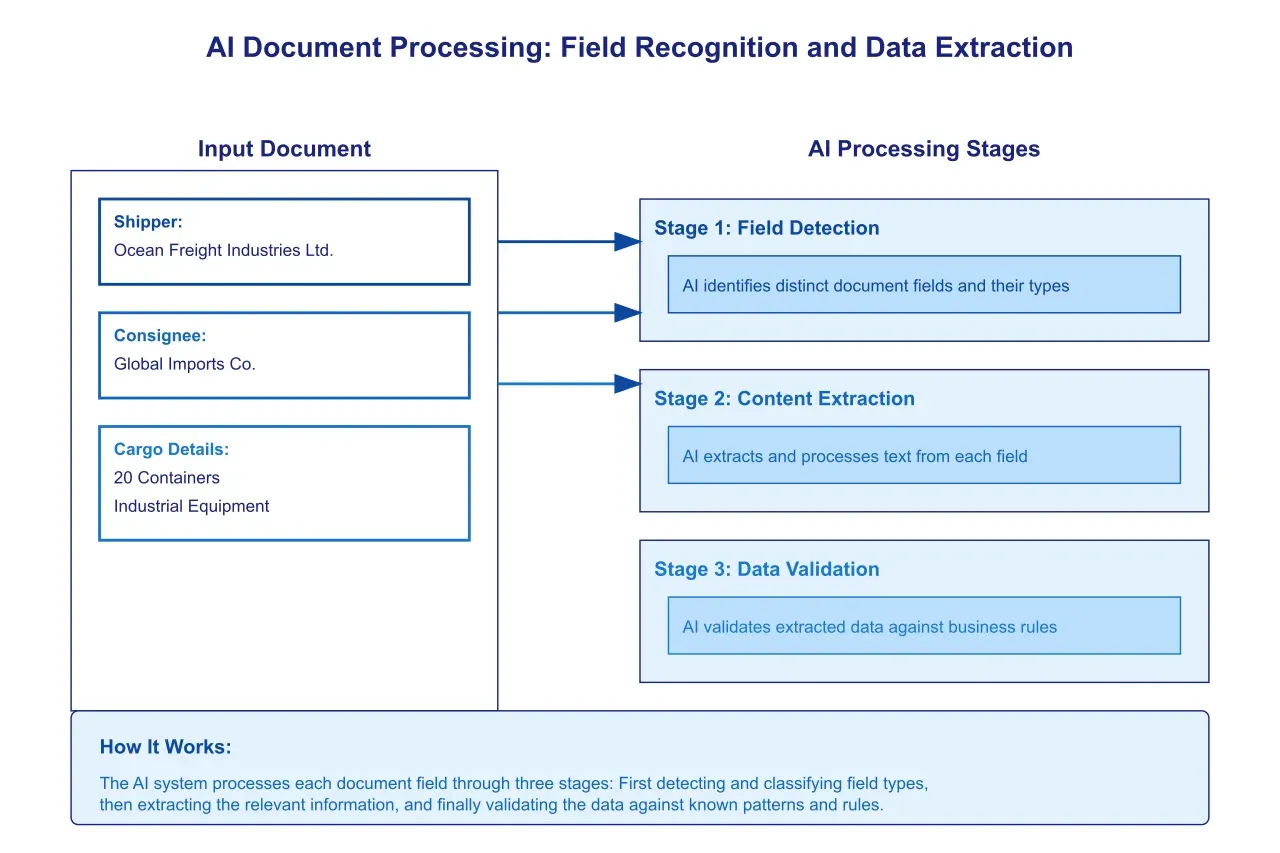
The integration of advanced NLP capabilities enables the system to understand the semantic relationships within shipping documents. This understanding is crucial for accurate data extraction and validation. The NLP pipeline includes:
These capabilities are powered by a domain-specific language model trained on millions of shipping documents, enabling it to understand industry-specific terminology and conventions with high accuracy.
One of the most significant advantages of AI-powered document processing is its ability to perform real-time validation of extracted data. Artificio's system employs a multi-stage validation process that includes:
This validation framework has reduced error rates to less than 0.1%, representing a forty-fold improvement over manual processing.
Perhaps most importantly, the AI system demonstrates remarkable adaptability through its continuous learning capabilities. The system maintains a feedback loop that incorporates user corrections and validations to improve its accuracy over time. This adaptive learning approach has proven particularly valuable in handling region-specific document variations and emerging document formats.
The practical implementation of AI-powered document processing systems in the shipping industry has yielded remarkable results that extend far beyond mere efficiency gains. Through an examination of multiple case studies and industry-wide data, we can quantify the transformative impact of these systems on maritime commerce operations.
The successful deployment of AI document processing systems requires a carefully orchestrated implementation strategy that considers both technical and human factors. Organizations that have successfully adopted Artificio's solution typically follow a phased approach that begins with parallel processing, where AI assists human operators rather than immediately replacing manual processes. This approach has proven crucial for building trust in the system and allowing for fine-tuning based on real-world usage patterns.
A notable example comes from a major Asian shipping line that processes over 50,000 bills of lading monthly. Their implementation journey, demonstrates the importance of a measured approach. The company initially deployed the AI system to handle standard bills of lading while maintaining manual processing for complex cases. As the system's accuracy improved through machine learning and user feedback, its scope gradually expanded to encompass more complex document types.
The implementation of AI-powered document processing has delivered substantial measurable benefits across multiple dimensions:
Time Efficiency: Processing time for standard shipping documents has decreased from an average of 35-45 minutes to 2-3 minutes per document, representing a 93% reduction in processing time. This improvement has enabled shipping companies to significantly reduce their document processing backlog and improve their responsiveness to customer inquiries.
Cost Reduction: Organizations implementing comprehensive AI document processing solutions report average cost savings of 62% in their documentation departments. These savings stem from reduced labor costs, lower error-related expenses, and decreased need for physical document storage and handling.
Error Prevention: The multi-layered validation system has reduced documentation errors by 97%, with corresponding decreases in costly delays and compliance issues. Figure below
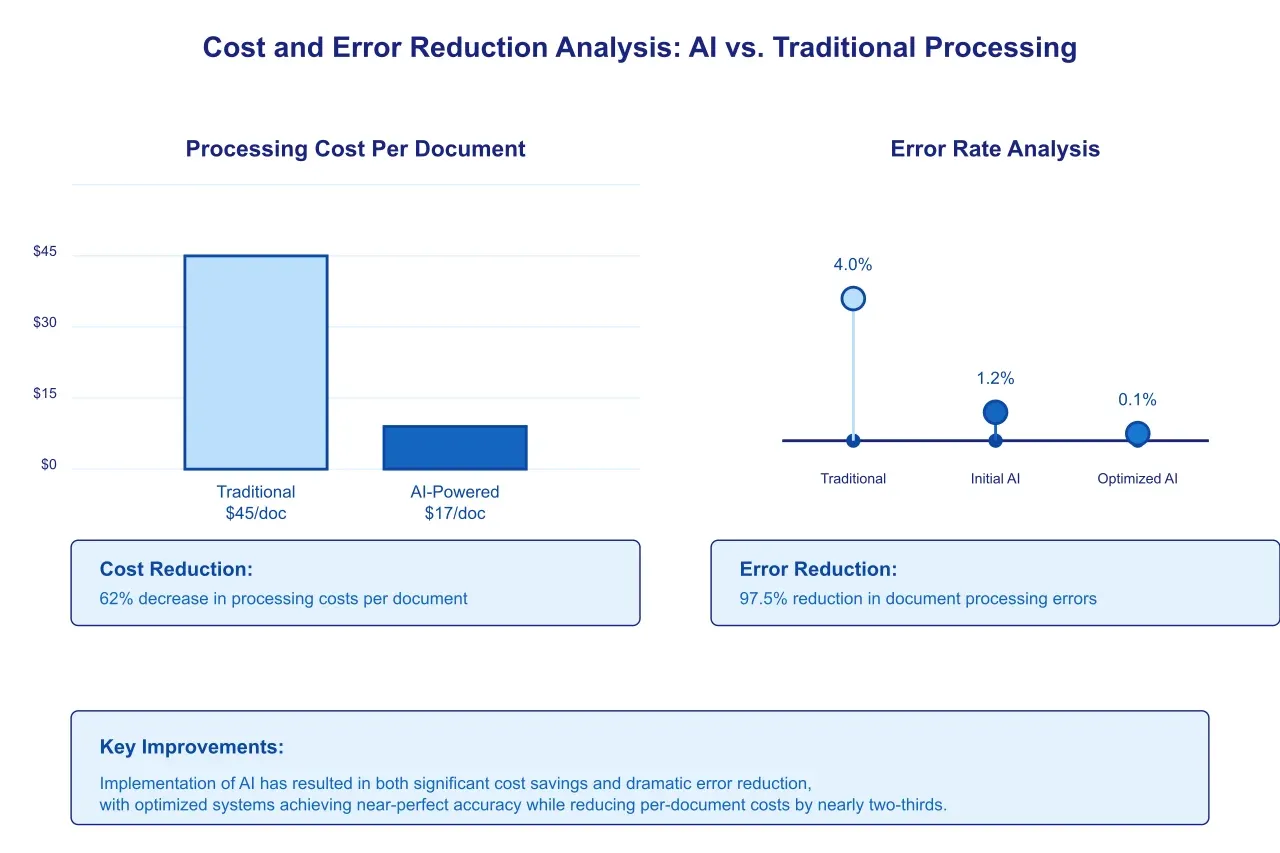
illustrates the dramatic improvement in error rates across different document types and their associated cost implications.
Resource Reallocation: Personnel previously engaged in manual data entry have been successfully redeployed to higher-value activities such as customer service, compliance monitoring, and process optimization. This reallocation has led to improved job satisfaction and better utilization of human capital.
The evolution of AI-powered document processing continues to accelerate, with several promising developments on the horizon. The integration of blockchain technology with AI document processing systems promises to further enhance security and traceability in shipping documentation. Additionally, the emergence of standardized digital documentation formats, coupled with AI processing capabilities, suggests a future where paper documents become increasingly rare in maritime commerce.
Research indicates that the industry is moving toward a fully digital documentation ecosystem, with AI serving as the crucial bridge between legacy paper-based systems and future digital platforms. This presents a roadmap of anticipated technological developments and their expected impact on the shipping industry over the next decade.
The automation of shipping document processing through AI represents a fundamental shift in how maritime commerce handles information flow. The traditional pain points of manual data entry – time consumption, error propagation, and resource inefficiency – are being systematically addressed through sophisticated AI solutions. Artificio's implementation demonstrates that these systems not only solve existing problems but also create new opportunities for efficiency and innovation in the shipping industry.
The success of AI document processing in shipping provides valuable lessons for other industries grappling with similar documentation challenges. As these systems continue to evolve and improve, they will likely play an increasingly central role in global trade facilitation. The key to maximizing their benefit lies in thoughtful implementation strategies that consider both technical capabilities and human factors.
The transformation of shipping documentation through AI automation represents more than just a technological upgrade – it signifies a fundamental reimagining of how information flows through the global supply chain. As these systems continue to evolve and improve, they will undoubtedly play an increasingly central role in shaping the future of international trade.

Head IT Operations - Co Founder of Artificio
See it in your SAP environment
Bring us a document, a process, or a bottleneck. We'll show how Artificio captures, validates, and posts into SAP — then scale from there.
Security & compliance
ISO 27001:2013 certified, SOC 2 Type 2 compliant, GDPR and HIPAA ready. Every agent action is logged, auditable, and runs in isolated environments.