Here's a scenario that plays out in finance departments every day: A company invests in SAP, bolts on an OCR tool, configures some approval workflows, and calls it "invoice automation." Six months later, the AP team is still manually handling a third of all invoices. The exceptions queue never empties. Month-end close is still a scramble.
Sound familiar? You're not alone. And — critically — it's not your team's fault.
The uncomfortable truth is that most SAP invoice automation isn't actually automation. It's digitization dressed up as intelligence. And in 2026, that distinction is costing organizations millions in processing overhead, missed early-payment discounts, compliance risk, and AP team burnout.
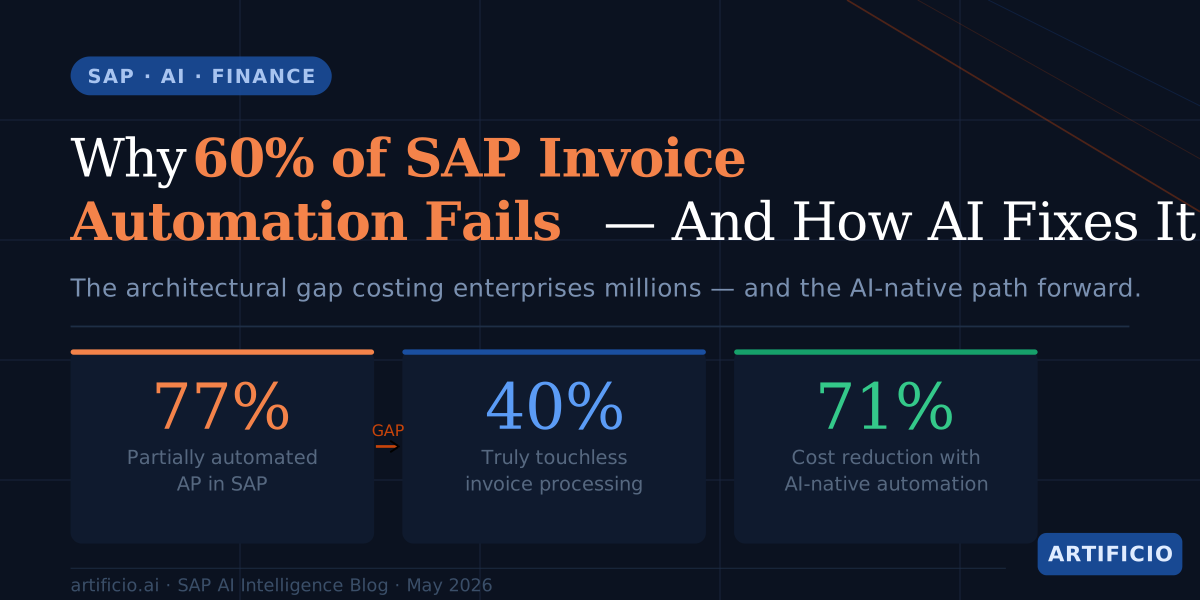
"That 37-point gap between partial automation and touchless processing is not a technology failure. It is an architectural and intelligence failure that first-generation automation tools were never designed to close."
SAP Future Trends Research, April 2026
This post breaks down exactly why SAP invoice automation keeps underperforming, what the root causes actually are, and how Artificio's AI-native integration with SAP finally delivers the straight-through processing rates your original business case promised.
The automation gap — where SAP teams actually stand
Companies with partial AP automation
77%
Companies achieving fully touchless processing
40%
AP teams satisfied with their current setup
54%
Source: SAP Future Trends Survey, 2026 · 173 SAP stakeholders
The Three Real Reasons SAP Invoice Automation Fails
Most diagnoses of AP automation failure focus on the wrong things — bad data, change management, user adoption. Those matter, but they're symptoms. The root causes run deeper.
01
OCR wasn't built for the real world
Template-based OCR achieves 70–85% accuracy on clean, printed documents. On the mixed-format, multi-language, multi-layout invoices that actually arrive in enterprise AP inboxes? That accuracy collapses — and every misread field becomes a manual exception.
02
Rules engines break on exceptions
20–30% of real invoice volumes trigger exceptions that rules-based engines can't handle. Partial deliveries, quantity tolerances, currency rounding, vendor reference mismatches — these aren't edge cases. They're the daily reality of enterprise procurement.
03
Middleware creates fragility, not intelligence
Many organizations route invoices through ECM layers before they ever reach SAP. Every middleware hop adds latency, failure points, and licensing cost. Worse, these legacy systems weren't designed for S/4HANA's Clean Core architecture — creating upgrade risk that grows every quarter.
The compounding effect is brutal. Invoices age in exception queues. Payment terms are missed. Vendors call for status updates. AP teams spend the majority of their time managing exceptions rather than resolving them — and every month-end close becomes a fire drill.
The three-way matching problem nobody talks about
Three-way matching sounds straightforward on paper: match an invoice to a purchase order and a goods receipt. In practice, it's one of the most failure-prone steps in the entire AP lifecycle.
Quantity tolerances, partial deliveries, currency rounding differences, and vendor reference format variations all cause matching failures that immediately require human investigation. Complex invoices — the ones running hundreds of pages with dozens of line items — can take 10–15 minutes to process manually. For an organization processing thousands of invoices monthly, that adds up to substantial overhead fast.
The average company today takes over 10 days to process a single invoice at a cost of more than $10 each, with nearly 20% of invoices containing errors. Top-performing AP departments, by contrast, process invoices for under $3 each. That performance gap is almost entirely explained by how well an organization handles matching exceptions.
Why S/4HANA Migration Makes This Worse (Before It Gets Better)
If your organization is in the middle of a RISE with SAP migration or planning one, invoice automation risk is likely hiding in your project plan right now.
The shift from SAP ECC to S/4HANA is not just a technical upgrade — it's an architectural rethink. SAP's Clean Core approach requires that customizations be moved out of the core and delivered through BTP extension points and published APIs. Any invoice automation tool that relies on custom ABAP modifications to integrate with SAP core creates upgrade friction that your migration team will eventually pay for.
"Clean Core compliance is no longer optional for SAP invoice automation vendors. A vendor with strong AI capabilities but poor BTP integration posture will cost you more in migration complexity than you'll recover in processing efficiency gains."
SAP Future Trends Research, April 2026
This is why so many organizations emerge from S/4HANA migrations only to discover that their existing invoice automation doesn't work properly with the new system — or requires expensive re-implementation to function correctly. It's not bad luck. It's an architectural mismatch that was always going to surface.
The good news: organizations that get this right during migration — not after it — enter S/4HANA with an AP function that actually performs as promised.
What "AI-Native" Actually Means for SAP Invoice Processing
The phrase "AI-powered" has been applied to so many AP tools — most of which are still fundamentally template-based OCR with a machine-learning label attached — that it's become nearly meaningless.
Here's a more useful distinction. Ask any AP automation vendor two questions:
- Can your system process a brand new vendor's invoice format — one it has never seen before — without any template configuration or human setup?
- When an exception occurs, does your system route it to a human queue, or does it construct a reasoned recommendation with all relevant context and learn from the resolution?
Template-based systems fail both tests. Genuine AI-native systems pass both. The difference in outcomes is not incremental — it's the difference between 40% straight-through processing and 85–90%.
The four layers of a real AI invoice agent
Modern AI agents for SAP invoice processing operate across four distinct functional layers — and each one is a departure from how legacy tools work:
- Intake and interpretation — The agent monitors all invoice arrival channels simultaneously (email, portal, EDI, scanned documents) and processes any format, any layout, any language without requiring pre-configuration per vendor.
- Validation and matching — Real-time three-way matching against SAP data with configurable tolerance rules. The system understands the difference between a mismatch requiring human approval and one that falls within pre-authorized thresholds — and it logs the reasoning, not just the outcome.
- Exception handling with governance — When an invoice can't be automatically confirmed, the agent constructs the full exception package: the invoice, relevant PO lines, specific validation failure, applicable business rules, and a recommended action. Human reviewers make decisions in one view, not five screens.
- Continuous learning — Approved exception patterns are fed back into the governance layer so the same exception type is handled automatically next time. The system gets better with every invoice processed.
How Artificio Integrates with SAP to Close the Gap
Artificio for SAP
AI-native invoice automation, built for the way SAP actually works in 2026.
Artificio integrates directly with SAP S/4HANA and SAP BTP — no custom ABAP, no middleware dependencies, no Clean Core risk. From intelligent document ingestion to autonomous three-way matching and exception resolution, Artificio runs the full invoice lifecycle inside your SAP environment.
🧠
Any-format extraction
Processes PDFs, Excel, CSV, scanned images, EDI — any format, any vendor, from day one.
⚡
SAP-native matching
Direct API integration with S/4HANA FI-AP for real-time PO and GR matching with configurable tolerances.
🔄
Intelligent exceptions
AI resolves 80%+ of exceptions autonomously. Human reviewers see full context, not just a queue item.
🛡️
Clean Core compliant
Built on SAP BTP extension patterns. Zero custom ABAP. Safe for S/4HANA migrations.
Artificio's approach is to embed intelligence at the point where SAP needs it most — not as a middleware layer sitting outside your ERP, but as an AI layer operating directly within your SAP data model. Every extraction, match, validation, and exception is logged with full auditability inside SAP. Finance teams work in familiar Fiori interfaces. Nothing feels bolted on because nothing is.
The e-invoicing mandate pressure
There's an additional forcing function that's accelerating the need for AI-native AP automation in 2026: global e-invoicing mandates. The wave of compliance requirements across the EU, Latin America, and Asia-Pacific requires SAP customers to process, validate, and report invoices in structured digital formats that legacy AP tools were not designed to handle.
Artificio handles e-invoicing compliance natively — validating invoice formats against country-specific requirements and translating complex error codes into plain language so your finance team knows exactly what action to take, without needing to decode XML or JSON error outputs manually.
What Realistic ROI Looks Like
Benchmark outcomes from AI-native SAP AP automation
71%
reduction in cost per invoice ($10.18 → $2.94)
85%+
straight-through processing rate (up from ~40%)
14→3
days average cycle time reduction
90%
reduction in processing errors
These numbers come from Ardent Partners' AP benchmarking data and real-world deployments of AI-native invoice automation across S/4HANA environments. They're not theoretical — they're what's achievable when the architecture is right.
The compounding effect matters too. Early-payment discount capture typically improves by 30–50% when cycle times fall from two weeks to three days. For a mid-sized enterprise processing 5,000 invoices per month, that discount recovery alone often pays for the entire automation platform.
But perhaps the most undervalued outcome is what happens to your AP team. When exceptions drop from 25% of invoice volume to under 5%, your finance professionals stop being data-entry clerks and start doing the strategic work they were hired for — vendor relationship management, cash flow forecasting, working capital optimization.
Is Your SAP Environment Ready for AI-Native Automation?
Not every SAP landscape is starting from the same place. Here are the three most common scenarios — and what Artificio's approach looks like for each:
SAP ECC (pre-migration)
Artificio integrates with ECC environments via published APIs, delivering immediate AP improvement while your S/4HANA migration is being planned. Critically, the same Artificio integration carries forward to S/4HANA without re-implementation — protecting your automation investment across the migration.
S/4HANA (cloud or on-premise)
The full Artificio AI capability stack deploys as a BTP side-car, connecting to S/4HANA FI-AP via SAP's standard API layer. Zero custom ABAP, full Clean Core alignment, and immediate access to SAP's Joule AI infrastructure for enhanced natural-language exception explanation and audit queries.
RISE with SAP (mid-migration)
For organizations mid-migration, Artificio can stabilize AP operations during the transition period — maintaining processing continuity while the core system migration completes — then seamlessly shift to the full S/4HANA integration upon go-live.
The Bottom Line
The gap between "we have AP automation" and "we have AP that actually works" is not going to close by adding more configuration rules to the same tools that created the problem. It closes by replacing the architectural foundation — moving from template-based OCR and rules engines to AI that reasons, matches, and learns in real time inside SAP.
In 2026, that capability exists. Organizations deploying AI-native AP automation are already operating at straight-through processing rates that were considered best-in-class benchmarks just two years ago. The competitive gap between those organizations and those still managing 25% exception rates is widening every quarter.
The only question is which side of that gap your AP function will be on at next year's budget review.
See Artificio + SAP in action
Book a 30-minute live demo and see exactly how Artificio's AI integration transforms SAP invoice processing in your environment.
Request a demo →
No commitment required · Works with ECC, S/4HANA, and RISE