

Blog
Transforming Document Workflows with Artificio's WhatsApp Integration
Solve document workflow delays. Artificio integrates WhatsApp for instant stakeholder communication and action.

Blog
Solve document workflow delays. Artificio integrates WhatsApp for instant stakeholder communication and action.
In today's digital business landscape, organizations face a growing challenge: how to efficiently extract valuable information from documents and communicate that information to stakeholders in a timely, accessible manner. Traditional document processing systems often operate in isolation from communication channels, creating friction in workflows and delays in action. The disconnect between document processing and customer communication represents a significant operational inefficiency that impacts businesses across industries.
Artificio, a leading intelligent document processing platform, has developed an innovative solution to this challenge by integrating WhatsApp Business API capabilities directly into its document workflow automation system. This integration creates a seamless bridge between document data extraction and stakeholder communication, enabling organizations to transform static document processes into dynamic, interactive workflows.
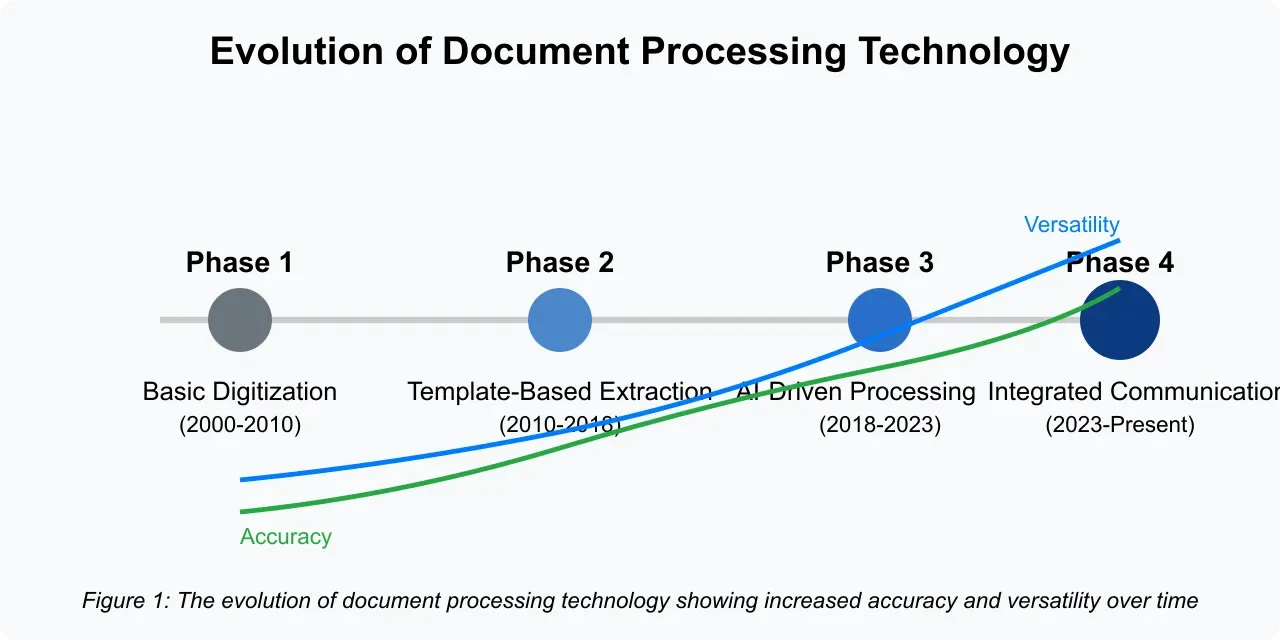
Document processing has evolved significantly over the past decade. Early systems focused primarily on digitization converting physical documents into digital formats through scanning and basic optical character recognition (OCR). While this represented an important first step, these systems lacked the intelligence to understand document context or extract specific information elements.
The next evolution came with template-based extraction, where predefined templates could identify and capture specific data fields from structured documents. However, these systems struggled with document variations and required extensive template maintenance to remain effective.
Today's intelligent document processing platforms like Artificio represent a quantum leap forward, employing advanced machine learning algorithms to understand document context, extract relevant information regardless of format variation, and even make decisions based on the extracted data. As illustrated in Figure 1, this evolution has dramatically increased both the accuracy and versatility of document processing systems.
However, even the most sophisticated document processing system faces a fundamental limitation: the extracted information must still be communicated to relevant stakeholders to drive action. Traditionally, this has occurred through separate channels such as email, SMS, or specialized applications, creating workflow disconnects and requiring manual intervention to bridge systems.
The separation between document processing and communication systems creates several significant challenges for organizations:
Organizations have attempted various solutions to these challenges, including custom integrations between document processing and communication platforms, middleware solutions that connect disparate systems, and completely custom-built applications. However, these approaches typically involve significant development resources, ongoing maintenance challenges, and limited flexibility to adapt to changing business needs.
WhatsApp represents an ideal channel for document-driven communications for several compelling reasons. With over 2 billion users globally, it offers unparalleled reach and familiarity. Unlike email or traditional SMS, WhatsApp provides rich messaging capabilities including structured templates, interactive elements, and multimedia support that enhance document-based communications.
The WhatsApp Business API, specifically designed for enterprises, enables programmatic message sending, template-based communications, and robust delivery tracking. These capabilities make it particularly well-suited for document workflow communications that require both formality and interactivity.
Most significantly, WhatsApp's near-ubiquitous presence on mobile devices ensures that document-related communications reach stakeholders wherever they are, enabling immediate action and response. This accessibility dramatically reduces the time between document processing and stakeholder action, addressing one of the fundamental challenges in document workflows.
Artificio's integration with the WhatsApp Business API represents a sophisticated technological solution that seamlessly connects intelligent document processing capabilities with WhatsApp's powerful messaging infrastructure. This integration is built on a foundation of carefully designed architectural components that work together to enable document-driven communications.
At its core, Artificio's WhatsApp integration relies on a microservices architecture that maintains clear separation of concerns while enabling smooth data flow between document processing and communication functions. As depicted in Figure 2, the architecture consists of several key components that work in concert to deliver the end-to-end solution.
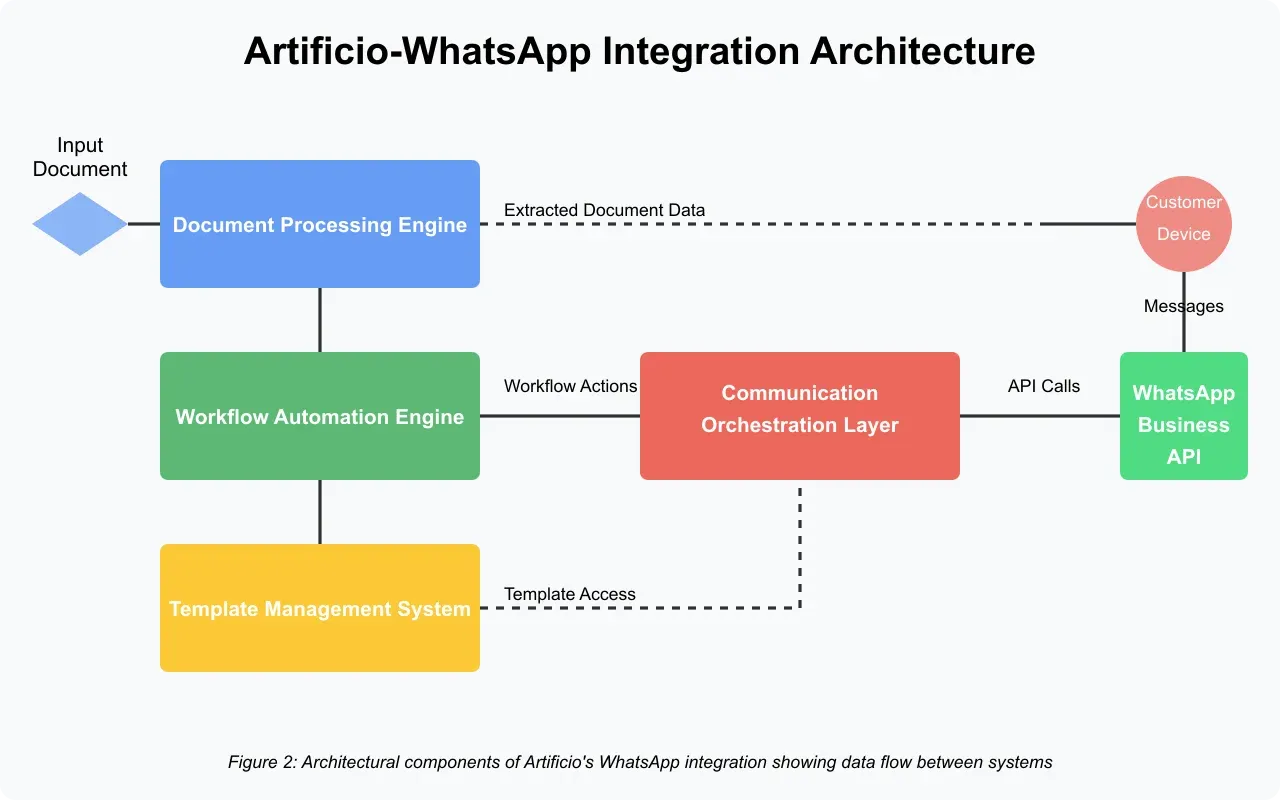
The Document Processing Engine forms the foundation of the solution, employing advanced machine learning models to extract structured data from unstructured documents. This engine processes incoming documents through multiple stages: document classification to identify document types, information extraction to identify and capture relevant data points, validation to ensure data accuracy, and enrichment to add contextual information from external systems.
The Workflow Automation Engine determines when and how extracted document information should trigger communications. This component maintains the business rules that govern document-driven workflows, including approval chains, notification requirements, and escalation paths. The engine evaluates extracted document data against these rules to determine appropriate communication actions.
The Template Management System interfaces directly with the WhatsApp Business Manager to access client-approved message templates. This component maintains a mapping between document types, extracted data fields, and appropriate WhatsApp templates, enabling the system to select the right template for each communication scenario.
The Communication Orchestration Layer serves as the bridge between Artificio and the WhatsApp Business API. This component handles the technical aspects of WhatsApp integration, including authentication, message formatting, media handling, and delivery tracking. It translates workflow actions into properly formatted WhatsApp API calls and processes webhook responses to update workflow status.
The integration creates a bidirectional flow of information between document processing and WhatsApp communications. When a document enters the system, it undergoes processing to extract relevant data. This data is then evaluated by the workflow engine to determine appropriate communication actions. For communications requiring WhatsApp delivery, the system selects an appropriate template, populates it with extracted document data, and sends it via the WhatsApp Business API.
Importantly, the integration also processes responses received through WhatsApp. When a recipient responds to a document-related message (such as approving a request or providing additional information), the system captures this response through webhooks, interprets its meaning in the context of the workflow, and updates the document status accordingly. This bidirectional capability enables truly interactive document workflows that can progress automatically based on stakeholder responses.
Given the sensitive nature of both document data and personal communications, Artificio's WhatsApp integration incorporates robust security measures at every level. All document data is encrypted both at rest and in transit, with strict access controls limiting data visibility to authorized users only. The system maintains detailed audit logs of all document processing and communication actions, enabling compliance with regulatory requirements across industries.
The integration also respects WhatsApp's strict messaging policies by exclusively using approved templates for business-initiated communications and ensuring all messages provide clear business value to recipients. By working within these guidelines, the system maintains high deliverability while protecting the user experience.
The marriage of intelligent document processing with WhatsApp communications enables transformative applications across diverse industries. Organizations in various sectors can leverage this integrated capability to streamline document workflows, enhance customer experience, and reduce operational costs.
In the financial services industry, document-heavy processes such as loan applications, insurance claims, and account openings have traditionally suffered from significant delays due to communication friction. Consider a mortgage application process where a bank must collect and verify numerous documents from prospective borrowers.
With Artificio's WhatsApp integration, a bank can automatically extract relevant information from submitted mortgage application documents and immediately communicate status updates or additional requirements to applicants via WhatsApp. When additional documentation is needed, the system can send specific requests through WhatsApp, allowing applicants to submit missing documents directly through the messaging interface. This integration reduces the application processing time from weeks to days, significantly improving both operational efficiency and customer satisfaction.
The healthcare industry faces unique document challenges, with patient information flowing through multiple systems and requiring careful handling to maintain both efficiency and compliance. Artificio's WhatsApp integration enables healthcare providers to transform patient documentation workflows while maintaining strict HIPAA compliance through secure, encrypted communications.
For example, when a patient completes intake forms, the system can automatically extract relevant information and send appointment confirmations or preparation instructions via WhatsApp. For ongoing care, the system can process lab results documents and send appropriate notifications to patients, including secure links to view detailed information through authenticated portals. The ability to communicate document-driven information through a channel that patients already use daily significantly improves engagement rates and reduces missed appointments.
Supply chain operations involve complex document flows including purchase orders, invoices, bills of lading, customs documentation, and quality certificates. Traditionally, these documents flow through disparate systems, creating visibility challenges and process delays. As illustrated in Figure 3, Artificio's WhatsApp integration creates a unified communication layer that connects all supply chain participants through document-driven messaging.
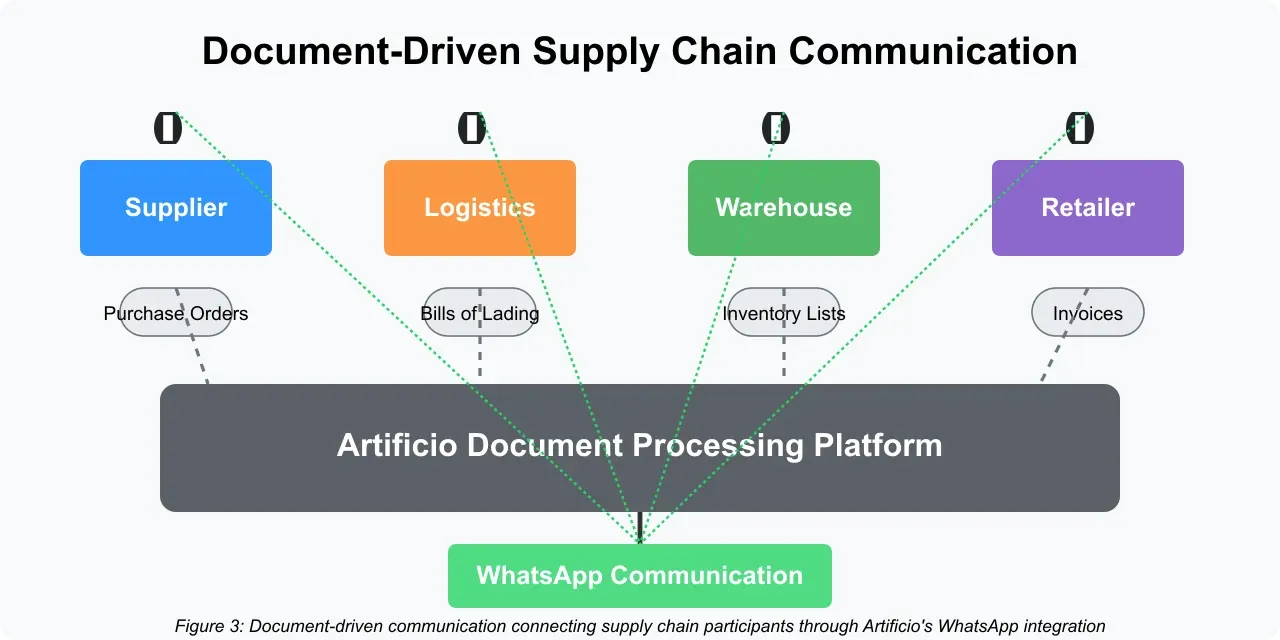
When a shipping manifest is processed, for instance, the system can automatically extract key information and notify relevant stakeholders about shipment contents, expected arrival times, and any discrepancies requiring attention. Warehouse managers can receive immediate notifications about incoming shipments, allowing for better resource planning. When quality issues are documented, the system can trigger immediate notifications to suppliers, along with detailed extraction of the specific quality parameters that failed inspection.
This integration dramatically improves supply chain visibility and responsiveness, reducing the time between document receipt and stakeholder action from days to minutes.
Organizations seeking to leverage Artificio's WhatsApp integration for document workflows should consider several strategic approaches to maximize effectiveness while ensuring smooth implementation.
Before implementing technology solutions, organizations should conduct comprehensive analysis of their current document workflows to identify communication bottlenecks and opportunities for enhancement. This analysis should map the complete document lifecycle, identifying all points where information extraction leads to stakeholder communication requirements.
The most successful implementations begin with clearly defined use cases that deliver immediate value. Rather than attempting to transform all document processes simultaneously, organizations should prioritize workflows with high communication friction, significant volume, or substantial business impact. This focused approach enables quick wins that build momentum for broader transformation.
Effective WhatsApp templates form the foundation of successful document-driven communication. Templates should be designed with several key principles in mind:
First, templates must maintain a careful balance between brevity and completeness. While WhatsApp messages should be concise, they must include sufficient context for recipients to understand the document-related action required. This often means including document identifiers, key extracted data points, and clear action instructions within the template structure.
Second, templates should employ personalization based on extracted document data to increase relevance and engagement. Dynamic fields within templates should be carefully mapped to specific document extraction points, ensuring accurate information transfer from document to message.
Third, templates should incorporate clear call-to-action elements that enable recipients to respond directly through WhatsApp when workflow progress requires their input. These interactive elements should be designed for mobile interaction, with simple response options that move the document workflow forward.
Introducing document-driven WhatsApp communications represents a significant change in how organizations interact with stakeholders. Successful implementation requires thoughtful change management to ensure adoption by both internal users and external recipients.
Organizations should develop clear communication plans explaining the new capabilities to all stakeholders, emphasizing benefits such as faster response times, increased convenience, and improved visibility. Internal users should receive comprehensive training on the new system, including hands-on experience with document processing outcomes and resulting communications.
For external recipients, organizations should consider phased rollouts that gradually introduce WhatsApp as a communication channel for document-related interactions. Clear opt-in processes and preference management ensure compliance with messaging regulations while respecting recipient channel preferences.
Evaluating the impact of Artificio's WhatsApp integration requires careful measurement across multiple dimensions. As shown in Figure 4, organizations should track KPIs that capture both operational improvements and stakeholder experience enhancements.
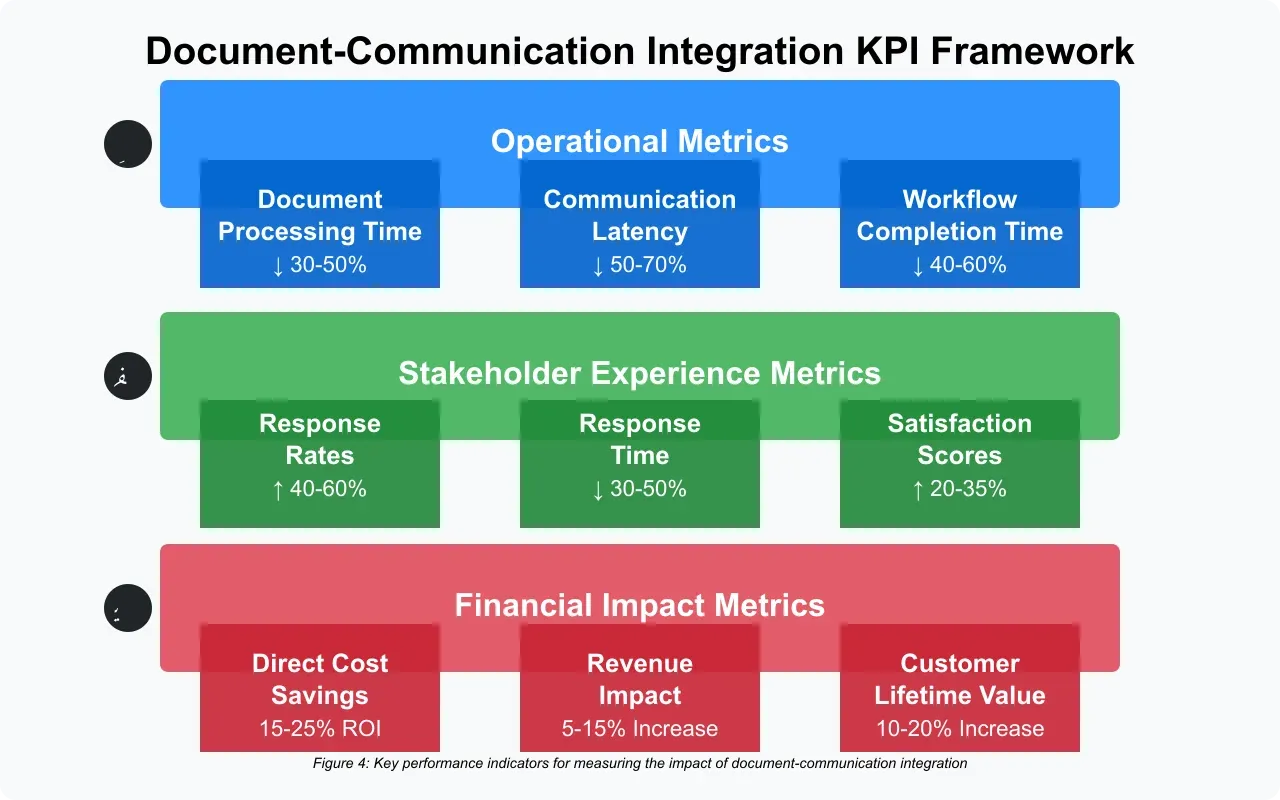
From an operational perspective, key metrics include document processing time (the duration from document receipt to information extraction), communication latency (the time between information extraction and stakeholder notification), and workflow completion time (the end-to-end duration of document-driven processes). Successful implementations typically show 30-70% reductions in these time-based metrics.
From a stakeholder experience perspective, organizations should measure response rates (the percentage of document-related communications that receive responses), response times (how quickly stakeholders react to document notifications), and satisfaction scores (explicit feedback on the communication experience). Leading implementations have demonstrated response rate improvements of 40-60% compared to traditional communication channels.
Financial metrics provide the ultimate validation of success. These include direct cost savings from reduced manual processing, revenue impacts from accelerated document workflows, and longer-term customer lifetime value improvements resulting from enhanced experience.
Artificio's WhatsApp integration represents the leading edge of a fundamental shift in how organizations handle document-driven communications. By bridging the traditional gap between document processing and stakeholder interaction, this integration enables truly seamless workflows that deliver significant operational benefits while enhancing the stakeholder experience.
Looking forward, we can expect continued evolution in this space, with several emerging trends likely to shape future capabilities. Advanced natural language processing will enable increasingly conversational interactions around documents, allowing stakeholders to ask questions and receive intelligent responses based on extracted document content. Enhanced analytics will provide deeper insights into document communication patterns, enabling predictive optimizations that further streamline workflows.
The integration of voice capabilities may eventually allow stakeholders to interact with document workflows through spoken commands within messaging platforms, creating even more accessible experiences. As document processing intelligence continues to advance, systems will increasingly make autonomous decisions based on document content, further reducing the need for manual intervention in routine processes.
Organizations that embrace the integration of intelligent document processing with messaging platforms like WhatsApp position themselves at the forefront of operational excellence. By transforming static documents into dynamic communication triggers, these organizations create responsive, efficient workflows that deliver competitive advantage in an increasingly digital business landscape.
For business leaders exploring document transformation initiatives, Artificio's WhatsApp integration offers a powerful pathway to connect document intelligence with stakeholder communication, creating seamless experiences that drive both efficiency and satisfaction. The organizations that move most quickly to implement these capabilities will enjoy significant advantages in operational efficiency, customer experience, and ultimately, market position.

Head IT Operations - Co Founder of Artificio
See it in your SAP environment
Bring us a document, a process, or a bottleneck. We'll show how Artificio captures, validates, and posts into SAP — then scale from there.
Security & compliance
ISO 27001:2013 certified, SOC 2 Type 2 compliant, GDPR and HIPAA ready. Every agent action is logged, auditable, and runs in isolated environments.