

Blog
The Evolution of LLM Agents with Named Entity Recognition
Learn how LLM-powered NER enhances accuracy and efficiency in complex document processing.

Blog
Learn how LLM-powered NER enhances accuracy and efficiency in complex document processing.
The convergence of sophisticated language modeling with specialized entity recognition frameworks has created a new generation of AI systems capable of understanding context, identifying relevant data points, and adapting to novel document formats with minimal human intervention. This technological progression has moved through distinct phases from manual data entry to rule-based systems, then to statistical machine learning approaches, and now to context-aware LLM agents with enhanced memory and reasoning capabilities.
For organizations like healthcare providers managing patient records, financial institutions processing transaction documents, or legal firms analyzing case documentation, these intelligent systems offer a compelling solution to longstanding challenges in data management. The ability to accurately extract named entities such as person names, organizations, locations, dates, monetary values, and domain-specific terminology from unstructured text represents a fundamental capability that underpins numerous downstream business processes.
Modern LLM agents designed for data extraction combine several sophisticated technologies to achieve their remarkable performance. At their core, these systems leverage transformer-based architectures that have revolutionized natural language processing since their introduction in 2017. These models process text through self-attention mechanisms that enable them to maintain awareness of long-range dependencies and contextual relationships between words a critical requirement for accurate entity recognition in complex documents.
The Named Entity Recognition component represents a specialized layer of functionality that allows these systems to identify and classify specific elements within text into predefined categories. Traditional NER systems relied heavily on hand-crafted features and linguistic rules, but modern approaches leverage deep learning techniques that can learn relevant patterns directly from data. When integrated with LLMs, these NER capabilities become dramatically more powerful due to the underlying language model's rich contextual understanding.
What truly distinguishes advanced LLM agents is their ability to maintain conversational memory and develop strategic approaches to information extraction tasks. Unlike simpler extraction tools, these agents can:
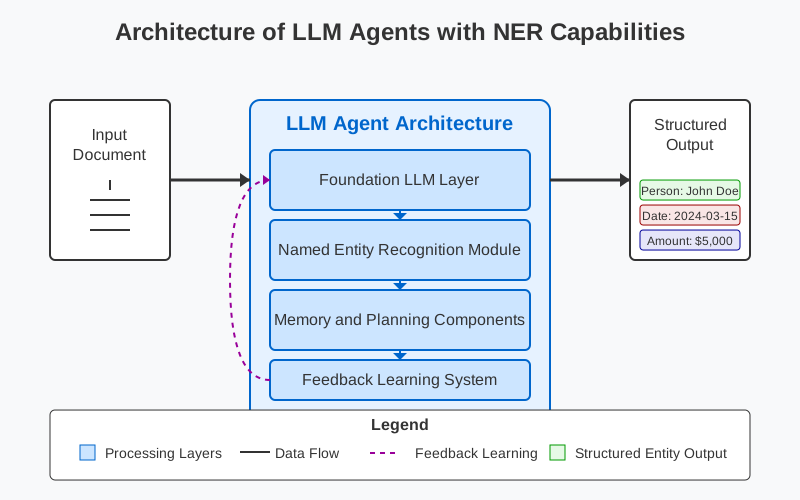
As illustrated in Figure 1: Architecture of LLM Agents with NER Capabilities, these systems typically implement a layered architecture that combines foundational language modeling with specialized entity recognition modules, memory systems, and planning components. This architecture enables a level of sophistication that far exceeds traditional extraction methods.
The impact of LLM agents with NER capabilities extends across numerous industries, with particularly transformative applications in healthcare, finance, and legal services sectors that routinely handle large volumes of complex, information-rich documents.
In healthcare settings, patient records contain vital information distributed across diverse document types admission notes, diagnostic reports, treatment plans, medication lists, and discharge summaries. Traditional data extraction approaches have struggled with the complex, specialized terminology and the interconnected nature of medical information.
LLM agents with medical domain specialization can now extract critical entities such as:
This enhanced extraction capability facilitates improved clinical decision support, more effective population health management, and streamlined insurance processing. For example, a major hospital network implementing these technologies reported a 67% reduction in manual chart review time and a 42% improvement in coding accuracy for billing purposes.
The ability of these systems to understand medical context represents a particular advantage. When encountering a phrase like "patient presents with elevated BP of 160/95," these agents can recognize that "BP" refers to blood pressure in this context and correctly categorize the values as systolic and diastolic readings a level of interpretation that would challenge rule-based systems.
The financial services industry operates on a foundation of document-intensive processes, from loan applications and investment prospectuses to regulatory filings and transaction records. Each document type contains critical entities that must be accurately extracted to support decision-making, risk assessment, and compliance requirements.
Modern LLM agents deployed in financial environments demonstrate remarkable proficiency in extracting and contextualizing entities such as:
This capability dramatically accelerates document processing workflows while reducing error rates. A leading investment bank reported that after implementing LLM-based extraction systems, their analysts could process 3.5 times more financial statements per day, with a 78% reduction in extraction errors compared to their previous semi-automated system.
The ability of these systems to understand financial context provides particular value when dealing with complex documents. For instance, when analyzing a corporate annual report, an LLM agent can distinguish between historical financial figures, projected forecasts, and hypothetical scenarios recognizing that different levels of confidence should be assigned to each type of information.
The legal profession has historically required extensive manual review of contracts, case law, legal briefs, and regulatory documents. These information-dense materials contain numerous entities that must be identified, categorized, and interrelated to support legal analysis and decision-making.
LLM agents specialized for legal applications excel at extracting entities such as:
Law firms employing these technologies report significant improvements in contract review efficiency, with some organizations achieving 85% reductions in time required for initial contract analysis. This acceleration enables legal professionals to focus more of their expertise on strategic analysis rather than information gathering.
The contextual understanding of these systems proves especially valuable in legal applications. When processing a paragraph that states "The Plaintiff must submit documentation within 30 days of the Effective Date," an advanced LLM agent can recognize that this represents a procedural obligation with a specific deadline relative to a defined event, rather than simply identifying "Plaintiff" and "30 days" as isolated entities.
Despite their impressive capabilities, LLM agents with NER functionality still face significant challenges that organizations must address to maximize their value. Understanding these limitations is essential for developing realistic implementation strategies and appropriate human-AI collaboration models.
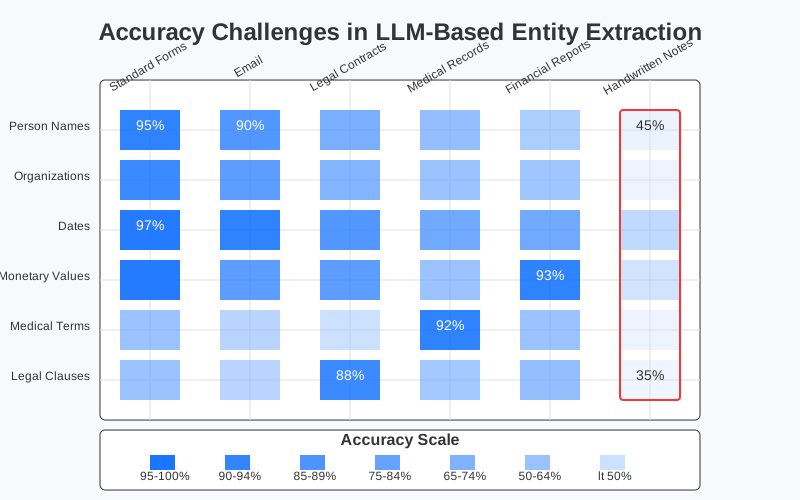
While state-of-the-art LLM agents achieve impressive accuracy rates, they remain imperfect, particularly when dealing with:
As shown in Figure 2: Accuracy Challenges in LLM-Based Entity Extraction, error rates vary significantly across different entity types and document contexts. Organizations implementing these technologies must establish appropriate quality assurance processes, including statistical sampling of results, confidence scoring mechanisms, and human review protocols for high-risk or ambiguous extractions.
The deployment of LLM agents in data extraction workflows raises important privacy and security considerations, particularly when processing sensitive information such as:
Organizations must implement robust security frameworks that protect data throughout the extraction process, including encryption, access controls, data minimization practices, and audit trails. Many enterprises are exploring on-premises deployment models or specialized cloud environments with enhanced security features to address these concerns.
Integrating LLM agents into existing business processes and technical ecosystems presents significant implementation challenges. These intelligent systems must interface effectively with:
Successful integration requires careful API design, data transformation layers, and sometimes custom middleware to facilitate seamless information flow between LLM agents and adjacent systems. Organizations that underestimate these integration requirements often experience delays in realizing the full value of their investments.
The evolution of LLM agents with NER capabilities continues at a rapid pace, with several emerging technologies poised to further enhance their effectiveness in data extraction applications.
Next-generation LLM agents increasingly incorporate sophisticated memory architectures that enable continuous learning from interactions and feedback. Unlike traditional systems that remain static after deployment, these advanced agents can:
This capability reduces the need for extensive retraining and allows systems to gradually align with the specific needs of each implementation environment. Organizations leveraging these adaptive capabilities report steadily improving accuracy rates, with some systems demonstrating 15-20% reductions in error rates over their first six months of operation without explicit retraining.
Traditional NER systems have primarily focused on text-based extraction, but documents frequently contain information distributed across multiple modalities text, tables, images, and charts. Advanced LLM agents are now developing cross-modal understanding capabilities that enable them to:
This multi-modal comprehension dramatically expands the range of information that can be reliably extracted from complex documents. For example, in financial reporting, these systems can extract not only the textual descriptions of performance metrics but also the numerical values presented in accompanying tables and the trends depicted in visualization charts.
Investment in cross-modal capabilities represents one of the most promising frontiers for enhancing the practical utility of LLM agents in real-world data extraction scenarios. Organizations processing documents with rich visual elements such as scientific publications, technical manuals, or marketing materials stand to benefit particularly from these advancements.
As LLM agents become more capable, there is growing interest in frameworks that can coordinate their activities within broader business processes. Emerging orchestration systems like HuggingGPT and AutoGen provide environments for:
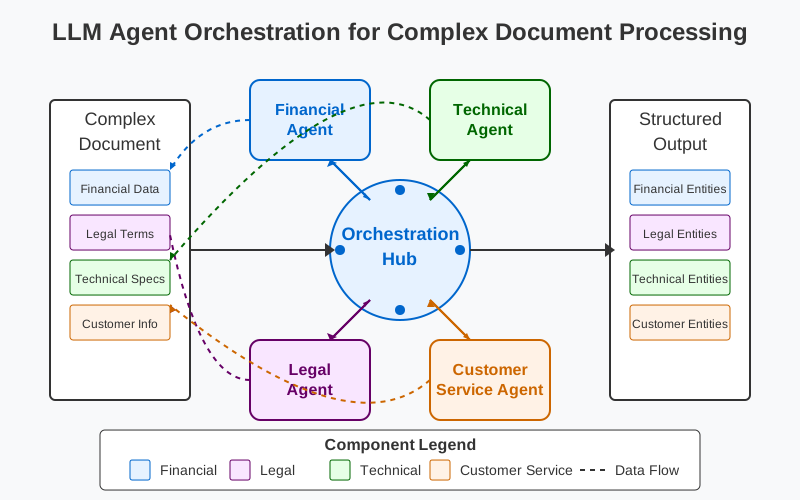
These frameworks enable the development of sophisticated extraction pipelines that leverage specialized agents for different document types or information categories. For instance, a mortgage processing workflow might employ one agent specialized in financial statement analysis, another focused on property documentation, and a third dedicated to legal agreement terms all coordinated through a central orchestration layer.
As represented in Figure 3: LLM Agent Orchestration for Complex Document Processing, these multi-agent architectures create opportunities for significant performance improvements through specialization while maintaining coherent overall process management. Organizations implementing these approaches report improvements in both throughput and accuracy compared to single-agent deployments.
Organizations seeking to leverage LLM agents with NER capabilities must develop thoughtful implementation strategies that address technical, operational, and human factors. The most successful deployments share several common characteristics:
Rather than attempting broad implementation across all document-intensive processes, leading organizations begin with carefully selected use cases that offer:
This targeted approach allows organizations to develop implementation expertise while delivering measurable business value. A global insurance company successfully followed this strategy by beginning with policy renewal document processing a high-volume, relatively standardized workflow before expanding to more complex claims documentation.
The most effective implementations of LLM agents for data extraction establish thoughtful collaboration models between AI systems and human workers. These models typically:
This collaborative approach acknowledges the complementary strengths of human and artificial intelligence combining the efficiency and consistency of AI with the judgment and contextual understanding of experienced knowledge workers. A pharmaceutical company implementing this approach for clinical trial documentation reported not only efficiency improvements but also higher employee satisfaction as staff were freed from routine extraction tasks to focus on more intellectually engaging analysis work.
Successful organizations establish robust mechanisms for ongoing evaluation and refinement of their LLM agent implementations. These processes typically include:
This commitment to continuous improvement ensures that extraction capabilities evolve alongside changing business requirements and document characteristics. A financial services firm adopting this approach reported steady improvements in extraction accuracy rates from an initial 84% to over 95% after eighteen months of operation and refinement.
As organizations deploy increasingly powerful LLM agents for data extraction, they must confront important ethical considerations regarding:
Stakeholders interacting with LLM-derived data need appropriate understanding of how information was extracted and processed. Organizations should develop:
These practices build trust in AI-assisted processes and ensure that decision-makers can appropriately contextualize the information provided through automated extraction systems.
The implementation of advanced extraction technologies inevitably impacts employees previously involved in manual data processing activities. Responsible organizations develop comprehensive workforce transformation strategies that include:
This human-centered approach recognizes that technological advancement should augment rather than simply replace human capabilities, creating opportunities for workers to develop new skills and provide higher-value contributions.
LLM agents with Named Entity Recognition capabilities represent a significant advancement in the evolution of data extraction technologies. By combining sophisticated language understanding with specialized entity recognition frameworks, these systems offer unprecedented levels of accuracy, adaptability, and intelligence in processing complex documents.
The practical applications across healthcare, finance, legal services, and numerous other document-intensive industries demonstrate the transformative potential of these technologies. Organizations implementing these advanced extraction capabilities report dramatic improvements in process efficiency, information accuracy, and knowledge worker productivity.
As research continues to address current limitations through enhanced memory systems, cross-modal understanding, and multi-agent orchestration frameworks, the capabilities of these systems will continue to expand. Forward-thinking organizations are already developing implementation strategies that leverage these emerging technologies while establishing appropriate human-AI collaboration models.
The journey toward fully intelligent document processing remains ongoing, with each advancement bringing us closer to systems that can truly understand rather than merely process the rich information contained in business documents. Organizations that thoughtfully engage with these technologies today are positioning themselves to thrive in an increasingly information-driven business environment.
By embracing the potential of LLM agents with NER capabilities while remaining mindful of implementation challenges and ethical considerations, businesses can transform their data extraction processes from operational bottlenecks into strategic assets that drive competitive advantage and organizational effectiveness.

Head IT Operations - Co Founder of Artificio
See it in your SAP environment
Bring us a document, a process, or a bottleneck. We'll show how Artificio captures, validates, and posts into SAP — then scale from there.
Security & compliance
ISO 27001:2013 certified, SOC 2 Type 2 compliant, GDPR and HIPAA ready. Every agent action is logged, auditable, and runs in isolated environments.