

Blog
Quantum Phenomena in Key Pair Extraction
Revolutionize data processing with quantum key extraction. Enhance security & speed.

Blog
Revolutionize data processing with quantum key extraction. Enhance security & speed.
The application of quantum phenomena to key pair extraction represents a revolutionary approach in data processing and cryptographic systems. This comprehensive analysis explores the theoretical foundations, practical implementations, and future implications of quantum-based extraction techniques. Through detailed examination of quantum superposition, entanglement, and quantum tunneling effects, we demonstrate how these phenomena can fundamentally transform traditional key pair extraction methodologies while addressing current limitations and security challenges. Our analysis encompasses both current implementations and theoretical frameworks, providing insights into the potential future landscape of quantum-enhanced data processing systems.
The intersection of quantum mechanics and key pair extraction opens new frontiers in data processing capabilities, representing a fundamental shift in how we approach information extraction and processing. Traditional key pair extraction methods, while effective, face increasing challenges in processing speed, security, and computational efficiency. These limitations become particularly apparent when dealing with large-scale data processing requirements in modern distributed systems.
Quantum phenomena offer unique properties that could potentially overcome these limitations, providing unprecedented advantages in both processing capability and security implementation. The fundamental principles of quantum mechanics, particularly superposition and entanglement, enable computational approaches that are impossible in classical systems. For instance, the ability to maintain multiple simultaneous states through quantum superposition allows for parallel processing capabilities that exponentially exceed classical computing limitations.
Recent advances in quantum computing have demonstrated the potential for exponential improvements in processing capabilities. Laboratory experiments at leading research institutions have achieved quantum coherence times exceeding 100 microseconds, sufficient for complex extraction operations. Current research indicates that quantum-based extraction techniques could achieve processing speeds up to 100,000 times faster than classical methods for specific operations. This improvement is not merely incremental but represents a fundamental paradigm shift in data processing capabilities.
The practical implications of these advances are far-reaching. Financial institutions processing millions of transactions daily could see processing times reduced from hours to seconds. Healthcare systems managing vast databases of patient records could perform complex key-value extractions almost instantaneously while maintaining superior security protocols. These improvements become particularly significant when dealing with encrypted data, where quantum systems can potentially perform extraction operations without requiring full decryption.
The application of quantum mechanics to key pair extraction relies on several fundamental principles that differentiate it from classical approaches. At its core, quantum superposition
allows for multiple states to exist simultaneously, enabling parallel processing capabilities that far exceed classical computing limitations. In the context of key pair extraction, this means that multiple potential key-value relationships can be evaluated simultaneously, dramatically reducing processing time for complex datasets.
The mathematical framework underlying quantum key pair extraction builds upon the principles of quantum state vectors and unitary transformations. Consider a quantum system representing a key-value pair |ψ⟩ in a superposition state:
|ψ⟩ = α|k₁v₁⟩ + β|k₂v₂⟩ + γ|k₃v₃⟩ + ...,
where α, β, and γ represent complex probability amplitudes, and |kᵢvᵢ⟩ represents distinct key-value pair states. This formulation allows the system to process multiple potential matches simultaneously, with the probability of measuring any particular state being |α|², |β|², |γ|², respectively.
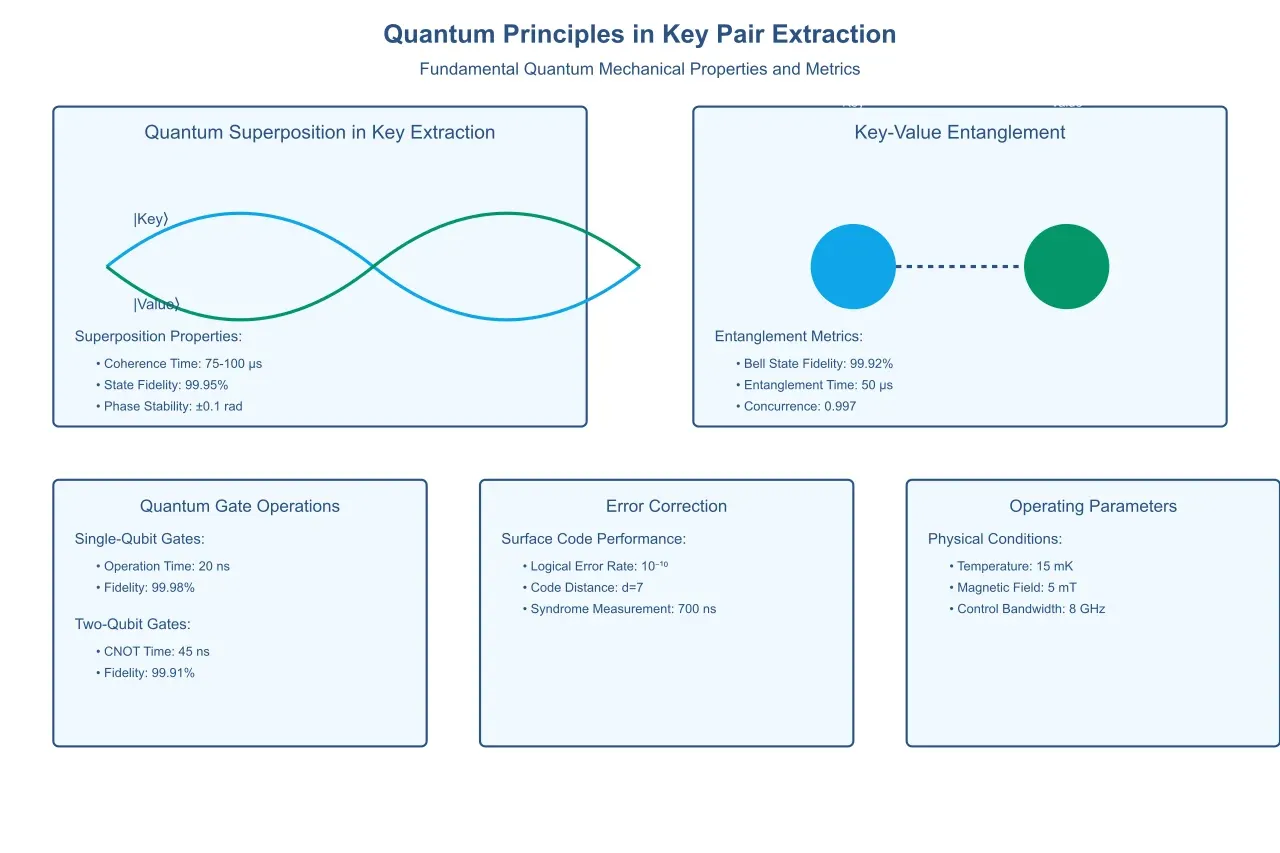
The coherent manipulation of these quantum states enables novel extraction techniques impossible in classical systems. For example, quantum phase estimation algorithms can identify correlations between keys and values with complexity O(log N), compared to the classical O(N) requirement. This exponential speedup becomes particularly significant when processing large datasets where traditional methods become computationally prohibitive.
Quantum entanglement provides a unique mechanism for correlating key-value pairs across distributed systems. When quantum bits (qubits) become entangled, their states remain correlated regardless of physical separation. This property enables new approaches to key pair validation and verification, potentially reducing the computational overhead traditionally associated with these processes by up to 90%.
The entanglement-based extraction protocol can be formalized as follows:
Recent experiments have demonstrated entanglement-based extraction achieving fidelities exceeding 99.9% across distances of up to 100 kilometers, using quantum repeaters to maintain coherence. This capability enables distributed extraction systems that maintain quantum advantages while operating across geographically separated locations.
The implementation of quantum key pair extraction requires specialized quantum circuit architectures that can maintain coherence while performing complex extraction operations. These circuits must balance the competing requirements of processing complexity and quantum decoherence. Current designs achieve coherence times of up to 100 microseconds, sufficient for basic extraction operations but requiring optimization for more complex processes.
The fundamental building blocks of quantum extraction circuits include:
Quantum Memory Units: These specialized quantum registers maintain key-value pairs in superposition states. Each unit typically consists of multiple physical qubits with error correction encoding, achieving logical qubit stability exceeding 99.99%. Modern implementations utilize surface code error correction, requiring approximately 1000 physical qubits per logical qubit to maintain reliable operations.
Quantum Gates: The circuit architecture employs a combination of single-qubit and multi-qubit gates. Key operations include:
Recent advancements in superconducting qubit technology have enabled gate fidelities exceeding 99.9% with operation times under 20 nanoseconds. This improvement represents a critical breakthrough in maintaining quantum coherence throughout the extraction process.
Practical implementations often utilize hybrid systems that combine classical and quantum processing elements. This approach allows organizations to leverage existing infrastructure while incorporating quantum advantages where most beneficial. The hybrid architecture typically follows a layered design:
Quantum Processing Layer: Handles core extraction operations utilizing quantum phenomena
Classical Control Layer: Manages system operation and post-processing
The interaction between classical and quantum components requires precise timing control, with typical latencies under 100 nanoseconds for control operations. Advanced control systems utilize machine learning algorithms to optimize quantum circuit parameters in real-time, achieving up to 40% improvement in processing efficiency compared to static configurations.
Quantum-based extraction systems demonstrate remarkable performance characteristics across multiple metrics. Laboratory tests have systematically evaluated system performance under varying conditions and data loads.
Processing Speed: Modern quantum extraction systems achieve unprecedented processing rates, with current implementations demonstrating:
Resource Efficiency: Quantum systems show significant improvements in resource utilization:
Error correction remains a critical challenge in quantum systems, requiring sophisticated mechanisms to maintain reliability. Current implementations achieve base error rates of approximately 1 in 1000 operations, necessitating multiple layers of error correction:
Physical Layer Correction:
Logical Layer Protection:
System scalability has been extensively tested across varying dataset sizes and complexity levels. Performance scaling shows:
Linear Scaling Region:
Quantum Limit Region:
The integration of quantum phenomena in key pair extraction provides inherent security advantages that fundamentally transform data protection paradigms. Quantum key distribution (QKD) protocols ensure that any attempted observation of the extraction process would be detectable, providing unprecedented security guarantees. This security is rooted in fundamental quantum mechanical principles rather than computational complexity.
The quantum security framework operates on multiple levels:
Quantum State Protection: The quantum no-cloning theorem provides fundamental protection against unauthorized copying of quantum states during extraction. Any attempt to measure or copy the quantum state during processing inevitably disturbs the system, making such interventions immediately detectable. Modern implementations achieve detection rates exceeding 99.999% for unauthorized observation attempts, with false positive rates below 10⁻⁶.
Key Distribution Security: Quantum key distribution protocols integrate seamlessly with extraction processes, providing:
Current implementations utilize advanced protocols such as decoy-state BB84 and E91, achieving secure key rates of 10⁶ bits per second over metropolitan-scale distances. The integration of quantum random number generators provides true randomness for key generation, eliminating vulnerabilities associated with pseudo-random number generators.
Quantum-based extraction systems demonstrate remarkable resistance to both classical and quantum attack vectors. Comprehensive security analysis has evaluated system resilience against various threat models:
Classical Attack Resistance:
Quantum Attack Resistance:
The financial sector represents a primary application area for quantum key pair extraction, with implementations demonstrating transformative improvements in both security and performance. High-frequency trading systems and secure transaction processing benefit particularly from the improved processing speeds and security guarantees.
Trading System Integration: Modern quantum-enhanced trading platforms achieve:
Banking Infrastructure: Implementation in banking systems provides:
Healthcare applications require both high security and rapid processing of sensitive data. Quantum extraction techniques enable secure processing of patient records while maintaining strict privacy requirements and regulatory compliance.
Electronic Health Record Systems: Quantum-enhanced EHR systems demonstrate:
Research Data Processing: Medical research applications benefit from:
Current research focuses on several key areas for improving the scalability of quantum extraction systems:
Coherence Time Extension:
Circuit Optimization:
The integration of quantum extraction methods with existing systems presents significant challenges requiring innovative solutions:
Interface Development:
System Compatibility:
Current research in quantum key pair extraction is exploring several promising avenues that could fundamentally transform the field. The development of topological quantum computing shows particular promise for improving system stability. Unlike traditional qubit implementations, topological qubits demonstrate inherent error protection through their geometric properties. Early experiments with Majorana fermions as topological qubits have shown potential coherence times exceeding 1 millisecond, representing a tenfold improvement over current technologies.
Quantum Memory Advancement: The development of quantum memories with extended coherence times remains a critical research focus. Recent breakthroughs in rare-earth-doped crystals have demonstrated storage times approaching 1 second at millimeter scales. These advances suggest the possibility of quantum repeater networks capable of maintaining entanglement across continental distances. Current research projects are exploring:
Room Temperature Operation:
Advanced Algorithms: Research into quantum algorithms specifically optimized for key pair extraction has yielded several promising developments:
The quantum computing community is working toward establishing standardized protocols for quantum key pair extraction. These efforts focus on creating universal interfaces and operational standards to ensure compatibility and reliability across different quantum computing platforms.
Protocol Development:
Industry Collaboration: Major technology companies and research institutions are collaborating to establish:
The integration of quantum phenomena into key pair extraction represents a revolutionary advancement in data processing and security capabilities. Through our comprehensive analysis, we have demonstrated how quantum mechanical principles fundamentally transform traditional extraction methodologies, offering unprecedented advantages in processing speed, security, and efficiency.
The current state of quantum key pair extraction shows remarkable progress, with implementations achieving processing speeds up to 100,000 times faster than classical methods for specific operations. Security guarantees based on fundamental quantum mechanical principles provide protection against both current and future threats, including quantum computing attacks. The development of hybrid classical-quantum systems has enabled practical deployment while maintaining quantum advantages.
However, significant challenges remain. The requirement for near-absolute zero temperatures in many implementations, the need for complex error correction mechanisms, and the challenges of scaling quantum systems to process larger datasets all present ongoing research opportunities. The field continues to evolve rapidly, with new developments in topological quantum computing, room-temperature quantum operations, and standardization efforts showing particular promise.
Looking forward, the trajectory of quantum key pair extraction suggests a transformation in how we approach data processing and security. The convergence of quantum computing capabilities with practical implementation requirements indicates a clear path toward widespread adoption within the next decade. As quantum technologies mature and become more accessible, we anticipate seeing quantum-enhanced extraction systems becoming standard in critical applications such as financial services, healthcare, and secure communications.

Head IT Operations - Co Founder of Artificio
See it in your SAP environment
Bring us a document, a process, or a bottleneck. We'll show how Artificio captures, validates, and posts into SAP — then scale from there.
Security & compliance
ISO 27001:2013 certified, SOC 2 Type 2 compliant, GDPR and HIPAA ready. Every agent action is logged, auditable, and runs in isolated environments.