

Blog
Transformative Document Processing in Modern Property Management
Discover how AI-powered document processing streamlines property management, enhancing efficiency and accuracy.

Blog
Discover how AI-powered document processing streamlines property management, enhancing efficiency and accuracy.
The real estate and property management industries have long been characterized by extensive documentation requirements, creating substantial operational challenges for professionals in these fields. The voluminous paperwork associated with property transactions, leasing agreements, and maintenance records has historically demanded significant human resources for processing, organizing, and retrieval. In recent years, however, technological advancements in document processing have begun to transform these traditionally paper-intensive workflows. The integration of artificial intelligence, machine learning, and natural language processing capabilities has catalyzed a paradigm shift in how property management firms handle documentation. This transformation is particularly evident in three critical areas: lease agreement processing, title deed and property records digitization, and vendor invoice management for property maintenance. These technological innovations have not merely automated existing processes but have fundamentally reimagined the document lifecycle in property management contexts, enabling enhanced efficiency, improved accuracy, and superior information accessibility.
The contemporary property management landscape is increasingly characterized by sophisticated document processing systems that leverage cutting-edge technologies to streamline operations. These systems typically incorporate optical character recognition (OCR) for converting physical documents into machine-readable formats, natural language processing (NLP) for understanding and categorizing document content, and machine learning algorithms for continuous improvement of document classification and information extraction capabilities. The implementation of these technologies enables property management firms to transition from manual document handling to automated workflows that significantly reduce processing time, minimize human error, and facilitate more effective data utilization. This technological evolution represents a critical development in the property management sector, as it addresses longstanding challenges related to document processing inefficiencies while simultaneously creating opportunities for enhanced service delivery and strategic decision-making based on readily accessible information.
Lease agreements constitute the foundational documents in property management, establishing the legal and financial parameters of landlord-tenant relationships. The processing of these documents has traditionally involved substantial manual effort, from the initial document creation through verification, storage, and eventual retrieval when necessary. The conventional approach to lease agreement processing typically required property managers to manually review each document, extract pertinent information, input data into management systems, and physically file documents for future reference. This methodology was not only time-consuming but also prone to human error, potentially resulting in inaccurate records, missed renewal deadlines, or compliance issues. The introduction of automated lease agreement processing systems has revolutionized this aspect of property management, providing a streamlined, accurate, and efficient alternative to traditional manual methods.
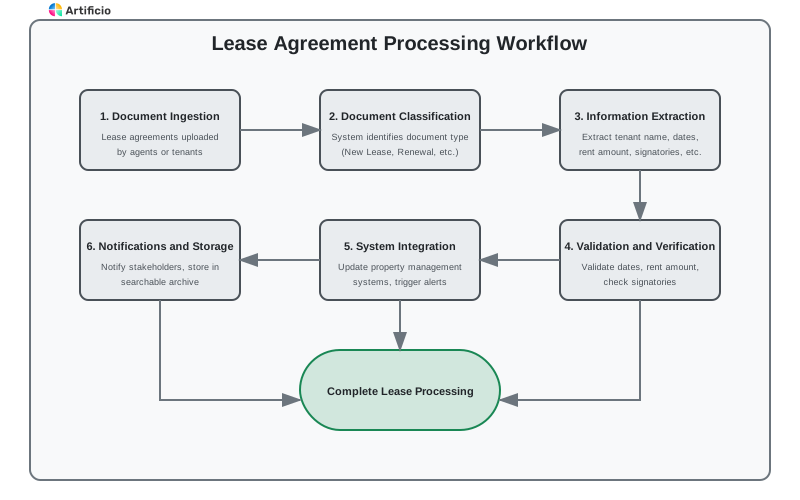
The contemporary lease agreement processing workflow begins with document ingestion, wherein lease agreements in various formats (PDF, scanned images, or digital forms) are uploaded into the processing system by property managers, leasing agents, or tenants themselves. These documents may arrive through diverse channels, including email attachments, tenant portal uploads, or in-office scans of physical documents. Once ingested, the system proceeds to document classification, utilizing artificial intelligence algorithms to identify the nature of the document distinguishing between new leases, lease renewals, amendments, or other document types. This automated classification process eliminates the need for manual sorting and categorization, significantly reducing the administrative burden on property management staff and minimizing the potential for misclassification errors.
Following classification, the system employs sophisticated named entity recognition (NER) models to extract key information from the lease agreements. These extraction algorithms identify and capture critical data points including tenant names, property addresses, lease term start and end dates, rent amounts, payment frequency specifications, security deposit information, and signatory details. The automation of this information extraction process represents a substantial improvement over manual data entry, enhancing both the speed and accuracy of data capture while freeing property management personnel for higher-value activities. The extracted information undergoes validation and verification procedures, with the system performing logical checks to ensure data consistency and accuracy. These validation processes might include verifying that lease end dates occur after start dates, confirming that rent amounts align with property management system records for the specific unit, and cross-referencing signatories against registered tenant information. This automated validation significantly reduces the likelihood of errors or inconsistencies in lease documentation.
Once validated, the extracted information is integrated with property management systems such as AppFolio, Yardi, or Buildium. This integration enables automatic updates to tenant records, property occupancy information, and financial projections based on lease terms. The system may also generate alerts for relevant stakeholders if discrepancies or anomalies are detected during the processing workflow. These integration capabilities eliminate redundant data entry requirements and ensure consistency across property management platforms, enhancing overall operational efficiency. The final stages of the lease agreement processing workflow involve notifications and document storage. The system generates automated notifications to relevant parties, including property owners, tenants, and internal teams such as finance or legal departments. These notifications might include confirmation of successful lease processing, reminders of key lease dates, or alerts regarding any issues requiring attention. Processed documents are stored in structured, searchable digital archives, typically tagged with relevant metadata such as property identification, tenant information, and lease term dates. This systematic organization of documents facilitates efficient retrieval when necessary, eliminating the inefficiencies associated with physical document storage and manual search processes.
The implementation of automated lease agreement processing delivers substantial benefits to property management firms. Operational efficiency is significantly enhanced through reduced processing times, with lease documents that previously required hours or days to process now being completed in minutes. Staff productivity improves as personnel are liberated from manual data entry and document handling tasks, enabling focus on strategic initiatives and tenant relationship management. Document accuracy and consistency are markedly improved, with automated extraction and validation processes minimizing the errors commonly associated with manual processing. Compliance with legal and regulatory requirements is strengthened through standardized processing protocols and systematic record-keeping. Additionally, tenant satisfaction is enhanced through faster processing of lease documents, reduced paperwork requirements, and improved information accessibility. These diverse benefits collectively position automated lease agreement processing as an essential technology for modern property management operations, enabling firms to manage larger portfolios with greater efficiency and reduced administrative overhead.
Title deeds and property records represent critical documentation in real estate operations, establishing legal ownership, detailing property characteristics, and recording historical transactions. The traditional management of these documents has predominantly relied on paper-based systems, with physical records stored in government offices, county courthouses, or property management archives. This conventional approach has presented numerous challenges, including limited accessibility, vulnerability to physical damage, inefficient search capabilities, and cumbersome transfer processes. The digitization of title deeds and property records addresses these longstanding challenges, leveraging technological solutions to transform physical documents into accessible, searchable, and securely stored digital assets. This transformation carries significant implications for property management efficiencies, legal compliance, and information accessibility for various stakeholders including property managers, owners, potential buyers, and legal professionals.
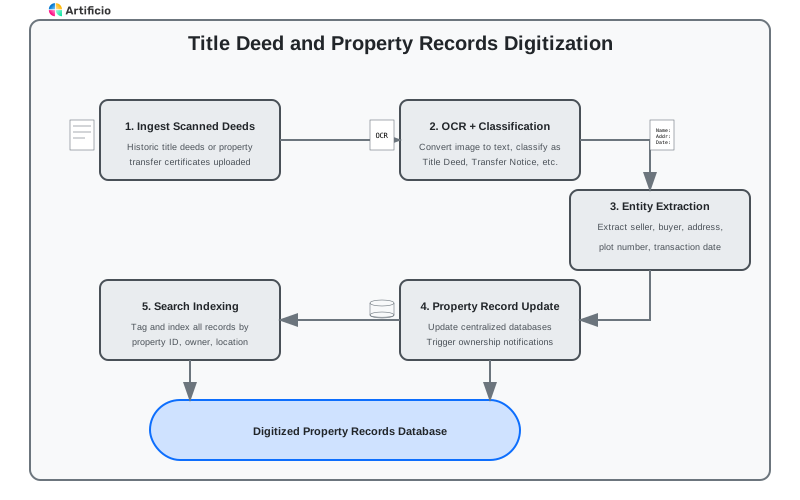
The digitization process begins with the ingestion of scanned deeds and related legal documents. These typically include historic title deeds, property transfer certificates, encumbrance documents, and various legal notices pertaining to property ownership or rights. Many of these documents may exist only in physical form, particularly for properties with lengthy ownership histories, necessitating scanning processes to create digital representations. Once scanned, these documents undergo optical character recognition (OCR) processing combined with classification procedures. The OCR technology converts the scanned images into machine-readable text, enabling subsequent analysis and information extraction. Classification algorithms then categorize each document according to its type distinguishing between title deeds, encumbrance certificates, transfer notices, and other legal instruments. This classification facilitates appropriate processing pathways and information extraction templates for different document categories.
Following OCR and classification, the system performs entity extraction to identify and capture key information elements from the documents. This extraction process identifies critical data points including seller and buyer information, property addresses, legal descriptions, plot numbers, transaction dates, and boundary specifications. The sophistication of contemporary extraction algorithms enables recognition of these elements even in documents with varying formats, older linguistic styles, or non-standard layouts a common characteristic of historical property records. The extracted information subsequently facilitates property record updates in centralized real estate databases or property registries. This integration enables automated updating of ownership records, property characteristics, and transaction histories in municipal databases, title insurance systems, or property management platforms. Furthermore, the system may generate notifications to relevant parties when ownership changes or significant property record modifications occur, ensuring that all stakeholders maintain current information regarding property status.
A critical component of the digitization workflow involves search indexing of the processed documents. Each digitized record is systematically tagged and indexed according to multiple parameters including property identification, owner names, geographic location, and transaction dates. This comprehensive indexing creates a searchable database that enables rapid retrieval of specific documents or information through various search criteria. The resulting searchable archive represents a transformative improvement over traditional physical filing systems, where document retrieval often necessitated extensive manual searching through chronologically or alphabetically organized files. The digital nature of the processed documents also facilitates more efficient property transfers, as relevant documentation can be readily assembled, verified, and transmitted electronically rather than through physical document exchanges.
The implementation of title deed and property records digitization delivers multiple benefits across the real estate ecosystem. Information accessibility is dramatically enhanced, with authorized users able to access property documentation immediately from various locations rather than requiring physical presence at document storage facilities. Search efficiency improvements enable rapid location of specific records or information, reducing research time from potentially days or hours to mere minutes or seconds. Document preservation is strengthened, as digital copies provide protection against physical deterioration, damage, or loss that might affect original documents. Transaction efficiency improves through faster document assembly and verification during property transfers, reducing closing timelines and administrative costs. Legal compliance is enhanced through more comprehensive and accessible records, facilitating due diligence processes and compliance verification. Additionally, data analysis capabilities emerge from digitized records, enabling trend identification, market analysis, and strategic decision-making based on property transaction patterns and characteristics.
The digitization of title deeds and property records represents not merely a technological upgrade but a fundamental transformation in how property ownership information is managed, accessed, and utilized. This transformation carries particular significance for property management firms with extensive portfolios, as it enables more efficient property acquisition processes, improved portfolio management, and enhanced client service through immediate access to comprehensive property histories. Furthermore, the searchable nature of digitized records provides strategic advantages in identifying property characteristics, ownership patterns, or historical issues that might influence management decisions or investment strategies. As technology continues to evolve, the integration of blockchain or distributed ledger technologies may further enhance the security, transparency, and immutability of digitized property records, potentially revolutionizing property ownership verification and transfer processes.
Property maintenance represents a significant operational and financial component of property management, encompassing diverse services from routine maintenance to emergency repairs across residential and commercial portfolios. The financial management of these maintenance activities traditionally involved extensive manual processing of vendor invoices, creating administrative bottlenecks, delayed payments, and potential for accounting errors. These conventional approaches typically required property managers or accounting personnel to manually receive, review, approve, code, and process paper invoices from various service providers. The time-intensive nature of these manual processes often resulted in delayed vendor payments, incomplete expense tracking, and limited visibility into maintenance-related financial patterns. Automated vendor invoice processing systems address these challenges through technological solutions that streamline the entire invoice lifecycle from receipt through payment authorization, delivering enhanced efficiency, accuracy, and financial control for property management operations.
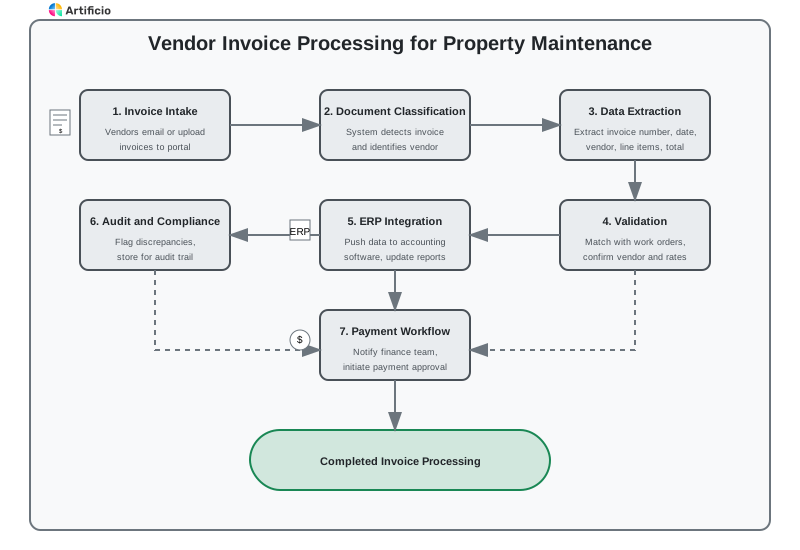
The vendor invoice processing workflow begins with invoice intake, wherein vendors submit invoices for maintenance services through digital channels such as email or dedicated vendor portals. This digital submission represents a significant improvement over traditional paper invoice delivery through mail services, eliminating transit delays and physical handling requirements. Once received, the system performs document classification, utilizing artificial intelligence to identify the document type as an invoice and determine the specific vendor based on document formatting, logos, or identification numbers. This automated classification eliminates manual sorting requirements and ensures appropriate routing for subsequent processing steps. The system then proceeds to data extraction, employing sophisticated recognition technologies to identify and capture critical invoice elements including invoice numbers, issue dates, vendor identification, itemized services, quantities, rates, total amounts, and payment terms. The automation of this extraction process eliminates manual data entry requirements, substantially reducing processing time while enhancing data accuracy.
Following extraction, the system performs validation procedures to verify invoice legitimacy and accuracy. These validation processes might include matching invoice details with corresponding work orders or maintenance requests, confirming vendor approval status within the property management system, and verifying pricing alignment with contracted rates or historical charges for similar services. This automated validation significantly reduces the risk of fraudulent or erroneous payments while ensuring proper documentation for legitimate expenses. Once validated, the system integrates invoice data with enterprise resource planning (ERP) or accounting platforms such as QuickBooks, SAP, or NetSuite. This integration enables automatic updating of general ledgers, expense reports, and budget tracking systems. The invoice data may be categorized according to property identifiers, expense categories, or other accounting parameters, facilitating comprehensive financial tracking and reporting across the property portfolio.
The audit and compliance component of the workflow involves systematic procedures to identify potential issues or discrepancies. The system may flag duplicate invoices, unusual charges, or deviations from standard pricing, directing these exceptions for human review while allowing standard invoices to proceed through automated processing channels. All processed invoices are stored with comprehensive metadata for audit trail purposes, ensuring proper documentation for financial reviews, tax preparation, or regulatory compliance requirements. The final stage of the workflow involves payment procedures, wherein the system either initiates automated payment processing for pre-approved vendors or generates notifications to finance teams to authorize payment through established approval workflows. These payment-related functions may include scheduling payments according to terms, generating payment records, and documenting payment completion for reconciliation purposes.
The implementation of automated vendor invoice processing delivers substantial benefits for property management financial operations. Processing efficiency is dramatically enhanced, with invoice handling times reduced from days or weeks to hours or minutes. This improved efficiency enables property management firms to capitalize on early payment discounts or avoid late payment penalties through more timely processing. Cost control is strengthened through more rigorous validation procedures and comprehensive expense tracking, potentially identifying unauthorized charges, pricing discrepancies, or service redundancies. Financial visibility is improved through more immediate and detailed expense reporting, enabling property managers to monitor maintenance costs in near real-time rather than awaiting monthly or quarterly accounting reconciliations. Vendor relationships are enhanced through consistent, predictable payment processes, potentially resulting in preferential service or pricing as vendors experience reduced payment delays and administrative burdens. Additionally, staff utilization improves as accounting personnel are redirected from manual data entry and document handling to higher-value activities such as financial analysis, vendor negotiation, or budget planning.
The strategic implications of automated vendor invoice processing extend beyond operational efficiencies to encompass broader financial management capabilities. The systematic categorization and analysis of maintenance expenses facilitate more accurate budget forecasting, enabling property managers to anticipate seasonal variations, identify recurring maintenance patterns, or plan for preventive measures to reduce long-term costs. The comprehensive expense tracking enables more detailed profitability analysis at the property level, potentially influencing portfolio decisions regarding property retention, improvement investments, or management fee structures. Furthermore, the detailed documentation of maintenance activities and associated costs provides valuable information for property valuation processes, potential property sales, or ownership transitions. These strategic advantages position automated vendor invoice processing not merely as an administrative improvement but as a substantive contributor to property management financial performance and strategic decision-making capabilities.
The transformative document processing workflows described in previous sections are underpinned by sophisticated technological capabilities that enable the transition from manual to automated processes. Understanding these technological foundations provides insight into both current capabilities and future potential as these technologies continue to evolve. At the core of modern document processing systems lies optical character recognition (OCR) technology, which converts document images into machine-readable text. Contemporary OCR systems demonstrate remarkable accuracy even with challenging document characteristics such as varying fonts, imperfect scans, handwritten annotations, or complex layouts. These capabilities prove particularly valuable in property management contexts, where documents may span decades and exhibit substantial variation in formatting and quality. The ability to accurately convert these diverse documents into searchable text represents a fundamental enabler for subsequent processing, analysis, and storage functions.
Natural language processing (NLP) constitutes another critical technological component, enabling systems to understand document content beyond mere text recognition. NLP algorithms analyze document text to identify document types, extract relevant information, and interpret contextual meanings within property-related documentation. These capabilities enable the system to distinguish between different document categories (such as leases versus amendments or title deeds versus encumbrances) and to identify specific information elements (such as property addresses, monetary amounts, or dates) within unstructured text. The contextual understanding facilitated by NLP enables more accurate information extraction and classification than would be possible with simple pattern matching or template-based approaches, particularly when processing documents with non-standard formatting or variable content structures.
Machine learning algorithms provide adaptive intelligence to document processing systems, enabling them to improve performance over time through exposure to additional documents. These algorithms typically incorporate supervised learning approaches, wherein the system learns from examples of correctly processed documents to enhance its classification, extraction, and validation capabilities. In property management contexts, machine learning enables systems to recognize vendor-specific invoice formats, identify particular clause structures in leases from different property types, or adapt to regional variations in title deed formatting. The continuous learning capabilities ensure that document processing systems become increasingly accurate and efficient as they process more documents, reducing the need for human intervention or correction over time. Additionally, machine learning facilitates anomaly detection, identifying unusual document characteristics or information patterns that might indicate errors, fraud, or special processing requirements.
Data integration capabilities represent essential technological components that enable processed document information to flow seamlessly into property management systems, accounting platforms, or other operational software. These integration functions typically utilize application programming interfaces (APIs), standardized data formats, and middleware solutions to ensure proper data mapping between document processing outputs and destination system requirements. In property management environments, these integration capabilities enable extracted lease information to update tenant management systems, invoice data to populate accounting platforms, or property record details to enhance portfolio management databases. The effectiveness of these integrations determines the ultimate value of the document processing system, as information must not only be accurately extracted but appropriately utilized within operational systems to deliver business benefits.
Workflow automation technologies orchestrate the movement of documents and information through various processing stages, ensuring appropriate sequencing, timing, and handling for different document types or exceptional cases. These workflow capabilities typically incorporate business rules engines that determine processing pathways based on document characteristics, content analysis, or external factors such as user roles or system configurations. In property management applications, workflow automation might route lease agreements with unusual clauses for legal review, direct invoices exceeding certain thresholds for managerial approval, or prioritize processing for time-sensitive documents. These capabilities ensure that while standard documents proceed through automated channels, exceptions receive appropriate human attention without delaying the entire processing operation.
Security and compliance technologies ensure that document processing systems maintain appropriate protections for sensitive information while adhering to regulatory requirements. These technologies typically include encryption for data in transit and at rest, access control mechanisms to restrict document visibility according to user authorization, audit logging to track document interactions, and data handling protocols that align with privacy regulations. In property management contexts, where documents contain personally identifiable information, financial details, and legally binding agreements, these security measures are particularly critical. Furthermore, compliance capabilities enable conformity with various regulatory requirements such as records retention policies, privacy protections, or financial reporting standards applicable to property management operations.
User interface technologies provide the human interaction layer for document processing systems, enabling property management personnel to monitor system performance, handle exceptions, and access processed information. Contemporary interfaces typically feature dashboard visualizations for processing metrics, exception handling workflows for documents requiring human review, and search capabilities for accessing processed documents or extracted information. These interfaces increasingly incorporate responsive design for mobile accessibility, enabling property managers to review documents or approve processing exceptions from various locations rather than requiring physical presence at specific workstations. The usability and functionality of these interfaces significantly influence system adoption and utilization among property management staff, determining whether the technological capabilities translate into practical operational benefits.
The convergence of these technological capabilities enables the comprehensive document processing workflows described in previous sections, transforming how property management firms handle lease agreements, property records, and vendor invoices. As these technologies continue to evolve, property management document processing will likely incorporate additional capabilities such as advanced predictive analytics for anticipating document processing requirements, blockchain integration for enhanced document verification and audit trails, or augmented reality interfaces for visualizing document information in physical property contexts. These ongoing technological advancements will further enhance the efficiency, accuracy, and strategic value of document processing in property management operations, reinforcing the importance of these systems as essential components of modern property management technology ecosystems.
The implementation of advanced document processing systems represents a significant organizational initiative for property management firms, requiring careful planning, resource allocation, and change management to ensure successful adoption and utilization. Understanding key implementation considerations provides property management leadership with frameworks for evaluating, planning, and executing document processing initiatives aligned with their operational requirements and strategic objectives. The initial consideration involves comprehensive needs assessment and scope definition, wherein property management firms should evaluate their current document processing workflows, identify specific pain points or inefficiencies, and determine which document types and processes offer the greatest potential benefit from automation. This assessment should incorporate quantitative metrics such as current processing volumes, handling times, and error rates alongside qualitative factors such as staff frustrations, client complaints, or competitive disadvantages stemming from document processing limitations. The resulting scope definition should clearly delineate which document types and processing functions will be included in the implementation, establishing realistic boundaries while allowing for potential future expansion.
Technology selection represents another critical consideration, requiring evaluation of available solutions against the firm's specific requirements. Property management firms should assess potential systems based on multiple criteria including accuracy rates for relevant document types, integration capabilities with existing property management and accounting systems, scalability to accommodate portfolio growth, customization options for property management-specific requirements, security features for protecting sensitive information, and total cost of ownership including implementation, licensing, and ongoing maintenance expenses. The evaluation should incorporate demonstrations with actual property management documents, reference checks with comparable firms, and detailed technical assessments of integration requirements to ensure selected technologies will function effectively within the firm's specific operational environment. Furthermore, technology selections should consider not only current requirements but future scalability and adaptability to accommodate portfolio growth or expansion into additional property types.
Integration planning constitutes an essential implementation consideration, as document processing systems must connect effectively with multiple operational platforms to deliver maximum value. Property management firms should conduct detailed mapping of data flows between document processing systems and destination platforms such as property management software (e.g., Yardi, AppFolio, Buildium), accounting systems (e.g., QuickBooks, SAP, NetSuite), customer relationship management platforms, and document storage repositories. This mapping should identify specific data elements, transformation requirements, and validation procedures to ensure information flows accurately between systems. Integration planning should also establish protocols for handling exceptions, synchronization timing, and data reconciliation procedures to maintain consistency across integrated systems. The effectiveness of these integrations often determines whether document processing systems deliver their full potential value or create new operational challenges through incomplete or inaccurate information transfers.
Process redesign represents a fundamental implementation consideration that extends beyond technology deployment to encompass operational changes that maximize automation benefits. Property management firms should critically evaluate existing document handling processes to identify opportunities for simplification, standardization, or elimination rather than merely automating current workflows. This assessment might identify opportunities to standardize lease agreement templates, implement consistent vendor invoicing requirements, or establish more structured document submission channels to enhance automation effectiveness. Process redesign should incorporate both upstream activities (how documents enter the organization) and downstream functions (how processed information is utilized) to ensure comprehensive workflow optimization. Furthermore, process redesign should establish clear protocols for handling exceptions, defining when documents require human review and establishing efficient resolution pathways that minimize processing delays while ensuring appropriate oversight for non-standard situations.
Change management represents perhaps the most critical implementation consideration, as document processing automation fundamentally alters how property management staff interact with documentation and information. Comprehensive change management approaches should include early stakeholder engagement to understand concerns and gather input, clear communication regarding implementation timelines and expected impacts, thorough training programs tailored to different user roles, and visible executive sponsorship demonstrating organizational commitment to the initiative. Change management should address potential resistance stemming from job security concerns, unfamiliarity with new technologies, or skepticism regarding system accuracy. Furthermore, change management approaches should establish realistic expectations regarding implementation timelines, initial accuracy rates, and potential adjustment periods, avoiding overpromising immediate perfection while maintaining confidence in ultimate benefits. The effectiveness of change management efforts often distinguishes successful implementations that deliver sustained benefits from those that experience limited adoption or premature abandonment.
Measurement and optimization frameworks provide essential mechanisms for evaluating implementation success and driving continuous improvement of document processing systems. Property management firms should establish baseline metrics before implementation, develop comprehensive key performance indicators (KPIs) for ongoing monitoring, and implement regular review processes to identify optimization opportunities. Relevant metrics might include processing volumes and throughput rates, automation percentages for different document types, error rates requiring human correction, processing cycle times from receipt to completion, cost per document processed, and user satisfaction scores. These metrics should be regularly reviewed to identify both system optimization opportunities and potential process adjustments to enhance overall effectiveness. Furthermore, measurement frameworks should incorporate feedback mechanisms enabling users to report specific issues or improvement suggestions, creating continuous learning loops for both technological optimization and process refinement.
Vendor management considerations remain relevant throughout the implementation lifecycle, particularly for property management firms utilizing third-party document processing solutions rather than developing in-house capabilities. Effective vendor management includes establishing clear service level agreements (SLAs) covering system availability, processing accuracy, response times for issues, and ongoing support expectations. Implementation planning should incorporate vendor roles and responsibilities, milestone definitions, acceptance criteria, and escalation protocols for addressing challenges. Furthermore, vendor management should establish governance mechanisms for ongoing relationship management, performance reviews, and future enhancement planning to ensure the document processing solution continues to evolve in alignment with the property management firm's changing requirements. The quality of this ongoing vendor relationship often determines whether the document processing solution remains a valuable operational asset or becomes an obsolete system that fails to adapt to evolving business needs.
These implementation considerations collectively determine whether document processing automation delivers its potential benefits for property management operations. Firms that approach implementation with comprehensive planning, realistic expectations, appropriate technological selections, and effective change management strategies position themselves to realize substantial operational improvements through document processing automation. Conversely, implementations that neglect these considerations may experience limited adoption, integration challenges, or failure to achieve expected efficiency gains despite significant technology investments. As property management operations become increasingly competitive and technology-dependent, the ability to successfully implement and optimize document processing automation may represent a significant differentiator between industry leaders and laggards in operational efficiency and service delivery excellence.
The evolution of document processing technologies continues at an accelerating pace, with emerging capabilities suggesting significant future advancements in how property management firms handle documentation and information. Understanding these potential developments enables forward-thinking property management leadership to anticipate future capabilities, incorporate technological roadmap considerations into current implementation planning, and position their organizations to capitalize on emerging opportunities for further operational enhancement. Artificial intelligence advancements represent perhaps the most significant vector for future development, with next-generation AI capabilities extending beyond current classification and extraction functions to incorporate more sophisticated understanding and decision-making capabilities. Future AI systems may demonstrate enhanced contextual comprehension of property documents, identifying not only standard elements but understanding complex contractual conditions, ambiguous language, or implied relationships between document sections. These advancements may enable automated identification of disadvantageous lease clauses, recognition of potential legal compliance issues, or detection of subtle inconsistencies between related documents that might indicate errors or intentional misrepresentation. Furthermore, AI advancements may enable more sophisticated predictive capabilities, anticipating document processing requirements based on portfolio activities, forecasting renewal patterns from lease agreement histories, or identifying potential maintenance issues from patterns in vendor invoices.
Blockchain and distributed ledger technologies present transformative potential for property record management, potentially revolutionizing how ownership information is verified, stored, and transferred. Future implementations may establish immutable records of property ownership, creating verifiable chains of title that reduce fraud risks while streamlining verification processes. Smart contracts built on blockchain foundations may automate aspects of lease agreements or property transactions, automatically executing payment transfers, access authorizations, or contractual notifications based on predefined conditions. Furthermore, blockchain implementations may enable more transparent and efficient property transactions, reducing settlement times and costs while enhancing security through cryptographic verification protocols. For property management firms, these capabilities may significantly reduce title search expenses, streamline property acquisition processes, enhance security of ownership records, and potentially transform how lease agreements are executed and managed across residential and commercial portfolios.
Mobile and field technologies will likely extend document processing capabilities beyond traditional office environments, enabling property management personnel to capture, process, and access documents from diverse locations. Advanced mobile capture capabilities may enable maintenance staff to document property conditions, capture repair approvals, or submit completion verification directly from service locations. Augmented reality interfaces may overlay document information onto physical property views, enabling property managers to visualize lease restrictions, maintenance histories, or property boundaries while conducting on-site inspections. Field-based document generation capabilities may enable immediate creation of inspection reports, work orders, or lease addenda during tenant interactions, eliminating delays associated with returning to office locations for documentation finalization. These mobile capabilities may significantly enhance operational efficiency while improving information accuracy through immediate documentation of property conditions or tenant interactions.
Internet of Things (IoT) integration represents an emerging frontier for property documentation, potentially generating automated documentation of property conditions, usage patterns, or maintenance requirements. Smart building systems may automatically document temperature variations, water usage anomalies, or access patterns, creating structured records for compliance verification or dispute resolution. Automated sensor readings may generate maintenance work orders based on predefined parameters, initiating documentation workflows without human intervention. Usage pattern documentation may inform lease compliance verification, providing objective records of occupancy patterns, utility consumption, or facility utilization relevant to lease terms or billing arrangements. For property management firms, these capabilities may reduce manual inspection requirements, enhance lease enforcement capabilities, and provide more comprehensive property condition documentation for potential liability issues or tenant disputes.
Enhanced data analytics capabilities will likely transform how property management firms utilize document-derived information, enabling more sophisticated portfolio analysis, predictive maintenance planning, or tenant behavior modeling. Future analytics platforms may identify subtle correlations between lease provisions and tenant retention rates, maintenance frequencies and property valuations, or payment patterns and default risks. Predictive analytics may forecast maintenance requirements based on property characteristics, usage patterns, and historical service records, enabling more proactive management approaches. Tenant behavior models may predict renewal probabilities, rent sensitivity thresholds, or amenity preferences based on lease histories, demographic information, and interaction patterns. These analytical capabilities may enhance strategic decision-making regarding portfolio composition, maintenance investments, tenant targeting, or pricing strategies, transforming document-derived information into strategic intelligence for property management leadership.
Voice and natural language interfaces may revolutionize how property management personnel interact with document processing systems, enabling more intuitive information retrieval and system interaction. Future implementations may support natural language queries such as "Show me all leases expiring next quarter for properties in the downtown district" or "Find maintenance expenses exceeding budget by more than 10% across the residential portfolio." Voice-driven document generation may enable property managers to create inspection reports, maintenance requests, or tenant communications through dictation rather than typing, potentially enhancing productivity during field activities or client interactions. These interfaces may reduce training requirements for document system utilization while increasing information accessibility for property management personnel, supporting more informed decision-making across various operational contexts.
Integration ecosystems will likely become increasingly sophisticated, with document processing systems functioning as central information hubs connecting diverse property management technologies. These integrations may extend beyond current accounting and property management systems to encompass smart building platforms, tenant experience applications, investor reporting tools, regulatory compliance systems, and market analysis platforms. The resulting information ecosystem may provide comprehensive property intelligence drawing from diverse documentation sources, enabling more holistic property management approaches. Furthermore, integration standards may evolve to support more seamless information sharing between property owners, managers, tenants, vendors, and regulatory authorities, reducing redundant documentation requirements while enhancing information consistency across the property ecosystem. These integration capabilities may position document processing systems as foundational elements of property management technology stacks rather than isolated functional applications.
The convergence of these technological developments suggests an increasingly automated, intelligent, and integrated future for property management documentation. Property management firms that anticipate these developments and incorporate appropriate technological foundations in current implementations position themselves to capitalize on emerging capabilities as they become commercially available. Furthermore, firms that develop organizational capabilities for technological adaptation and process innovation will likely demonstrate competitive advantages in operational efficiency, service delivery, and strategic decision-making as document processing technologies continue to evolve. The future of property management appears inextricably linked with these technological advancements, suggesting that technology strategy should represent a core consideration for property management leadership planning for long-term market success.
The comprehensive examination of document processing transformations in property management contexts reveals not merely technological advancements but fundamental shifts in operational capabilities, information utilization, and strategic possibilities. The evolution from manual document handling to intelligent, automated workflows represents a paradigm shift in how property management firms process lease agreements, property records, and vendor invoices—transitioning from administrative burdens to strategic assets that enhance operational efficiency, improve decision-making capabilities, and elevate service delivery standards. This transformation carries implications beyond immediate operational improvements to encompass competitive positioning, scalability potential, and strategic differentiation in increasingly technology-enabled property management markets. The implementation of advanced document processing capabilities represents not merely a technological upgrade but a strategic imperative for property management firms seeking sustainable competitive advantages in contemporary market environments.
The convergence of artificial intelligence, machine learning, natural language processing, and workflow automation technologies has enabled unprecedented capabilities in document classification, information extraction, validation, and integration. These capabilities address longstanding challenges in property documentation, including processing inefficiencies, information accessibility limitations, error susceptibility, and utilization constraints. The resulting improvements in processing speed, information accuracy, and data accessibility deliver tangible operational benefits while creating foundations for strategic advantages through enhanced decision-making capabilities. As these technologies continue to evolve, property management firms that establish appropriate technological foundations and organizational capabilities for continuous innovation will likely realize expanding benefits through increasingly sophisticated document processing functionalities aligned with their operational requirements and strategic objectives.
Property management leaders should recognize document processing transformation not as an isolated technological initiative but as a fundamental component of broader digital transformation strategies. Document processing systems establish critical information foundations that support diverse operational functions from tenant acquisition through financial management and regulatory compliance. The effectiveness of these information foundations significantly influences operational efficiency, service quality, and strategic agility across the property management value chain. Furthermore, the integration of document-derived information with other technological systems including property management platforms, accounting systems, maintenance management solutions, and client communication tools creates comprehensive operational ecosystems that enhance overall organizational effectiveness. This integrative perspective positions document processing transformation as an essential element of technology strategy rather than a discrete functional improvement.
The implementation considerations explored in this analysis provide frameworks for property management firms approaching document processing initiatives, emphasizing the importance of comprehensive planning, appropriate technology selection, process redesign, change management, and continuous optimization. These considerations highlight that successful implementation requires not merely technological deployment but organizational transformation encompassing processes, skills, and operational models. Property management firms that approach document processing initiatives with this comprehensive perspective position themselves to realize substantial benefits while avoiding implementation challenges that might otherwise limit return on technology investments. Furthermore, firms that establish foundations for continuous innovation through measurement frameworks, feedback mechanisms, and vendor partnerships create sustainable capabilities for ongoing enhancements as technologies and operational requirements evolve.
The future developments examined in this analysis suggest significant potential for further advancement in property management document processing, with emerging technologies offering increasingly sophisticated capabilities for information capture, analysis, and utilization. Property management firms should maintain awareness of these developing technologies while establishing flexible architectural foundations that accommodate future enhancements without requiring complete system replacements. Furthermore, organizational capabilities for technological evaluation, process innovation, and change implementation represent essential competencies for capitalizing on emerging opportunities as they become commercially viable. This forward-looking perspective enables property management firms to maintain technological currency while avoiding premature investments in unproven technologies that might not deliver anticipated benefits.
In conclusion, document processing transformation represents a strategic imperative for modern property management operations, offering immediate efficiency improvements while establishing foundations for future competitive advantages through enhanced information utilization capabilities. Property management firms that successfully implement and optimize document processing technologies position themselves for operational excellence, enhanced service delivery, and strategic agility in increasingly competitive market environments. The transformation journey from paper-based processes to intelligent automation may present implementation challenges and organizational adjustments, but the resulting capabilities deliver substantial returns through reduced administrative burdens, improved information accessibility, enhanced compliance capabilities, and superior decision support functions. As property management continues to evolve toward increasingly technology-enabled operational models, excellence in document processing represents not merely a back-office function but a strategic capability that significantly influences overall organizational performance and market positioning.

Head IT Operations - Co Founder of Artificio
See it in your SAP environment
Bring us a document, a process, or a bottleneck. We'll show how Artificio captures, validates, and posts into SAP — then scale from there.
Security & compliance
ISO 27001:2013 certified, SOC 2 Type 2 compliant, GDPR and HIPAA ready. Every agent action is logged, auditable, and runs in isolated environments.