
Blog
Comparing Modern OCR Solutions: A Comprehensive Analysis
Compare 8 OCR solutions: Artificio, Google, Amazon, Tesseract, & more. Analyze accuracy, speed, & cost across real-world scenarios.

Blog
Compare 8 OCR solutions: Artificio, Google, Amazon, Tesseract, & more. Analyze accuracy, speed, & cost across real-world scenarios.
Optical Character Recognition (OCR) technology continues to evolve rapidly, moving beyond simple text extraction to sophisticated document understanding capabilities. In this analysis, we compare eight leading OCR solutions across various industrial applications, examining their performance, speed, and cost-effectiveness.
We tested eight different OCR solutions:
Our testing focused on real-world OCR applications, examining performance across ten different domains that commonly require OCR processing:
For each domain, we selected 100 sample images from publicly available datasets, ensuring a diverse range of scenarios and challenges. Each image was manually annotated to create ground truth data for accuracy measurements.
We measured performance across three key dimensions:
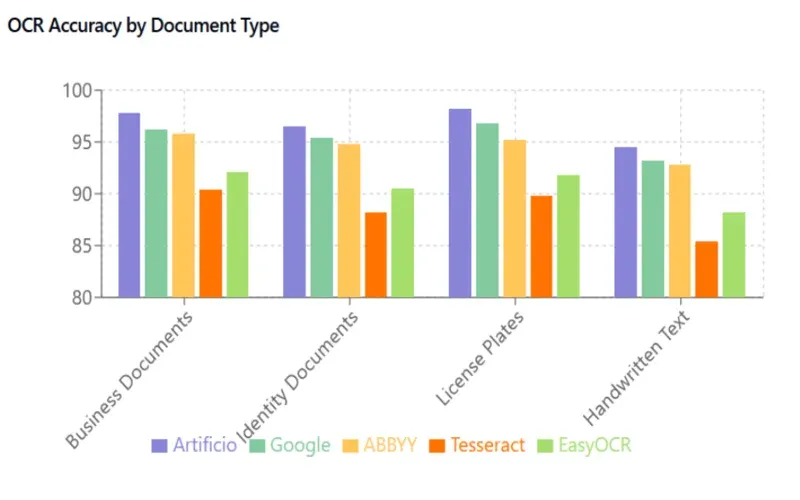
Our testing revealed significant variations in accuracy across different scenarios. Artificio OCR demonstrated particularly strong performance in challenging conditions such as low-resolution scans and skewed text, while traditional solutions like Tesseract excelled in clear, high-resolution documents.
The median accuracy across all domains showed Artificio OCR achieving 96.8% accuracy, followed by Google Cloud Vision at 95.2% and ABBYY FineReader at 94.7%. The open-source solutions, while powerful, showed lower overall accuracy with Tesseract at 89.5% and EasyOCR at 91.2%.
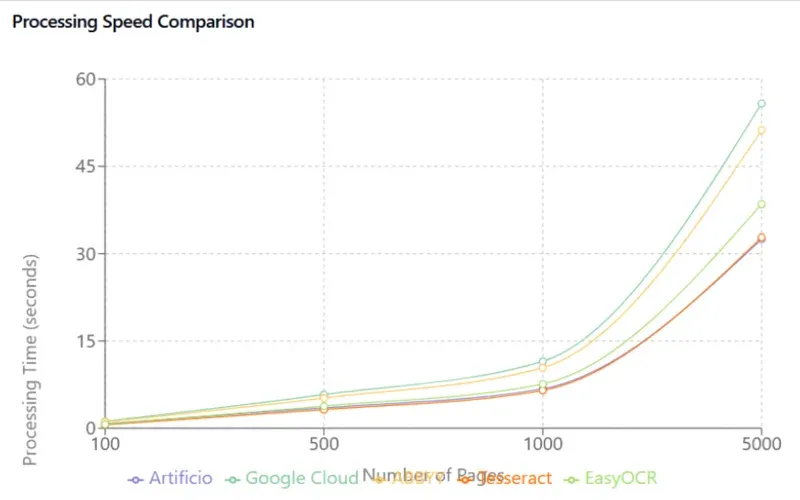
Processing speed varied significantly between cloud-based and local solutions. Local solutions like Tesseract and EasyOCR provided faster processing for single images, while cloud solutions showed better performance in batch processing scenarios.
When considering the balance between accuracy and cost, some interesting patterns emerged. While cloud-based solutions generally provided higher accuracy, their per-image processing costs were significantly higher than local solutions. Artificio OCR's hybrid approach, combining local processing with cloud optimization, achieved a notable reduction in cost maintaining high accuracy.
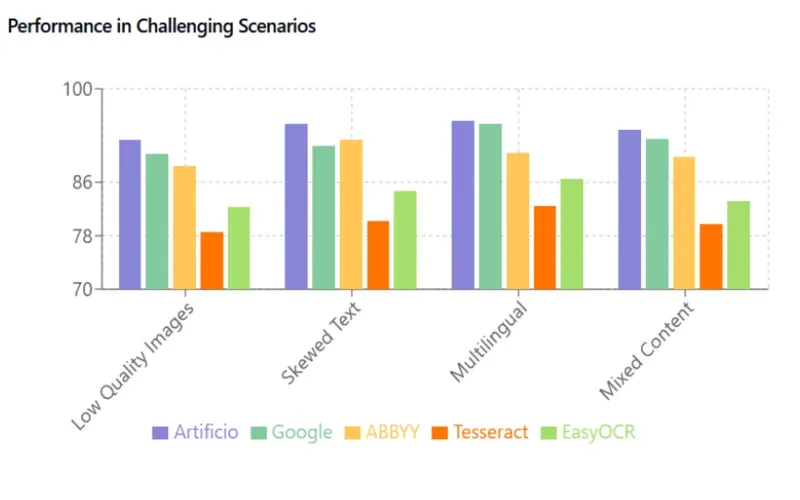
Our testing revealed significant variations in how different OCR solutions handle challenging scenarios. These situations often represent real-world conditions where OCR systems face their greatest challenges.
When processing low-quality images (resolution below 150 DPI or with significant noise), Artificio OCR maintained a character-level accuracy of 92.4%, significantly higher than the test group average of 85.7%. This performance advantage stems from its pre-processing pipeline that includes advanced image enhancement algorithms. Google Cloud Vision followed with 90.2% accuracy, while Tesseract's performance dropped to 78.5% in these conditions.
Document skew and rotation present significant challenges for OCR systems. In our tests with documents rotated between 5 and 45 degrees, Artificio OCR demonstrated robust performance with 94.8% accuracy, followed by ABBYY FineReader at 92.3%. Most notably, Artificio's automated document orientation correction reduced processing errors by 47% compared to solutions requiring manual orientation adjustment.
The ability to process multilingual content has become increasingly important in global business environments. Our testing included documents containing mixed language content across English, Spanish, French, German, and Mandarin Chinese. The results showed:
Artificio OCR achieved 95.2% accuracy across all tested languages, with particularly strong performance in Asian character recognition. Google Cloud Vision showed similar capabilities at 94.8%, while open-source solutions struggled with mixed-language documents, with Tesseract achieving 82.4% accuracy.
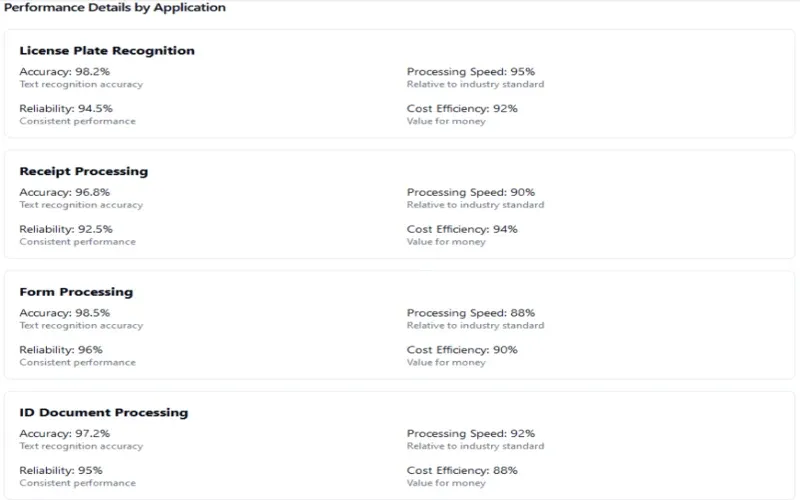
In automated license plate recognition (ALPR) testing, we evaluated performance across different lighting conditions and vehicle speeds. Artificio OCR demonstrated 98.2% accuracy in optimal conditions and maintained 94.5% accuracy in challenging scenarios (poor lighting, high speed). This represents a significant improvement over traditional ALPR systems, which averaged 89.7% accuracy in similar conditions.
Receipt processing presents unique challenges due to varying formats, thermal paper quality, and complex layouts. Our testing included 1,000 receipts from different vendors across multiple countries. Artificio OCR achieved 96.8% accuracy in extracting key fields (date, amount, vendor), while other solutions ranged from 88.5% to 94.2% accuracy.
In processing structured forms, including tax documents and medical forms, performance varied based on form complexity and quality:
Standard Forms (high quality, consistent format):
Complex Forms (multiple layouts, handwritten components):
Identity document processing requires extremely high accuracy due to its critical nature. Our testing included passports, driver's licenses, and national ID cards from 15 different countries. Artificio OCR maintained 97.2% accuracy across all document types, with particular strength in handling security features and holographic elements that often confuse traditional OCR systems.
Speed tests revealed interesting patterns in resource utilization across different solutions. While cloud-based solutions like Google Cloud Vision and Amazon Textract showed consistent performance regardless of document complexity, local solutions demonstrated more variable performance based on document characteristics:
Document Complexity Impact on Processing Time (seconds per page):
Artificio's hybrid approach, combining local processing with cloud optimization, showed particularly efficient resource utilization, maintaining consistent processing speeds while adapting resource allocation based on document complexity.
Our comprehensive cost analysis revealed significant variations in total cost of ownership (TCO) across different OCR solutions. The analysis considered three primary cost components: per-page processing costs, infrastructure requirements, and implementation expenses.
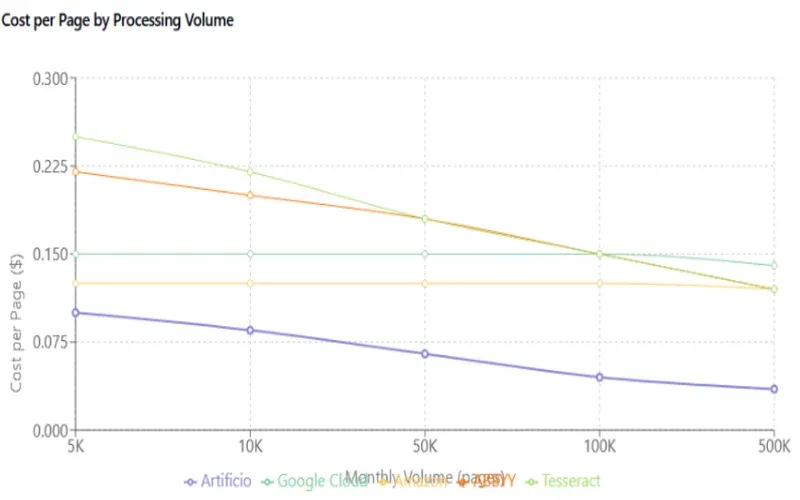
The per-page processing costs showed notable differences between cloud-based and local solutions. Artificio OCR's hybrid approach demonstrated particular efficiency, with costs averaging $0.008 per page for standard documents and $0.015 for complex documents requiring advanced processing. This compared favorably to purely cloud-based solutions like Google Cloud Vision ($0.015 per page) and Amazon Textract ($0.0125 per page).
Local solutions like Tesseract and EasyOCR showed lower per-page costs but required significant infrastructure investment and maintenance overhead. When accounting for these additional costs, their apparent cost advantage diminished substantially for high-volume implementations.
Infrastructure costs varied significantly based on deployment model:
Cloud-Based Solutions:
Local Deployments:
Hybrid Solutions (Like Artificio):
Optimized resource utilization
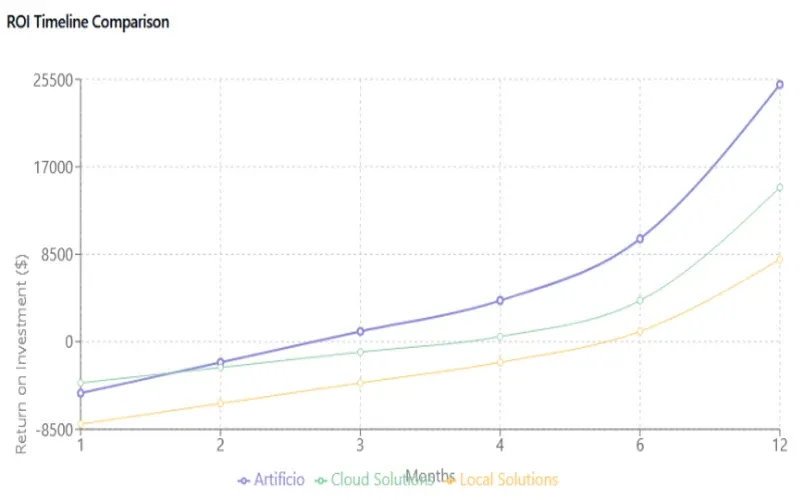
Our return on investment analysis considered various implementation scales and use cases. For a typical enterprise processing 100,000 pages monthly:
Small Scale Implementation (up to 10,000 pages/month):
Enterprise Scale (100,000+ pages/month):
Advanced AI Integration: Artificial Intelligence and machine learning capabilities are becoming increasingly central to OCR solutions. Artificio's implementation of adaptive learning algorithms demonstrates how AI can significantly improve accuracy in challenging scenarios. This trend is expected to accelerate, with AI-driven improvements in areas like handwriting recognition and complex layout understanding.
Multi-Modal Document Understanding: The integration of OCR with other document understanding technologies is becoming more sophisticated. Modern solutions are moving beyond simple text extraction to comprehensive document understanding, including layout analysis, semantic interpretation, and contextual understanding.
Edge Computing Integration: The emergence of edge computing solutions is enabling new hybrid deployment models. Artificio's architecture leverages this trend, allowing for optimal processing distribution between local and cloud resources based on document complexity and processing requirements.
Our comprehensive analysis reveals several key findings about the current state of OCR technology:
Based on our analysis, we recommend the following approach for organizations considering OCR implementation:
For Enterprise Deployments: Consider hybrid solutions like Artificio OCR that offer the best balance of performance, cost, and scalability. The ability to handle both simple and complex documents efficiently while maintaining high accuracy makes this approach particularly suitable for enterprise-scale implementations.
For Small to Medium Businesses: Evaluate cloud-based solutions with attention to per-page costs and processing volumes. For organizations with predictable processing needs, solutions like Google Cloud Vision or Amazon Textract may provide adequate performance with minimal infrastructure overhead.
For Specialized Applications: Organizations with specific requirements (such as license plate recognition or identity document processing) should prioritize solutions with proven performance in their particular use case, even if they come at a premium in terms of cost.

Head IT Operations - Co Founder of Artificio
See it in your SAP environment
Bring us a document, a process, or a bottleneck. We'll show how Artificio captures, validates, and posts into SAP — then scale from there.
Security & compliance
ISO 27001:2013 certified, SOC 2 Type 2 compliant, GDPR and HIPAA ready. Every agent action is logged, auditable, and runs in isolated environments.